Category Archives: Around Bosco

Around Bosco: Bosco Students Live Out The Oratory Model On Marian Day

by Josue Sanchez, co-Editor-in-Chief

Marian Day reflected the foundations upon which St. John Bosco High School is built on, as carried out by students and faculty.

To many, the celebrations carried out on the first day of May could simply appear to be a free day—a break from the academic environments that Bosco students face.

However, the festivities that were celebrated two Thursday’s ago were not exclusively based on the simple idea of rest. Rather, the day is rooted in Salesian ideas that also connect to the four pillars of the Oratory model that St. John Bosco High School is built upon: home, school, church and playground.

These ideas were of particular interest to Dr. Francesca Po, the Coordinator of Youth Ministry and a senior theology instructor. She was behind much of the planning of the event and wanted to ensure that the ideals of the Salesian faith remained an important part.

First and foremost, she stated that it is a day to honor Mary, the mother of Jesus, for saying “yes” to God’s plan. While this is not seen in the form of prayer—Salesians do not pray to Mary, rather asking for her intercession in our matters—it is seen through the developments of events like these.

“The Salesians, in particular, have a special devotion to Mary Help of Christians,” Dr. Po stated. “Mary Help of Christians is a specific [version of Mary] that St. John Bosco had a devotion to, so that’s why we Salesians have a devotion to her.”

This is seen through some of the preparatory events that happened before the Bosco “field day” that is most associated with the event. Earlier on April 30th, the statue of Mary in the Bosco Quad was crowned, reflecting the importance of faith in the celebrations carried out by Bosco staff.

This includes the Mass that happened approximately midway through the day: a representation of Salesian belief on the Bosco (or rather, St. Dominic Savio) campus. All of these highlighted the religious significance—or the church aspect of the Oratory—of the day.

Of course, the other aspects of the Oratory model shine through with the other events. The playground aspect was represented through the variety of games held on the fields of the Bosco campus. The teachers vs. students baseball game was another important representation of this, making Bosco seniors and faculty compete against each other in a lively game—which the teachers won, 3-0.

All of this is meant to present Bosco as an active, engaging space: a home, again representing the corresponding aspect of the Oratory model.

“Having that fellowship time with your Bosco brothers,” according to Dr. Po, allows for the formation of the positive experience that students of all types can enjoy.

“We’re all part of one family,” Dr. Po said.

Of course, Bosco students didn’t spend the entire time at Mass and in the outdoors—classes, although significantly shortened, still took place, reflecting how Bosco is still a school at its core.

This different day resulted in a variety of different experiences for many Bosco students. An anonymous junior used the time in Marian Day to meet with various friends and connect with others at Bosco.

“I like the fact that we get to roam a lot freer than I usually see,” said the junior. “People are a lot freer, and I see that most people are using that pretty responsibly.”

These positive experiences were also seen with other students. Josiah Hernandez, a current freshman, found that it was a positive opportunity to learn from and connect more with other students on campus.

“Marian Day is probably my favorite day of the school year,” Josiah said. “[I liked] hanging out as a community [and] being able to connect with more people than I usually do.”

As a whole, Bosco’s celebration of Marian Day is a representation of what makes the school an impactful place—especially when it comes to the ideals that are established here on campus. It is one of the best manifestations of the Oratory model that is preached for the benefit of everyone in the Bosco community.

Most importantly, it is a sign of our commitment towards Mary—as shown through Salesian belief. While Salesians do not directly worship Mary, Dr. Po emphasized that there is still a powerful connection to Mary. When we partake in events like Marian Day, it is a sign of the commitment and importance that we give to her, as an important part of Christian beliefs.

“It’s a big part of our faith as Catholics and as Salesians,” said Dr. Po. “We want to make sure that we honor that and we spend some extra time focused on that devotion to Mary.”

Around Bosco: Seniors Celebrate Prom 2025 In La La Land

by Cuahutemoc Solorzano

St. John Bosco seniors just had their last school dance of the year! The class of 2025’s prom was a spectacular night with an unexpected but welcomed surprise. 

Photo courtesy of @sj.jesters via Instagram

According to St. Joseph’s Senior Treasurer Julia Gisel, this prom was held at the Hyatt Regency Long Beach Hotel, which was chosen because it has areas separated from each other. 

“Our board didn’t want a venue that was too far, and one of the things we were looking for was a divided space. We wanted areas divided so that people could actually talk away from the dance floor or hang around the drinks,” said Julia. 

More so, this venue was previously used for a Mother-Daughter brunch hosted by St. Joseph’s High School. Though, prom might’ve taken place in an entirely different venue. 

“We considered doing the venue at the Queen Mary, but the ceiling inside of it was about 6 feet, and we didn’t like it since people wouldn’t be able to jump on the dance floor, especially for taller people,” said Julia.

They venue, in the end, was well-received by attendees, who experienced a night to remember.

“My prom experience was a 10 out of 10 – I had a lot of fun. The food’s really good and the venue’s beautiful, but an elegant kind of beautiful,” said St. Joseph’s senior Maerix Hernandez.

The lights within the venue were strung in waves throughout the entire ceiling and created a calm atmosphere during the prom dinner, according to Maerix, while the young men at Bosco appreciated the food.

“This prom is really good. I’m having a great time with my friends, and the food is really good,” said Bosco senior Elijah Sanchez.

The dance floor was wide enough for everyone to dance at the same time, and let students dance whilst surrounded by those they’ve known for the past four years, providing a sense of closure for some individuals, according to SJ senior Jolynn Hallum. SJ seniors Sofia Castro and Saydee Morales shared that sentiment.

“I would give my prom experience a 7 out of 10. A lot of work and thought were put into it, but I feel like the music wasn’t taking into account the students’ choices. But it added to the overall classic bittersweet prom experience for me,” said Sofia.

“Being able to enjoy my last dance with my best friends is so special, and it’s already memorable,” said SJ senior Saydee. 

Prom was, for the most part, a great experience for many SJ and SJB students. 

Something extremely special occurred at the end of the dance, according to Jolynn Hallum. 

“I really liked [at the end] when we held hands and danced around in a circle together. I liked how when the DJ played ‘Party in the USA.’ All of my friends sang the SJ version of it; it was really cute.”

SJ and Bosco students gathered around in a circle with arms interlinked as they danced to the last few songs of the night, while Elijah Farris and Jacquelyn Reyes were crowned 2025 Prom King and Queen.

Around Bosco: Bridging Campuses, Bosco And SJ Unite For A Day Of Faith And Fun

by Jesus Biag, co-Editor-in-Chief

Last Friday on the Feast Day of St. John Bosco, St. John Bosco and St. Joseph’s High Schools celebrated ‘Unity Day,’ an event designed to bring the sibling schools closer and recognize their respective histories. 

Photo by @stjohnbosco via Instagram

The Braves are celebrating their 85th anniversary this year, while the Jesters celebrated their 60th this past year. These two key milestones were part of why the schools came together to bring back this event, which last took place a decade ago.

The last time Unity Day was celebrated, Mr. Sergio Esparza, theology instructor and Campus Minister, was just starting his teaching career at St. Joseph’s High School. While he wasn’t directly involved in coordinating  2015’s Unity Day, which took place on our campus, he learned a lot and enjoyed watching the shared energy between Bosco and SJ.

“It was crazy. There was a lot going on,” said Mr. Esparza. “There were so many students interacting with one another, and it was such a fun time for students to hang out with one another.”

Ten years later, as Bosco’s Campus Minister, Mr. Esparza had to figure out how to combine faith and fun during Mass, the first activity of 2025’s Unity Day, which started after students checked in. 

Fr. Mel Trinidad, Provincial and President of St. John Bosco, presided over Mass. Classes sat together and celebrated in the Flynn Center, St. Joseph’s gymnasium. 

Before Mass started, however, the presidents from St. John Bosco and St. Joseph’s class boards brought up a flower to honor St. John Bosco on his feast day. Senior Board President, Josh Samonte, found the moment to be a particularly powerful one.

“Bringing up the flower alongside one of my SJ sisters resonated with me,” Josh said. “Being able to celebrate Mass with one another was extremely powerful, and [to me], that’s what Unity Day was all about.”

At the end of Mass, before everyone was dismissed, members of Bosco’s Youth Ministry came up to ask Father Mel for the day off. Instead of directly asking, they presented a pre-recorded video that was played to enormous laughter. Fr. Mel obliged, granting the Braves a day off on Monday, February 10th.

After being dismissed from the gym, the true festivities started. While Mr. Esparza was behind the “Church” aspect of Unity Day, Dr. Francesca Po, Bosco’s Coordinator of Youth Ministry, wanted to focus more on a different part of the Oratory Model: the “playground” aspect.

“We wanted to [have] a field day to celebrate the playground aspect of a Salesian school,” said Dr. Po. “[St. John Bosco] is one of the only schools that hasn’t been having a field day to acknowledge [the playground aspect].”

In Dr. Po’s opinion, Unity Day truly embodies the spirit of St. John Bosco. 

“[St. John Bosco] was a magician. He would do magic as he taught his students to show how playful he was,” said Dr. Po. “A huge part of Unity Day was to focus on that part of his character and personality.”

To embody the playground spirit, the Jesters and Braves gathered on SJ’s field to play games, engage in conversation and enjoy one another’s company. There were carnival games and a jumper castle, as well as an ice cream truck for students to enjoy some sweet treats.

After that, everyone returned back to the gym for a rally. St. Joseph’s is famous for their rallies, which was reinforced by Mr. Esparza, who taught at SJ before coming to Bosco.

“There’s nothing like [a St. Joseph’s rally],” Mr. Esparza said. “The girls come with so much energy, and you can feel the youthful spirit of someone like St. John Bosco when you’re there.”

Unity Day’s rally parodied Disney Channel’s Teen Beach Movie, with members of SJ and Bosco’s executive boards leading the way. They led games where different classes competed against one another and introduced the Winter Formal court, headlined by As’ad Kashim, the Winter Formal King.

After lunch concluded, signaling the end of the day, As’ad remembered what he enjoyed most about Unity Day.

“I was very happy to connect with my Bosco brothers and SJ sisters,” As’ad said. “I don’t think it’s something I’ll ever forget.”

As’ad’s statements were reiterated by Jolynn Hallum, St. Joseph’s Senior Board President who also competes as a member of their highly competitive cheer team. 

“With an emphasis on inclusivity throughout Unity Day, I feel we were able to mend [the gap between our two schools], building lasting bonds that will last a lifetime,” Jolynn said.

The leaders of Campus Ministry don’t want to let another ten years pass before they hold this event again.

“We plan on making this an annual thing, with both schools alternating who hosts,” said Dr. Po.

By continuing efforts to unite St. John Bosco and St. Joseph’s together, both schools hope to make the bonds between brothers and sisters even stronger.

Around Bosco: Toy And Blanket Drive Capture The Spirit Of Christmas

by Andy Ortiz, Managing Editor

As Braves in this season of giving, we have the opportunity to spread joy to others for the holidays through Bosco’s Finest Club’s Toy Drive and the Counseling Department’s Annual Blanket Drive.

The final week of school is upon us, and the students of St. John Bosco High School are getting ready to enjoy a long awaited Christmas break. But before students head off for the holiday, there are some opportunities to give back to people in need of some joy and warmth this season.

There are two charities being held here at Bosco: a Toy Drive sponsored by the Bosco’s Finest Club and the Annual Blanket Drive held by the Counseling Department.

First is the Toy Drive being sponsored by the Bosco’s Finest Club, led by senior Joel Ambriz and moderated by history teacher Eduardo Diaz. Bosco’s Finest, a group that was recently formed this year, is a campus service club that focuses on helping the Bosco community. One of their major goals this year is to make this Christmas a special one for kids who wouldn’t be receiving any gifts.

“Club members wish to share the good blessings we have received and allow others to feel the warmth and love that exists here at St. John Bosco,” said Mr. Diaz. “We want our immediate community to realize that Bosco remains an open school for everyone to resource.”

Any new or gently used toys can be dropped off at Mr. Diaz’s classroom in room 212. All of the donated toys will be sent to Ford Elementary and Toys for Tots at Our Lady of Talpa, both in East L.A.

The members of Bosco’s Finest hope to spread cheer and joy to kids in the surrounding L.A. community this Christmas.

Alongside the toy drive, there is also the Annual Blanket Drive that is being held by the Counseling Department.

This yearly tradition for the Counseling Department to give back has been pioneered by Bosco counselor Omar Delgado. Mr. Delgado has been doing this blanket drive since he was a wrestling coach, starting almost 30 years ago. 

“The main goal of the blanket drive is to help those less fortunate,” said Mr. Delgado.

There are drop off boxes in front of the school lobby where anyone can leave any new or gently used blankets. These blankets will be delivered to the Los Angeles Catholic Worker Hospitality Kitchen and The Society of St. Vincent de Paul Los Angeles.

Mr. Delgado and everyone in the Counseling Department believe that giving during this time of year and helping the less fortunate is important because that is the biggest part of what Christmas is all about.

“Bosco men should strive to be men of service and compassion for others. St. John Bosco [said], ‘Let us strive to fare well in this life and in the next’,” said Mr. Delgado.

Around Bosco: St. John Bosco Students Explore Global Culture At Annual Culture Fair

by Nels Nelsen

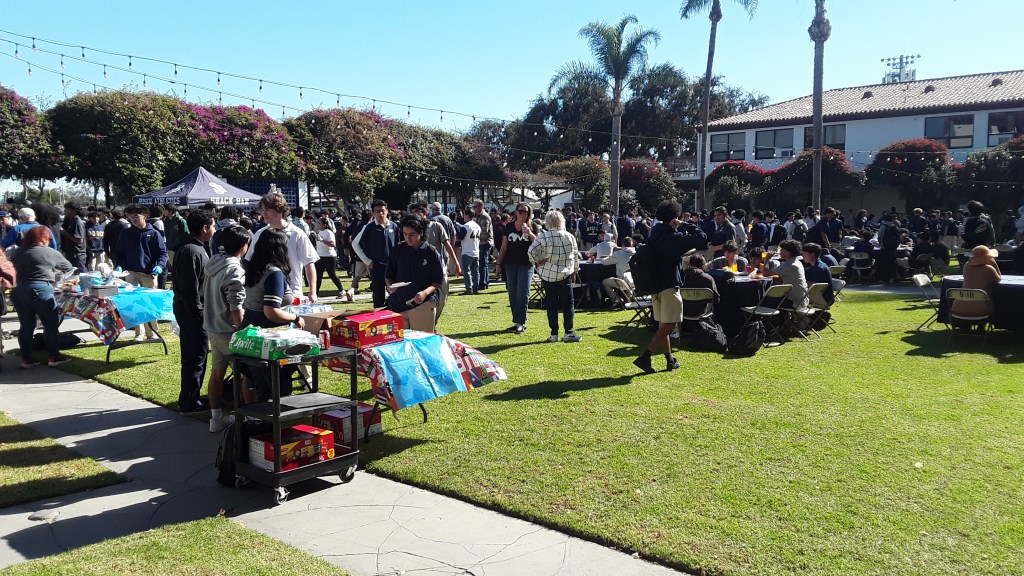
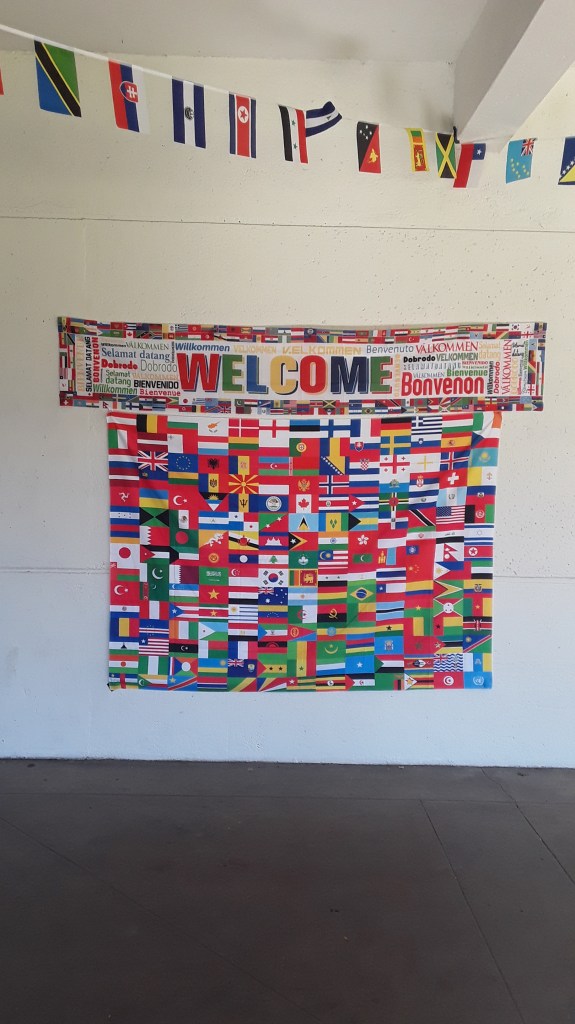
St. John Bosco’s annual Culture Fair, which took place November 8th, allowed the student body to showcase and explore the world’s various cultures.

Photo by Nels Nelsen

At the fair, multiple tables were arranged, all selling various foods and drinks. English teacher and Junior Board Moderator, Mrs. Michelle Tracy, was running her board’s table for the Culture Fair, where chips, soda and water were being sold. Additionally, she hails from Mexican descent and takes great pride in her Mexican-American culture.

“I think [I’ve] just always found the traditions interesting,” Mrs. Tracy said.

Her family eats tamales at Christmas time, often getting together to make them.

Mrs. Tracy thinks the Culture Fair is important because it helps students and faculty connect with not just their cultures, but other cultures as well. With as diverse of a population as Bosco’s, students are definitely able to do that.

“I just think that having a connection to a culture can enrich your life,” said Mrs. Tracy.

Several students also helped share their culture by selling food, drinks and desserts. For example, the Filipino Club sold traditional entrees, such as lumpia. Additionally, Bosco’s Black Student Union sold a plate with ribs, macaroni and cheese and baked beans. Another student who participated in selling food was senior Noah Wayner, who was running the shaved ice table with his mother.

He sees and does things with his mother’s side of the family more, which makes him deem family as a majorly important aspect of culture.

“The concept of [how] family and food [connect is what’s most important to me],” Noah said.

Noah always wishes to build strong family bonds in things he is involved in. He did so when he played football, and he currently builds these bonds as a part of Bosco’s theater program.

Photo by Nels Nelsen

Noah believes that consuming other culture’s foods is the physical way of bringing culture to yourself.

“I think [the Culture Fair] is important because we get to see a lot of different cultures [and] how they celebrate. [That’s [primarily shown through] what their food is like because they are very food-oriented,” said Noah. 

Junior Adrian Irannejad was working a table for the Speech and Debate Club he started. Like Mrs. Tracy, he aligns himself with Mexican culture and sees food as one of its biggest parts.

“In our culture, food brings us together after a funeral or during a party,” Adrian said.

This is extremely important because food is often a huge source of happiness that allows us to bond with others. He also thinks it is important that, as a human race, understand each other.

“I think the Culture Fair here is important because we have students from all sorts of [places], we have [Pacific] Islanders, Mexicans [and] Asians. [Students come] from all over the world,” said Adrian.

It’s important that students learn where their brothers come from because it teaches them to be more receptive toward people who aren’t the same as them. Bosco’s annual Culture Fair allows them to do that.

Around Bosco: Through Trials And Tribulations, Academic Decathlon Finds A Way To Succeed

by Jesus Biag, co-Editor-In-Chief

St. John Bosco and St. Joseph’s Academic Decathlon team has never failed to put forward some great teams to compete on the local, national and international stage. But for the past couple of years, some surmised that the program was in decline. 

Photo courtesy of Josue Sanchez, co-Editor-in-Chief

For years, Mr. Edgar Salmingo, former Vice Principal of Academic Affairs, served as the decathlon team’s coach. After he left St. John Bosco at the end of the 2021-2022 school year, however, a period of high coaching turnover ensued.

This was no more apparent than in this current year, where the Bosco Academic Decathlon team has seen multiple coaches in the same season—something unheard of for the program in years past. 

Ms. Drea Sanchez, a former teacher at St. Joseph’s, handled the program from the beginning of last school year to just about Spring break. She departed from the team over Spring break after coming to the difficult decision to switch careers and pursue nursing, a move that hurt the team.

“[Something] that was truly detrimental to the team was the lack of a stable teacher. [When Ms. Sanchez left] in the middle of our season, we kind of had to pilot ourselves for a while,” said senior decathlete Ben Garza.

While the coaching changes have been hard, Ben believes that it’s brought the team closer together.

“Because our team hasn’t had a permanent teacher in a few years, we have all sort of grown closer together. We realized that being cold to one another wouldn’t do us any good, especially if we would have to collaborate with one another to compete,” Ben said. “[We’ve] started to grow closer [because] most of us were returning competitors. This has helped our team chemistry tremendously. Almost all of us have gotten to interact and compete with one another, [which has led] to more synergy in our group.”

Ben believes this synergy will help the team tremendously, as they face off against the best the world has to offer.

Ms. Sanchez’s departure was the first coaching change of the year, and it couldn’t have come at a more crucial time. When she left, the team was preparing for the regional round of the World Scholars Cup, which was set to take place in Pasadena. Luckily for the decathlon team, they were able to find an extremely capable coach to take Ms. Sanchez’s place. 

Ms. Nicole Scalas stepped into the role of Head Decathlon Coach post-Spring break last school year. In addition to being the team’s new coach, she also served as St. Joseph’s Theology Department Chair, an English teacher and a child development teacher. 

Ms. Scalas guided Bosco and St. Joseph’s decathletes through the regional and international rounds. While dozens of Braves and Jesters compete during the regional round, numbers tend to shrink during the second round. This year, eight students from Bosco and St. Joseph’s competed in Stockholm, Sweden over Summer break. There, the team faced students from many other countries, such as Turkey, China and Kenya. 

Outside of the competition, one of Ms. Scalas’ favorite moments from the trip was touring Stockholm, which was very beautiful and green in the summertime. Although the team did their fair share of exploring, they came to Sweden to handle business—which they did.

The team, prepared by Summer months of studying and practicing, were able to secure several individual and team medals. Seniors Josue Sanchez and Ben Garza were two Braves that Ms. Scalas noted as top performers. 

One of the biggest things that the team learned from the quick staff turnover during the Spring and Summer months was a Japanese term called kintsugi. 

“[Kintsugi] means “to repair”—but by using gold to seal the cracks. [It makes] the ‘broken; item more beautiful,” said Ms. Scalas. “This team has been through quite a lot—with changes in coaching, teams being moved around, teams lacking all the members and a very difficult curriculum. But look what [they’ve] made!”

The team has truly made something beautiful with their strong teamwork, competitiveness and success. But with the final round, the Tournament of Champions, ahead, the team once again had to deal with coaching turnover.

This year, Ms. Scalas stepped into a bigger role as St. Joseph’s Director of Integration and Student Success, which meant she could no longer continue her role as Head Coach.

Despite this, she still maintains a strong support for the team. Part of that can be attributed to the fact that her daughter, Julia, a junior at St. Joseph’s, is a member of the team. 

The transition from coach to fan hasn’t really been too difficult for Ms. Scalas. The decathletes are all extremely capable, passionate and enthusiastic, so it made her job easy as a coach. She knows that the qualities they possess will make them incredibly successful during the Tournament of Champions—strongly believing that at least one of the teams will place in the top five.

While Ms. Scalas cheers on the Braves and Jesters from the sideline, new Bosco English teacher and alumnus of the Class of 2021, Mr. Joshua Hernandez, has stepped up to guide the team through the Tournament of Champions and beyond. 

The transition into his new coaching job was a little shaky at first. But he attributes Principal Mr. Ernest Antonelli, Assistant Principal of Academic Affairs Mr. Derrick Fernando, Dean of Academics Mrs. Elizabeth Hunt, Spiritual Director Father Mike Gergen and Assistant Coach Ms. Fatima Gutierrez-Castaneda for helping him make his adjustment. 

Mr. Hernandez has been especially grateful for senior Josue Sanchez, who’s helped maintain stability and become someone that Mr. Hernandez has built a connection with—keeping him in the know with recruiting new scholars and future plans. 

But Mr. Hernandez is extremely qualified for his new position because of his experience, which he believes will help him as a coach going forward. As a student, he competed in Academic Decathlon. In 2019, he received seven gold and three silver medals, notably placing 45th overall in Manila, where the global round was held in 2019, for writing and being in the top 45% of overall scholars.

At his own Tournament of Champions, Mr. Hernandez placed 155th overall in the debate and 415th in writing. This is incredibly impressive considering that roughly 2,500 scholars compete in this final round of the World Scholars Cup. 

Mr. Hernandez wants the decathletes to approach this final round as their championship game. But no matter the end result, Mr. Hernandez is proud of all the team has accomplished.

Above all, he sees this as the first step of restoring Academic Decathlon’s glory.  

“I am working really hard to make sure we can get this program back to where it was and really make it a staple on campus in the way Bosco Football is or extracurriculars like ASB and Ambassadors are,” said Mr. Hernandez.

A strong performance in the Tournament of Champions—which began yesterday and ends on November 20th at Yale University—will definitely help that goal.

Life of a Brave: Hispanic Heritage Month Continues To Shape Bosco Student Life

by Josue Sanchez, co-Editor-in-Chief

Hispanic Heritage Month, which began last month on the 15th, reflects centuries of history in South and Central America—history that continues to be told through the experiences of St. John Bosco students in the present day.

The celebration started in September to commemorate the independence of various Central and South American countries. The first day, September 15th, remembers the signing of the Act of Independence of Central America in 1821, which led to the declaration of Guatemala, Honduras, El Salvador, Nicaragua and Costa Rica as independent countries.

The following day remembers Mexican independence leader Miguel Hidalgo, who on September 16, 1810 launched the Mexican independence movement.

Other significant events take place throughout the month as well, like the Chilean celebrations of independence that start on September 18th, or perhaps most recognizable to most Americans, Columbus Day, known as “The Day of the Race” to Hispanics.

While this historical significance is important to acknowledge, it is also very important to see how these historical events and celebrations have changed local communities.

This has been seen in a variety of ways at Bosco. Mr. Eduardo “Lalo” Díaz, a current social studies instructor for Bosco juniors, joined the school last year. Coming from Mexico City, his background has made him see the impact that Hispanic culture and contributions have made to the United States.

“The U.S. educational system hasn’t recognized us or given us our place in the history or development of our country,” said Mr. Díaz. “Celebrating our contributions to the development of our country, our city and the state of California is important so that we broaden the love that our people have for México.”

Mr. Díaz believes that Hispanic-American students—not just at Bosco, but elsewhere—live within two juxtaposed environments. At home, they might exclusively speak Spanish, which is something they might not do while at school. In his view, we should all be proud of our backgrounds—and should maintain and keep these cultures in mind, lest they be forgotten.

“We want to keep these traditions,” said Mr. Díaz.

As a teacher of US history, he also believes in the importance of recognizing Hispanic contributions to this nation.

“By teaching [students] United States history, I must include events that show us [Latinos] as people who have contributed to American development,” said Mr. Díaz. “The United States didn’t get to where it has without the help of many cultures.”

He believes that it is important for everyone to know about the influence of cultures present within the United States, as it is important to keep these cultures alive.

Ms. Cindy Rayas has also seen the significance of Hispanic Heritage Month at Bosco. As the World Languages Department Chair, the Moderator of the Spanish Honors Society and a Spanish teacher for sophomores and juniors, she interacts with a large portion of Bosco’s Hispanic students.

She notes the ways that Hispanic culture has made many proud here at Bosco. Many of the other cultures, she believes, are diverse, with their own selection of cultures and traditions.

“[Hispanic] culture is rich in many aspects. It makes me feel proud, as well as the language. Each country has its own traditions,” Ms. Rayas said.

She also recognizes the connection that Hispanic cultures have with religion—something central to students’ educations at Bosco. Oftentimes, these ideas are completely intertwined with each other.

As a Spanish teacher, she has also noticed specific trends amongst each of her classes. She emphasizes the importance of learning Spanish culture alongside the Spanish language.

“The students who speak Spanish at home have a more ingrained culture,” said Ms. Rayas. “I tell them: everything is connected, especially when it comes to language.”

She notes that it is very important for Hispanic students to respect their own culture and to not feel like they cannot embrace their Hispanic heritage because they don’t speak Spanish as much as they would hope.

“If they don’t respect their culture or language, others won’t respect us,” said Ms. Rayas. “Therefore, it is important to tell them to respect their culture and to respect who they are.”

In future years, Ms. Rayas plans to help with special events relating to the celebration of Hispanic culture, including a potential celebration for Our Lady of Guadalupe, as well as various potlucks. These, she hopes, will lead to the promotion of Hispanic culture on campus, encouraging students to be proud of their cultures.

“[I want them] to feel proud of who they are and of where their parents came from. We were born here in the United States, but we must remember that our beginnings come from Latin America,” said Ms. Rayas. “We must always carry that with pride.”

Around Bosco: Student Ambassadors Shepherd Brave “Shadows” And Promote Bosco

by Nels Nelsen

St. John Bosco High School’s Student Ambassador Program draws in prospective students and represents the whole student body.

Photo by Nels Nelsen

”I would just say [they] are the leaders of our school and the community,” said Mrs. Becky Ellison, the Dean of Enrollment.

The Student Ambassadors go out to different middle schools, mainly in the Los Angeles area, to reach out to the junior high students that will become the next generation of Braves.

“The goal of the ambassadors program is [that] it’s a group of students who will represent our school outside of our campus,” said Coach Matt Dunn, who is an Admissions Community Partner that helps coordinate the Student Ambassador Program.

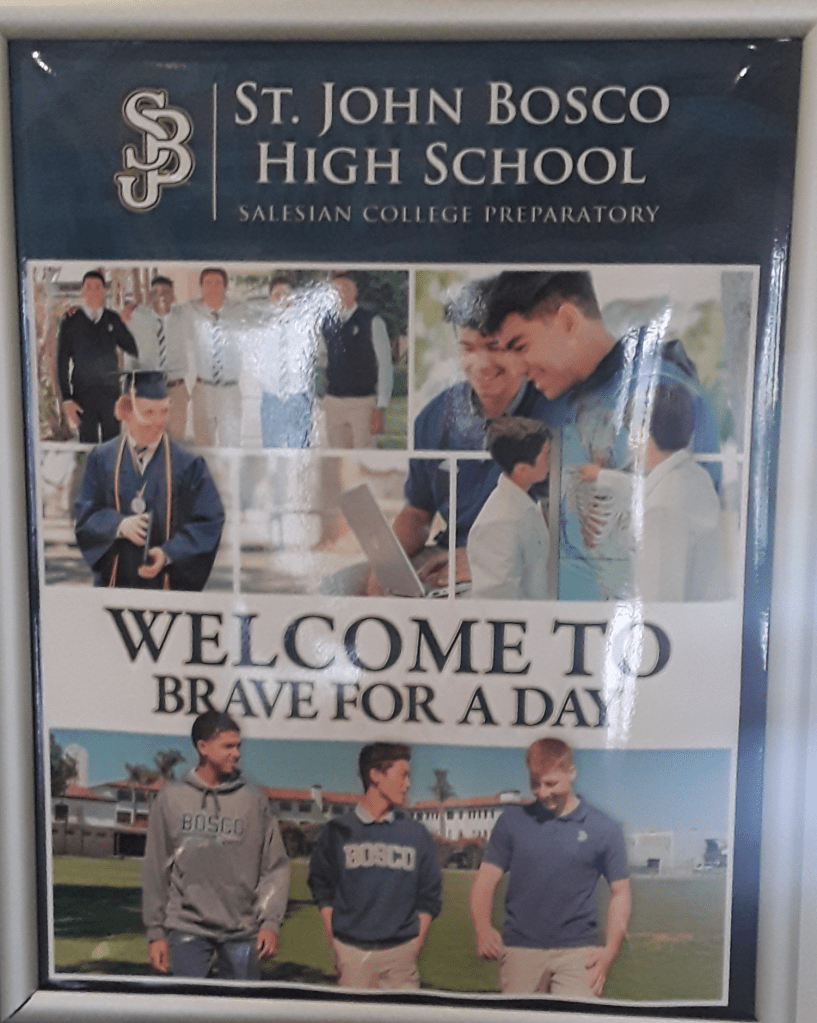
Students go out into the community and give presentations at local middle schools. They also help with Open House and are instrumental in the Brave for a Day “shadow” visits.

“Shadow” days are when seventh and eighth grade students spend a day on the campus shadowing a current Bosco Brave. They are even matched with a student with the same interests as them, for example a shadow who would want to do theater would be matched with a student who does theater.

The “shadows” spend the day with their assigned student and sit in class with them, go on a tour of the school and are fed lunch. The shadow students arrive at the beginning of the school day and leave between 1:00-1:30 pm.

The impact shadow days serve at Bosco is that they are the best way to recruit new students. This is because it shows prospective students the active and engaging campus experience firsthand, as they get to see what an all-boys school is really like. The Student Ambassadors have a great impact because the junior high students have someone they can relate to.

Mrs. Patty Lozcano is the Admissions Coordinator here at Bosco, and she thinks the Student Ambassadors are an important factor when it comes to the admissions process.

”We use [them] when we do high school fairs and presentations at night to a bunch of different middle schools,” said Mrs. Lozcano. “And we also take [them] to actual middle schools when we do a class presentation during the day.”

Because the Student Ambassadors go out to speak to large groups of people, it actually improves professional skills like public speaking.

”It’s a great opportunity for students to learn to communicate with adults and parents at different situations,” Mrs. Lozcano said.

The Student Ambassadors speak about their personal experiences and time at Bosco to encourage middle schoolers to become St. John Bosco Braves.

Some common questions the Student Ambassadors receive from shadows are things like: How is it being at an all-boys school? Are there any interactions with an all-girls school? What are the teachers like? What clubs and activities are there?

Many students deciding whether or not they want to go Bosco also like asking about the different Pathway Programs.

“For me, I’ve gotten a lot of kids who are interested in the Computer Science Pathway,” said senior Student Ambassador Connor Gallagher.

Being part of the Student Ambassador Program is more optimal for students who have been at Bosco for some time because they have more experiences they can share.

The Student Ambassadors also help with “Youth Night” at Panish Family Stadium, which is where fifty seventh and eight grade students get on the football field and meet the coaches, get a meal and enjoy what it is like to be a Bosco Brave at a football game.

Around Bosco: Selfless Braves Help Community By Donating Blood

by Jesus Biag, co-Editor-in-Chief

Last Thursday, September 19th, St. John Bosco High School partnered with Cedars-Sinai Hospital to organize the first of at least two blood drives this school year. 

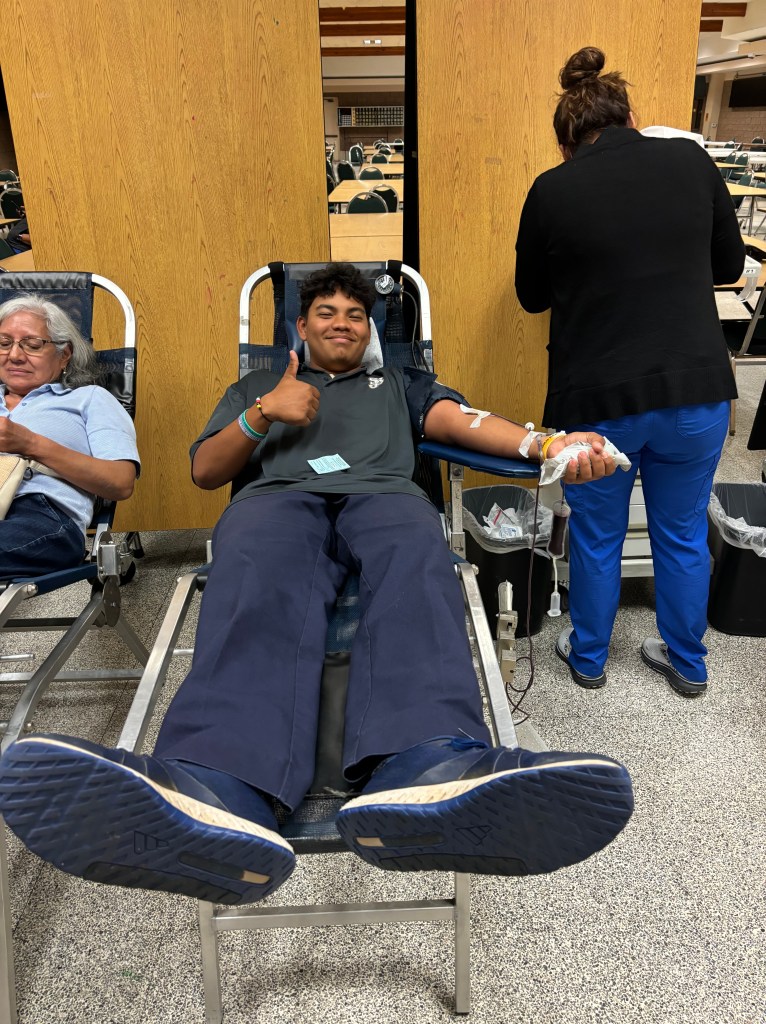
Senior Jaden Wright gives blood. (Photo by Jesus Biag)

Due to turnover in Bosco’s Campus Ministry, Ms. Jen Schnorr, Vice Principal of Student Affairs, stepped up this year to help coordinate the blood drive with the hospital. In years past, assisting in coordinating the blood drive was a role reserved for the school’s Coordinator of Youth Ministry (CYM). 

Working closely with Ms. Schnorr and helping her along the way, however, was Ms. Darlene Garcia, Cedars-Sinai’s Blood Drive Coordinator, who has coordinated the blood drive at Bosco since 2016.

Ms. Garcia’s connection with the school stems back to her two sons, Sammy, Class of 2019, and Emilio, Class of 2022. Both of them were heavily involved in Bosco’s baseball program—and still actively participate in the sport today.

Her close relationship with Bosco makes organizing the blood drive at the school all the more rewarding.

“I feel so incredibly blessed to work in a field where I get to make a difference in so many people’s lives,” said Ms. Garcia. “I’m honored to partner with the Bosco family to help save [those] lives.”

Donors last Thursday gave blood in the multi-purpose room (MPR) from roughly 8:00 am to a little past 2:00 pm. For participating, they were given a gift card to In-N-Out and a free t-shirt.

Students that wished to donate needed to be at least 110 pounds, 17 years old and in good health. A 16-year-old student would still be able to donate if they had signed parent consent and weighed at least 135 pounds.

One of the Braves that donated blood was senior Jaden Wright, a member of the baseball team. This being his first time giving blood, Jaden had some concerns as he was donating.

“Walking in here, I wasn’t scared. But when I sat down, I got a little nervous. [I] had to hit a little prayer real quick,” Jaden said. “In the middle [of the process], I really wasn’t worried too much.”

Jaden credits the staff drawing his blood, who took good care of him and were extremely patient and encouraging, for calming his fears.

Another first time donor, who didn’t have quite as many fears, was Mr. Albert Soliguen, new Biology and Environmental Science teacher. Donating blood was incredibly moving, as it allowed him to recognize his own personal blessings.

“It felt great [to donate]. I’m grateful for my own life and the people around me. [Those things] drove me to come out today and donate blood,” said Mr. Soliguen.

The whole experience was rewarding for Mr. Soliguen, who said with confidence that we would donate again. 

People from around the community, such as Mr. Raul Vallejo, a staple at St. Dominic Savio’s church, where the Braves go for school Mass, also came to donate blood.

Although last Thursday was his first time donating blood at Bosco, he’s participated in several blood drives organized by Cedars-Sinai at Savio, where he serves as a lector and eucharistic minister. Mr. Vallejo’s primary motivation to donate blood was to make a difference in the lives of those in need.

“I wanted to donate because I know that there’s a need for blood,” Mr. Vallejo said. “[I feel] like I’m doing something good for whoever needs it.”

Mr. Vallejo and all of those who donated blood last Thursday made huge differences. According to Ms. Garcia, while 38% of the American population is eligible to give blood, only 2% of Americans actually go out and donate.

The blood given to Cedars-Sinai will be used for anyone who needs a transfusion. Reasons for needing a blood transfusion vary, but people need it for trauma care in the case of an accident, cancer treatments or surgery. At the hospital, they use over 60,000 blood products a year, primarily using them during organ transplants. 

This year, the Fall Blood Drive saw 30 people participate and provide 27 pints of blood, which was within range of their post-COVID-19 standards. Comparing it to the two blood drives held during the 2023-2024 school year, which saw a combined total of 60 donors and 51 pints of blood collected, Bosco is on track to donate more blood and save more lives than last year.

Ms. Garcia and Cedars-Sinai will be at St. Joseph’s High School, Bosco’s sister school, for the first time on October 24th. Bosco’s Spring Blood Drive is set to take place on Thursday, March 27th, 2025.

Life of a Brave: How To Build A Foundation And Get Support To Improve Your Mental Health

by Cuahutemoc Solorzano

Mental health matters, but what exactly do we know about it? Learn how to regulate emotions, create a positive perspective and how happy you are.

Photo by Cuahutemoc Solorzano

Mr. Basil Totah, St. John Bosco’s Lead Counselor shines some light on what mental health is.

“Mental health to people is having a positive and beneficial thought process – having a healthy mind,” said Mr. Totah. “Which means not [fixating] on negative aspects of your life or becoming trapped with anxiety.”

Mr. Totah expands on how anyone, not just a student here at Bosco could recognize the state of their mental health. Just ask yourself a simple question.

“How happy are you?”

Mental health doesn’t mean always being happy in life. It’s important to recognize all emotions in order to healthily deal with them.

“Everybody goes through certain things,” said Mr. Totah. “There’s no perfection. There’s no such thing as feeling happy all the time; it just doesn’t work that way.”

St. John Bosco’s Coordinator of Youth Ministry and theology instructor, Dr. Francesca Po, brings some more light on what shapes one’s mental health.

“What you eat and the people you surround yourself with and the activities you put in your life also add on to the stability of your mind, emotions and spirit,” Dr. Po said.

Mental health is influenced by external influences, but that also means your physical health is affected by your mental health.

“Your physical health could be affected by your mental health and your mental health can affect your physical health,” Dr. Po said.

Positive mental health allows an individual to create healthy routines and makes them more likely to have a positive perspective and improve their physical health, according to Dr. Po.

There are ways to mold positive mental health. Breathing exercises are a quick and easy way to get started.

“There is a lot of scientific research that demonstrates meditation brings your blood pressure down; it gives you mental clarity,” said Dr. Po. “The most basic aspect of meditation are breathing exercises – taking big deep breaths through your nose and slowly letting it out through your mouth.”

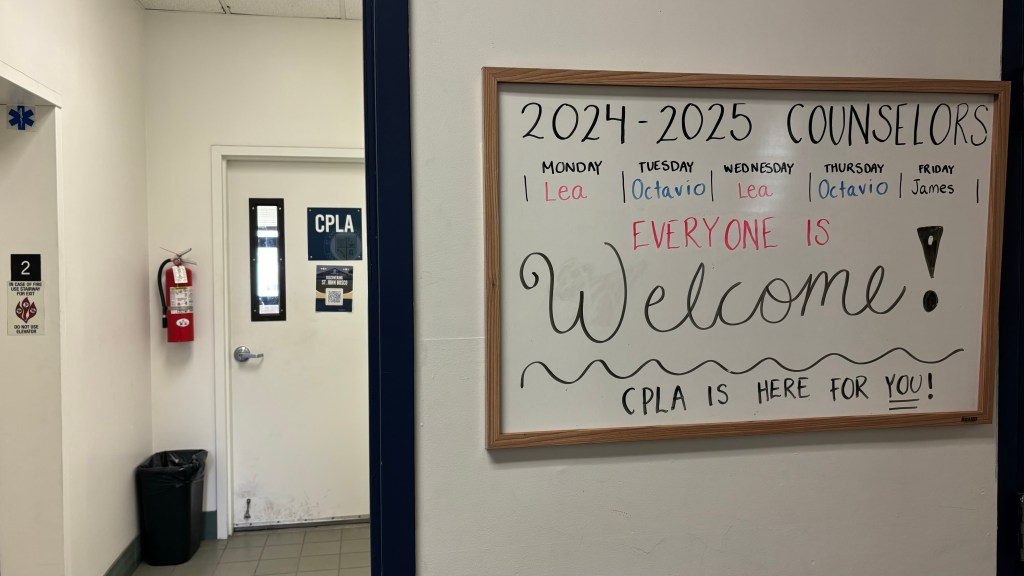
St. John Bosco’s Counseling Partners of Los Angeles (CPLA) intern counselor Octavio Campos provided some more insight on how physical health can be affected by mental health.

“Many people have different [indications] of anxiety: stomach pain, butterflies in their stomach or headaches,” said Mr. Campos. “There are coping skills. A lot of people listen to music or binge-watch a series – something to get them distracted.”

Though, there are instances when someone can’t change or fix what is causing them anxiety. In these situations, acceptance is vital to form a positive perspective.

Bosco science instructor Mr. Brian Miller, who has taught for decades, believes your mental health evolves over time.

“Your perspective changes throughout your life. Your perspective changes with each and every relationship. Your perspective changes based on who you’re with and when [you’re with them],” Mr. Miller said. “My perspective on things changed completely when my wife passed away. I value each and every day all the more.”

Loss is a part of life that everyone experiences and acceptance is the key to grow from it. But there are times when we feel overwhelmed by life. During these times, our mental health is tested, and it’s important to realize that these feelings are normal.

“It comes down to understanding it’s okay to have a problem. It’s okay to feel a certain way, and we don’t all have to be strong all the time,” Mr. Miller said. “[Emotions] are valuable. We have to accept the fact that we all have to experience [emotions] and [we] have to understand how to deal with them in our way.”

The steps toward forming positive mental health are difficult because it means facing our sources of anxiety, which can vary from person to person, and the first step can be the most difficult for people. When you’re dealing with a truckload of tasks or the most difficult part of your life, it’s important to remember: it only takes one action toward growth to form a healthier perspective and subsequently a healthier mindset.

“You can’t reach the top of the mountain unless you take your first step. Sometimes, when you have twenty things to do, you have to choose one thing to do and get it done,” said Mr. Miller. “Too often people see the mountain and think they have to climb it all at once.”

It’s important to focus on the present and be grounded in reality. The past has already happened, nothing can change it. The future will happen when the time comes, and there’s no way of predicting it, so there’s no point in worrying about it. 

“Tomorrow may not come, so you have to make the best of today,” said Mr. Miller.

Issues surrounding mental health are being recognized now more than ever. But perspective matters. An anonymous senior student reveals his own thoughts on the recognition of mental health.

“I feel as though students among my age, mental health isn’t commonly talked about. I don’t think a lot of them have been told by their parents that it is okay to do so,” said the anonymous senior.

The CPLA counselor’s office is located within the 200 building on the second level and beside the elevator. The counselor in the office alternates each day, and there will be a different counselor there everyday of the week. There is no need to set a schedule with the CPLA counselors, all that is required is that you knock before you enter. It is open during school hours.

The academic counseling office, located on the first floor of the 200 building across from the Front Office is commonly open during break and lunch hours. You can always feel free to reach out to your academic counselor via email and schedule a time to meet.

Dr. Po’s office is located in room 238 on the third floor of the 200 building near the center of the hallway. You can knock or enter if the door is open to talk about mental health or spirituality.

All of these sources are avenues for any students who want to talk about their mental health or get help in general.

« Older Entries