Monthly Archives: October 2020

News/Op-Ed: Pardon the Interruption… President Trump, Former V.P. Biden Collide In Chaotic First Debate

By Joshua Hernandez, Editor-In-Chief

On Tuesday night, President Trump and former Vice President Joe Biden clashed in one of the most chaotic, insult-laden presidential debates in history, leaving political pundits stunned, American families appalled and the country in an untenable struggle for decency and civility. 
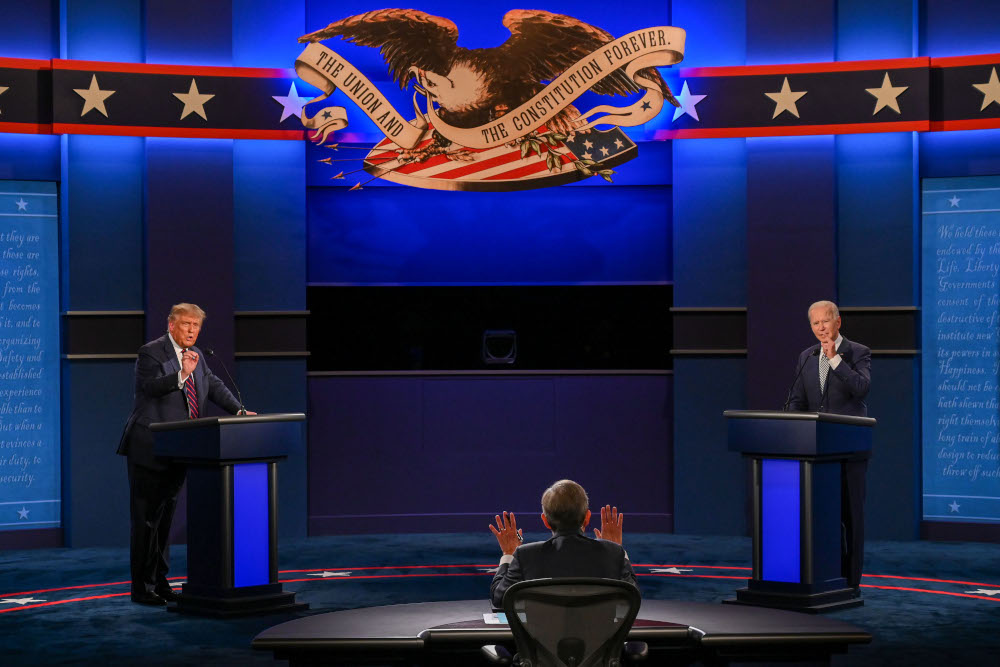
US President Donald Trump and Democratic Presidential candidate and former US Vice President Joe Biden exchange arguments as moderator and Fox News anchor Chris Wallace (C) raises his hands to stop them during the first presidential debate at Case Western Reserve University and Cleveland Clinic in Cleveland, Ohio, on September 29, 2020. (Photo by Jim WATSON / AFP)

Throughout the past few months, Democratic presidential nominee and former Vice President Joe Biden has been subject to a litany of insults from President Donald Trump and his administration, who have directly attacked the former Vice President’s mental acuity as well as his record as a senator and the eight years he served under President Barack Obama. Despite the personal attacks and insults that Former Vice President Biden and his family have faced at the hands of the President, the former Vice President has maintained a stranglehold on his leads in the polls, while his opponent has continued to ignite his base despite low approval ratings. 

On Tuesday at Case Western University and Cleveland Clinic in Cleveland, Ohio, the seasoned, veteran debater in the form of Joe Biden and the unpredictable, unorthodox debater in the form of President Trump had the opportunity to put the months of insults to rest and appeal to the American people by discussing policy, visions, and providing a semblance of unity through their rhetoric in a time where the country is experiencing tremendous political polarization. 

Instead of getting a civil, decent, and controlled debate, the American people witnessed a nightmare unfold right before their very eyes. The moderator, widely respected Fox News Sunday Anchor Chris Wallace, seemingly struggled to control the personality of President Trump, who continuously interrupted the former Vice President more times than Biden was even able to speak. Rather than employ a message of unity, optimism, and leadership, the President continued to evoke rhetoric that was divisive, despicable and abrasive – yet another trampling over norms of presidential etiquette by an administration that has continually embraced the unconventional, regardless of cultural backlash. 

This debate, amidst all the issues currently going on throughout America and on the global stage, could have been huge. One may argue that perhaps this debate could have been the one to change poll numbers, make undecided voters commit to a candidate or even change the tightly held perceptions some people have regarding the character of both candidates. The debate had all the potential in the world, and certainty all the subject matter that America cares about during this election cycle. The topics that were supposed to be discussed in detail, chosen by Wallace, were as follows: the Supreme Court and Trump’s nomination, the COVID-19 Pandemic that has killed 200,000 and counting, the state of affairs in America economically, the battles for racial justice, and the integrity of the election itself. 

The debate could have been memorable, an opportunity for both of the candidates to be a shining star during a time in our country where everything is bleak – but the American people were left with more questions than answers. Immediately following the debate, Americans on Twitter, reporters on CNN and Fox News, and many politicians were quick to discuss what they had just seen.

The debate had no clear winner. President Trump rarely followed the rules agreed upon by the campaigns, driving the discussion into tangents of low-blow attacks against the former Vice President, while Biden cleared a very low bar set by months of smears against his mental acuity. 

In every way possible, no matter how people now and in the future decide to digest and analyze this debate, one thing is clear – the losers in this debate are the American people, as well as the integrity of our Democracy that is being taken down and overthrown by thuggish rhetoric. The people are suffering because of the utter embarrassment and shame that comes with seeing two grown American men – who are in a battle to run the free world – unable to engage in a debate that should have been civil, informative and unifying for a country that is bleeding for hope and leadership. 

After everything the American people have been through in 2020, Tuesday served as an opportunity to provide optimism in a better direction for the future and ignite the bases of two campaigns that have many flaws. Instead, it was the American people who suffered and were left with nothing to cheer for, nothing to feel proud of, nothing gained in terms of who has a better vision for our nation. 

In lieu of finally getting an opportunity to see what former Vice President Joe Biden would do differently than Trump as President to fix the economy, healthcare, the environment and social injustice, the American people weren’t able to hear his words over President Trump’s consistent interruptions, side comments and insults. The highlights of the debate for former Vice President Biden came in the form of him telling the President to “shut up, man” as well as calling him a “clown.”

On the flip side, President Trump had a debate performance that can only be described as unpresidential. Entering this debate amidst slipping poll numbers, President Trump truly needed a magical – or, at the very least, adequate – debate performance in order to give more fight and direction to his reelection campaign. Yet, he failed to do so.

All night, the President butted in, hurling insults toward the former Vice President in an attempt to get his challenger to make a big mistake – but it never happened. It almost seems as if Biden, the 47-year political veteran, the elder statesman in government is immune to the mudslinging and diabolical rhetoric that the President and his campaign choose to employ day-to-day on the campaign trail. When former Vice President Biden brought up his deceased son Beau Biden’s military service, the President brushed it off, choosing instead to insult Biden’s living son, Hunter. 

Furthermore, the President chose not to condemn white supremacists and far right extremist groups when asked to do so, instead telling the Proud Boys – a far right extremist group that promotes violence – to “stand by.”

In the midst of a pandemic and increased racial tensions, President Trump offered no solutions – only insults and green lights to alt-right militia groups – saying that the reason former Vice President Biden did not host in-person rallies and campaign events was not due to COVID-19 concerns, but because “no one would show up.”

Instead of raising the bar for a man he calls “sleepy” and “unfit for the job” of president, he has lowered it, while making the former Vice President look competitive for telling the President to “get out of his bunker.” All the while, former Vice President Biden has furthered the concerns amongst Americans that he is not energetic enough to truly bridge the divide between the left and the right and excite Americans enough to get tremendous voter turnout.

As both of their respective campaigns continue to play out, the former Vice President has continued to tout that the country is in “a battle for the soul of America.” Meanwhile, the President has continue to maintain a stranglehold on his base of support by promising to take down the “radical left” and to “Keep America Great.”

But, if the debate is any indication of what is in store for this country in the next few weeks, rhetoric will not be a reliable source of optimism, and traditional etiquette in American Democracy might be a thing of the past. 

News/Op-Ed: COVID-19 Responses Around the Globe Highlight U.S. Challenges

by John Udabe

As the United States persists months into the pandemic, people have continually adapted to an ever-changing “new normal.” Places in the U.S. then began to open up, and then some inevitably began to close again. Some cities around the country are in a perpetual state of cautious phased reopening, while other places remain open as if a pandemic weren’t occurring at all. Around the world, other countries have responded differently to the virus. 

Some countries now appear to be over the hump, while others are resisting a second wave of cases. Some places have returned to nearly normal, others are on their way, and some expect a return in a distant future. Quick and enforced policy appears to have been the key element to striking the problem early, as can be seen throughout the world.

Let’s take a closer look at Taiwan. An extensive list published by the American Medical Association shows that Taiwan was one of the first countries to initiate protocols regarding the virus, with health screenings on flights from Wuhan beginning as early as December 31, 2019. In the months following, Taiwan began more extensive travel restrictions and public safety measures in response to the virus. Tours and transiting to China were soon suspended. 

Places like Taiwan would likely be cautious regardless of public policy. Taiwanese citizens are no strangers to being in the worldy neighborhood of deadly viruses. The effect of the SARS outbreak in the early 2000s, for example, which also originated in mainland China, likely remains in their memories.

By February 1st, roughly 4 million masks were being locally manufactured and sent out, with a set price of about $0.20 per mask, making them widely accessible. A few days later, the mobilization of resources, provided by government and private organizations, allowed for ten million masks to be made per day. 

By the beginning of February, a break in quarantine protocol for positive cases could warrant up to a $10,000 fine. An extended winter break allowed for preparation of returning students. As the months progressed, enforced entry bans and mandatory quarantining led to a relatively minimal effect from COVID-19. According to the CDC, as of last week, Taiwan currently has a reported 509 total cases, with seven deaths nationwide.

These swift actions have had beneficial repercussions to the country. A minimal effect was felt on education especially, and other than a two week buffer in February during winter break, no other time was lost for in-person instruction. School began as normal this school year as well. 

For a large time, Taiwan had launched the only professional baseball season in the entire world. And now, you can even catch a game in person at Taichung Intercontinental Stadium in Taipei after a temperature check and taking your seat in adequately spaced stands. Catching a live baseball game is a rare sight anywhere in the world, and as the MLB begins to enter the postseason in the US, it is a sorely missed sight.

New Zealand has also been notably effective in controlling the virus and is finally in the stages of reopening. Their COVID-19 response is obviously unique, as they are an island nation. Spikes in new cases have been minimal for the past few months, likely due to their strict lockdown measures. From May to August, new cases were extremely rare, and despite a small spike since then, it appears that New Zealand has the virus relatively under control. 

As of September 30th, New Zealand’s Ministry of Health states that there have been 1,480 cases, only about 200 in the last month, and 25 deaths total. Until Wednesday, September 23rd, citizens were not allowed to gather in groups greater than ten. Since April, new daily cases have been kept under 20, and cities are beginning to lift restrictions; the current plan is to slowly lift them and eliminate them completely within two weeks.

Egypt’s COVID-19 response, on the other hand, has been deemed ineffective by many. The World Health Organization states that the North African nation has accumulated over 103 thousand cases with over 5,900 total deaths to date. Toward the beginning of the pandemic, Egypt’s measures apparently failed to effectively contain the virus, which was comparable to other countries at the time, such as the U.S., United Kingdom, Italy, and others. 

According to the U.S. Embassy in Egypt, a government-mandated lockdown was initiated in March, when there were less than 500 cases reported. Public areas such as restaurants and mosques, as well as schools were promptly shut down, and a curfew and flight restrictions were put in place. Yet due to a number of factors, these actions were partly in vain. It is alleged that Egypt did not record data properly, inferring that a large number of cases went unreported and therefore void from precautionary measures. 

In addition to inaccurate numbers, many places in Egypt did not have proper resources available, especially in rural and urban areas, where clean water and proper sanitation is not adequate. A lot of effort by the government focused more on preserving the economy, namely in their oil, gas, and Suez canal infrastructure, and a failed social safety net has thrown many into poverty. The amalgamation of fragile healthcare, ineffective and ill-directed policy, diverse socioeconomic statuses, and contrasting geographic areas have all led Egypt down an undesirable path.

There is no faultless way to deal with a worldwide virus, especially in this day and age, where international travel has never been so conventional. The success of a pandemic response varies from country to country. Coming up with a standard worldwide response would be utterly futile, as effectiveness is contingent upon how a specific society functions. 

The United States is a demonstration of this: states, counties, even cities are reacting to COVID-19 policies differently. Some areas embrace the ideas of social distancing and mask wearing, while others are repulsed by the idea and see the virus as a hoax. 

Life of a Brave: Don’t Make Halloween a Pandemic Nightmare

by Nicholas Neoman

Celebrating Halloween in the midst of the COVID-19 pandemic poses a tremendous new health risk. In the wake of a spike in cases nationwide following Labor Day weekend, health experts are concerned with the implications Halloween places on the rate of transmission.

According to NBC Los Angeles, Labor Day saw a massive “uptick in virus cases.” Events such as barbecues and public gatherings on Labor Day caused a spike in the COVID-19 infection rate. According to the Blueprint for a Safer Economy, Los Angeles County’s cases are hovering around 7 cases per 100,000 people. Health experts fear the COVID-19 infection rate will see exponential growth during Halloween, which may mean the popular holiday will look different for at least 2020.

The Los Angeles County Department of Public Health has placed new guidelines for Halloween in the midst of this pandemic. Social gatherings, such as parties, are now forbidden as close interactions will surely cause a spike in cases. Other traditions like Trick-Or-Treating are strictly advised against. Everyone must be six feet apart, which is simply not realistic. While many restless children will still go door-to-door asking for candy, the Health Department strongly advises to limit the amount of contact. Even small interactions with others, like handing out candy, put people at risk of contracting the novel coronavirus.

Furthermore, the Health Department has deemed online parties and drive-in-movies as safe actions for celebrating Halloween. While many are still very sick of doing everything from a distance, one moment of close interaction can ruin what months of time have built. Halloween floods people with nostalgia of times before this pandemic. Thus, the inclination to return to “normal” will be stronger than usual. But, remember: this can be deadly. 

Sharing food such as candy can transmit the virus amongst one another. According to Healthline, as much as 42% of the infected are asymptomatic. Therefore, it is wise to take candy and other food that has not been touched or individually wrapped. While people may not experience symptoms such as coughs and runny noses, they may be carriers of this deadly virus. In the case of Halloween, like always, people will not be able to tell those who are infected based on symptoms. Thus, keep the philosophy in mind that everyone may have the virus.

On top of pandemic precautions and community restlessness, for the first time in five years, Halloween will be on a Saturday. There are no reasons for going home early – school and work do not follow as they usually did in past years. Staying out later because Halloween is on a Saturday only increases the chances of spreading the deadly coronavirus. The more time spent with someone, the larger the chances are of transmission.

The greatest fallacy the news is spreading is that cases are decreasing. While case rates may not be as colossal as they once were, this is misleading. They indicate that public gatherings are not discouraged since case rates have dropped. If people are careless and do not listen to public health and safety warnings, Coronavirus cases will leap as they did on Labor Day.

Halloween attracts many different social groups which increases interactions. Those who have been cooped up in their homes will seek to finally have some fun in months. Things like interacting with others who have not been quarantined together only increases the chances of contracting the virus. The Health Department of Los Angeles implores people to be cautious about actions that they take on Halloween. 

The Saint John Bosco community is nearing its return to campus, and a major spike from Halloween would only delay when students and faculty can come back. Halloween amidst a pandemic does not have to mean there will be a spike in COVID-19 cases. Follow the guidelines, take logical actions, preserve cleanly habits, wear a mask and stay safe.

Recent Entries »