St. John Bosco High School junior and Frontier Selects LA/Bosco ice hockey goaltender, Logan Owens-Scott, got his Detroit Red Wings jersey signed by San Jose Sharks and former Detroit Red Wings defenseman Jake Walman at an Anaheim Ducks game, a moment he shared with his Bosco brothers that circulated on social media.
Jake Walman is a professional ice hockey player who currently plays for the Sharks in the National Hockey League. Walman spent the last three seasons in Detroit with the Red Wings. This season the Red Wings front office made the decision to let Walman go and traded him to San Jose.
This left Detroit fans stunned and angry to be losing a fan favorite. At the time, Walman described the trade as “heartbreaking” as he had no plan to leave Detroit, affectionately referred to as “Hockey Town” by NHL fans.
“My heart was there, you know? I wanted to bring that success and passion to Detroit. It was my first time, like I’ve said to you before, that I felt like I was in a place that loved me, and I loved that place,” said Walman, according to The Hockey News.
In a matchup between the Ducks and the Sharks on October 22nd, Logan made sure to take his Jake Walman jersey and go right up to the glass during warmups to put himself right in the eyeline of Walman.
Walman skated a few times shooting some smiles at Logan. Eventually tapping on the glass and waving him over towards the bench. Logan and his Frontier Selects/Bosco teammates walked their way over to the bench, and the training staff took his jersey and laid it out on a table for Walman to sign.
After warmups, Walman walked off the ice and personally signed the jersey with a written “Atta boy” on the top of the jersey number. The NHL media team wasted no time in catching this moment of a lifetime, and the Sharks posted it on their social media. The post’s video currently has almost 300,000 views.
“It was so cool to have my favorite hockey player, who was traded away from my home state and favorite team, recognize me and treat me the way he did – who had just released a statement about how much he missed the [Red Wings], then still showed support to his fans. [He is a] class act and [I] hope he will come back to Detroit,” said Logan.
Logan and his teammates want all Bosco and St. Joseph’s students to come out and support Frontier Selects/Bosco hockey. On Thursday, Frontier Selects/Bosco takes on Santa Margarita at the Honda Center, the home of the Anaheim Ducks, at 7:00pm.
They will take on Santa Margarita again on Saturday at 4:00pm at Great Park Ice in Irvine. Frontier Selects/Bosco is currently 11-5-0 in their inaugural season. Admission to all game is free.
St. John Bosco High School students Martin and Oliver Shiekh are hosting a volleyball tournament this weekend in order to raise money to help those affected by the rampage of Hurricane Helene in late September.
The event, called the “Hit Hard And Rally 4 Relief,” has given an example of the generous and altruistic activities carried out by Bosco students—both inside and outside the campus.
The initial idea for the event started shortly after the category four hurricane slammed into the Big Bend region in Northern Florida on September 26th. After making landfall, the storm moved north, flooding entire parts of the southern United States including Florida, Georgia and North Carolina.
One of the people affected by the hurricane was Ms. Lori Vinskus, a Social Science and Latin instructor in Bosco’s online program, SJB Global. She resides in North Carolina, which was severely impacted by the flooding from the hurricane. Upon seeing this happen, Martin and Oliver decided to begin this project to help all those in need.
Teaming up with the Global Empowerment Mission (GEM), a non-profit organization based in Florida, the two will be sending all the funds to the GEM Hurricane Helene relief project.
In some way, they already had some experience with these types of events, having previously made one for the series of fires in the state of Hawaii in 2023.
“We’ve done similar tournaments for fire damage in Maui,” said Martin. “So, we decided to jump into action [this time around] with a tournament-style fundraiser.”
This tournament, however, will be different from the one held earlier. At this event, Martin and Oliver plan to increase engagement and participation among the Bosco youth by holding more than just a simple volleyball tournament.
Members from local high schools like Bosco and St. Joseph’s are involved in this event, as well as various volleyball clubs. These include the Pulse Volleyball Club, based in Anaheim.
Aside from the volleyball events themselves, the two highlight the other events that will occur, including events featuring AVP (Association of Volleyball Professionals) professionals and, of course, food.
Many external companies are also involved in the effort, including the company Slunks, known for its production of volleyball shorts and gear, and Shiekh, a reputable shoe store. Both companies are planning to give away select merchandise at the event.
The two were able to secure these sponsors and connections by simply asking around in the local community, as well as in some volleyball clubs.
“It’s just asking a lot of questions, basically,” said Martin.
They asked a large number of people, including reputable leaders at Bosco, in order to make this event more well-known and increase their outreach.
They believe it is possible for anyone to make these types of fundraiser events and that it’s a matter of getting all the work done while establishing connections with people in local communities.
“People want to help you, so just don’t be afraid to ask,” said Martin.
“Have a plan before you go into anything,” Oliver added. “Map everything out and try to get a list of all the steps you need to do to create an effective fundraiser.”
The event is open to anyone—students, adults and more—with no required level of experience in the sport. The two are hoping for an increase in turnout in order to achieve their $5,000 goal.
“It’s often easy to get people to say ‘yes,’” said Martin. “But, it’s a different thing to actually get them to come to the event.”
The event will be held this weekend on Sunday, November 10th at the Long Beach City College Sand Courts, south of Bosco in north Long Beach. Events will last from 1:00 pm to 10:00 pm, and will include a variety of other activities and giveaways to those in attendance.
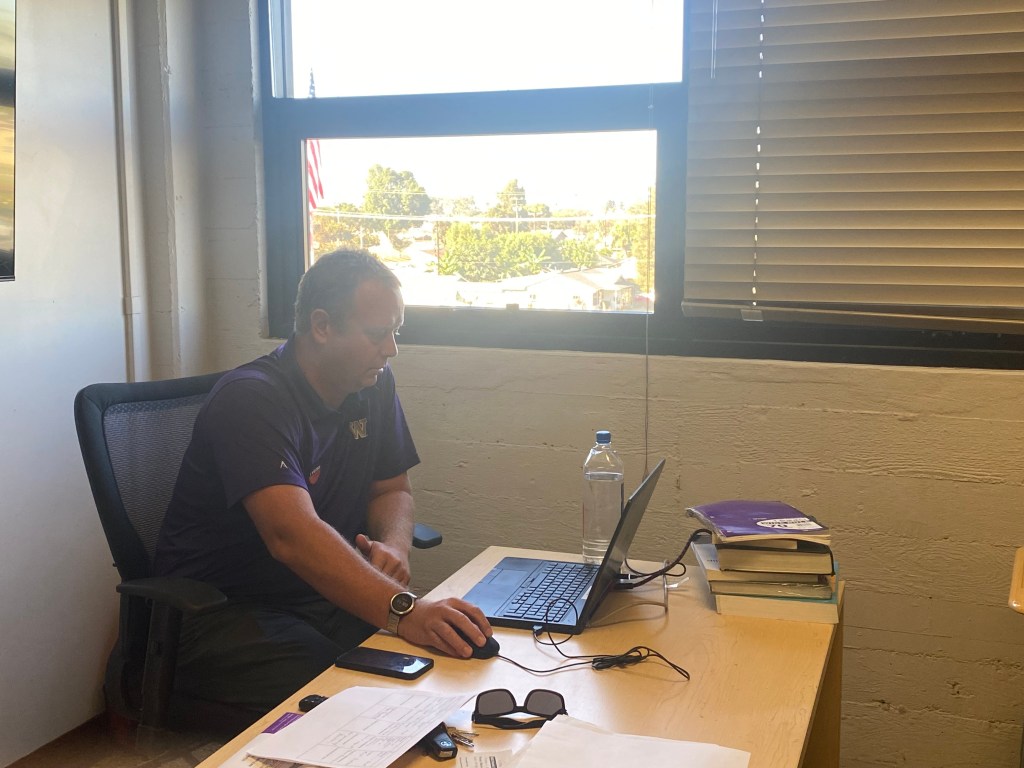
St. John Bosco High School welcomes a new teacher and coach, Mr. Kellyn Carlson, to lead the Entrepreneur Pathway and teach students crucial business lessons, as well as to serve as an assistant water polo coach.
Photo by Nicholas Valenzuela
Q: Where did you grow up?
A: I grew up in Tacoma, WA.
Q: What was your best subject when you were in school?
A: History. I like to learn from the past to be prepared for the future.
Q: Where did you go to school to get your degree?
A: The University of Washington and California State University, Long Beach. I have a B.A. in Political Science from UW and an M.A. in Sports Management as well as a Teaching Credential from CSULB.
Q: What jobs did you do before teaching at Bosco?
A: A lot. I started in the family business, Aqua Quip. I stocked shelves and cleaned, fixed and built pools and spas all the way to managing the logistics of the service department. I had many sales jobs at biotech that taught me that I am not a salesperson. I also had coaching jobs here at Bosco many years ago and spent time at Orange Lutheran and Millikan as a teacher and coach.
Q: Why did you decide to pursue a future in teaching?
A: During the pandemic, I lost my job like many other people and got back into coaching, that led me to realize that making a difference in people’s lives made me feel like I did when playing sports, and no matter how many hours I spent coaching or teaching, I never felt like I was working. When you love what you do, it’s not work.
Q: What is your favorite sports team?
A: Washington Husky Football might be my all-time favorite and Liverpool FC, as well.
Q: If you could have lunch with one person from history, who would it be and why?
A: Marcus Aurelius, Emperor of Rome. The stoic philosophy he learned from Epictetus and other ancient Greek philosophers is something that I am using to make myself a better person every day. I find it fascinating how those philosophies helped him rule over one of the greatest empires in history.
Q: What is your favorite band or musical artist and song, and why?
A: Tough question. I think it depends on my mood. I love Bob Marley and his message, but at the same time, I think my musical evolution into jazz has me listening more and more to Thelonious Monk, Dizzy Gillespie, John Coltrane and other jazz legends. I grew up in the Grunge Era of Seattle music, so I always like a little bit of Pearl Jam, Nirvana and other 90’s era music.
Q: What’s your favorite cuisine, and what is your favorite dish from that cuisine?
A: Again, it depends on my mood, but I always go back to my northwest roots of seafood. I love oysters, clams, salmon, halibut and really anything from the sea mixed with fresh vegetables and a little rice.
Q: If you could go anywhere in the world, where would you go and why?
A: I would like to visit Eastern Europe and attend professional water polo games in Hungary, Croatia and Montenegro. Water polo is huge there, and I have never had the opportunity to visit that part of Europe and see the sport where it is most loved.
Q: What is the advice you would like to give to students in your class?
A: To be open to learning and not miss the great opportunities they have here at Bosco. It is an important time in your life, and you have a faculty that is passionate about helping you. Take this big step forward into the adult you want to become.
Q: If you could start a business, what would it be?
A: A small community pub. Pub is short for public place where people gather to talk, share stories, play music and connect. I like food, people, and talking, and would love to do it all while making a living.
Q: How much can you bench?
A: Today, not as much as I used to that is for sure. I couldn’t tell you. I think if memory is correct I was somewhere around 235-250 lbs. at one point, so not very much.
Q: What’s something that you learned from a hard experience?
A: When times are rough, those closest to you will be there for you without question. That is why keeping great relationships and honesty are so important.
Q: What sports do you coach and why?
A: Water polo and swimming. I try to pass what I know on to others and help others go as far as they can. I like seeing athletes achieve more than they thought was possible.
Q: Do you prefer coffee or tea, and how do you make it?
A: I like my coffee black, but don’t mind having a cup of tea either.
Q: If you were on a stranded island and could only bring one item, what would you bring?
A: The book Meditations by Marcus Aurelius to remind me that I am so lucky and privileged to have every day on that island.
Q: If you found out you had 48 hours to live, what would you do with it?
A: Spend as much time with my family as possible. I am very lucky to have an amazing family where generations are connected so deeply and help each other with no questions asked.
Q: If you could go back in time and talk to your younger self, what would you say?
A: I would tell myself that the journey is unexpected, not what you think it will be, and that the experiences will lead you to happiness and doing what you’re meant to do.
Q: What motivates you to work hard?
A: The desire to do things right and an innate sense that I always want to do it better than someone else. I am very competitive and that drives me to always be better than I was today.
Q: What’s your proudest accomplishment?
A: Having the opportunity to travel overseas after college and continue to play water polo in Australia and win their National Water Polo League Championship.
Halfway through semester one and with final grades getting closer, students should be prepared— with work ethic being a large part of having academic success. But what is work ethic, and what are some ways to improve it?
Photo by Michael Bartelt, The Brave News Faculty Advisor
Work ethic is an extremely important skill to have in school, yet not everyone inherently has a good one, according to Elizabeth Hunt, the Dean of Academics, World Languages Instructor, Sophomore Class Moderator and Key Club Moderator for St. John Bosco High School.
But to form a good work ethic, you need to know what work ethic is. According to Ms. Hunt, work ethic is the integrity and perseverance within someone that enables them to do your work to the best of your ability.
This doesn’t mean work ethic can’t be learned. Integrity and perseverance are skills, and like all skills, it requires practice.
“Work ethic is something that you can learn,” Ms. Hunt said. “It’s not always something that’s innate in us.”
According to Ms. Hunt, work ethic also requires a positive perspective to cultivate it. Though, this can be difficult when you’re faced with multiple deadlines all at once.
“It’s very easy to get overwhelmed [when] you know everything you have to do,” said Ms. Hunt. “You need to break it down [and] set deadlines for yourself ahead of time so you can approach it little by little.”
There are a variety of ways to approach this. Ms. Hunt suggests using a calendar or reminders on your phone. Everyone is different and they should use whatever method works for them.
Another avenue to form a growth mindset and good work ethic is peer tutoring.
Kelly Blakeman, SJB’s Mathematics Department Chair, Mathematics Instructor, and Math Honors Society Moderator shares how the math peer tutoring program at SJB can help grow a good work ethic.
“I have a few students who come in for [peer tutoring] just as a space to work and do their homework, and if they have a question they’ll ask the peer tutors for help,” said Ms. Blakeman.
An environment without distractions allows students to focus solely on their work, with peer tutoring programs at SJB providing this space for students.
Peer tutoring also helps new students entering high school to adjust to Bosco, meet new people ranging from freshmen to seniors and cultivate their work ethic early on.
“[Peer Tutoring] encourages newer students to come in and [learn] from experienced students closer [to their] age,” said Ms. Blakeman.
A senior tutor here at SJB, Gerald Leyva, who is a part of the Spanish and Math Honors Society as well as the Onori Society, shares how he’s seen peer tutoring help students improve their work ethic.
“I feel peer tutoring can be helpful to keep people on top of their work,” Gerald said. “In my experience, a lot of students have been able to learn better time management skills, tips on how to get their work done in a more efficient manner and other tactics to not fall behind.”
Peer tutoring can help students form a good work ethic, and there are many other advantages that come with peer tutoring that help students further create a good work ethic.
Freshman student, Rowan Brown, shares exactly how peer tutoring has helped him consistently have a good work ethic.
“Going to peer tutoring, if you have a hard time with procrastination, can really help. It also allows you to be in a space without all these distractions.” Said Rowan.
Having a good work ethic is vital to the growth of the mind since it alleviates stress and anxiety from deadlines.
“It’s just hard to keep yourself emotionally stable when the [work] is overwhelming you,” said Rowan. “Sometimes I can get emotionally overwhelmed, especially if I have a lot of [work] to do. Procrastination is a really big [cause] of that.”
Senior student, Kashim-As’Ad Kashim, or As’Ad, shares how his growth in work ethic due to peer tutoring has helped him in his academics.
“I [had] a grade D in Algebra 2 during junior year, and by the end of the semester one, [I] ended with a grade B [because] of peer tutoring and I was doing my work before the [deadline].” Said As’Ad.
Work ethic can be learned and is essential to reduce stress from school assignments, with peer tutoring being able to help instill work ethic into struggling students, according to Ms. Hunt.
“Work ethic is a set of values that push you to do the job to the best of your ability,” Ms. Hunt said. “Somebody who has a good work ethic is going to have less stress, less anxiety and is probably going to [ascend] as opposed to somebody who is doing the bare minimum.”
St. John Bosco contains many peer tutoring programs. Mr. Michael Bartelt is the Onori Society Faculty Advisor; Ms. Kelly Blakeman is the Math Honor Society Moderator; and Ms. Cindy Rayas is the Spanish Honors Society Moderator. You can find their contact information in SJB’s directory for inquiries regarding academic support.
The schedule for peer tutoring is also included in the “Week Ahead” email sent to parents and students each weekend.
Hispanic Heritage Month, which began last month on the 15th, reflects centuries of history in South and Central America—history that continues to be told through the experiences of St. John Bosco students in the present day.
The celebration started in September to commemorate the independence of various Central and South American countries. The first day, September 15th, remembers the signing of the Act of Independence of Central America in 1821, which led to the declaration of Guatemala, Honduras, El Salvador, Nicaragua and Costa Rica as independent countries.
The following day remembers Mexican independence leader Miguel Hidalgo, who on September 16, 1810 launched the Mexican independence movement.
Other significant events take place throughout the month as well, like the Chilean celebrations of independence that start on September 18th, or perhaps most recognizable to most Americans, Columbus Day, known as “The Day of the Race” to Hispanics.
While this historical significance is important to acknowledge, it is also very important to see how these historical events and celebrations have changed local communities.
This has been seen in a variety of ways at Bosco. Mr. Eduardo “Lalo” Díaz, a current social studies instructor for Bosco juniors, joined the school last year. Coming from Mexico City, his background has made him see the impact that Hispanic culture and contributions have made to the United States.
“The U.S. educational system hasn’t recognized us or given us our place in the history or development of our country,” said Mr. Díaz. “Celebrating our contributions to the development of our country, our city and the state of California is important so that we broaden the love that our people have for México.”
Mr. Díaz believes that Hispanic-American students—not just at Bosco, but elsewhere—live within two juxtaposed environments. At home, they might exclusively speak Spanish, which is something they might not do while at school. In his view, we should all be proud of our backgrounds—and should maintain and keep these cultures in mind, lest they be forgotten.
“We want to keep these traditions,” said Mr. Díaz.
As a teacher of US history, he also believes in the importance of recognizing Hispanic contributions to this nation.
“By teaching [students] United States history, I must include events that show us [Latinos] as people who have contributed to American development,” said Mr. Díaz. “The United States didn’t get to where it has without the help of many cultures.”
He believes that it is important for everyone to know about the influence of cultures present within the United States, as it is important to keep these cultures alive.
Ms. Cindy Rayas has also seen the significance of Hispanic Heritage Month at Bosco. As the World Languages Department Chair, the Moderator of the Spanish Honors Society and a Spanish teacher for sophomores and juniors, she interacts with a large portion of Bosco’s Hispanic students.
She notes the ways that Hispanic culture has made many proud here at Bosco. Many of the other cultures, she believes, are diverse, with their own selection of cultures and traditions.
“[Hispanic] culture is rich in many aspects. It makes me feel proud, as well as the language. Each country has its own traditions,” Ms. Rayas said.
She also recognizes the connection that Hispanic cultures have with religion—something central to students’ educations at Bosco. Oftentimes, these ideas are completely intertwined with each other.
As a Spanish teacher, she has also noticed specific trends amongst each of her classes. She emphasizes the importance of learning Spanish culture alongside the Spanish language.
“The students who speak Spanish at home have a more ingrained culture,” said Ms. Rayas. “I tell them: everything is connected, especially when it comes to language.”
She notes that it is very important for Hispanic students to respect their own culture and to not feel like they cannot embrace their Hispanic heritage because they don’t speak Spanish as much as they would hope.
“If they don’t respect their culture or language, others won’t respect us,” said Ms. Rayas. “Therefore, it is important to tell them to respect their culture and to respect who they are.”
In future years, Ms. Rayas plans to help with special events relating to the celebration of Hispanic culture, including a potential celebration for Our Lady of Guadalupe, as well as various potlucks. These, she hopes, will lead to the promotion of Hispanic culture on campus, encouraging students to be proud of their cultures.
“[I want them] to feel proud of who they are and of where their parents came from. We were born here in the United States, but we must remember that our beginnings come from Latin America,” said Ms. Rayas. “We must always carry that with pride.”
Imagine standing with your St. John Bosco brothers and St. Joseph sisters under the Friday night lights, singing, dancing and cheering on your Braves going to battle on the field.
Photo by Jet Walls
The culture of Bosco Football games has evolved significantly throughout the years. Though the game day experience is in many ways unmatched – from the tailgating to the state-of-the-art Panish Family Stadium – the Tribe student section used to be more fervent in its support.
It used to be the place to be on a Friday night: a game defending our home stadium against an opponent in a clash of titans on the field.
Alumnus and theology instructor, Mr. JP Garcia-Esparza, reflects fondly on to his experience as a student coming to games on campus.
Mr. Garcia-Esparza’s favorite game day memory with his Bosco brothers and St. Joseph’s sisters was during his freshman year when the team beat the “Team in Red” at home. The student section rushed the field to celebrate their win with the team and even joined them in prayer on the field.
Back then students would get way more hyped for game day. Some even showed up in paint and costumes.
“The student section is a representation of our school,” said Mr. Garcia-Esparza
The student sections need to be bigger, louder and more enthusiastic. We need all the students to come support the boys on the field. The Bosco Football players urge the students to come out and support them at games. They love to see their classmates in the stands supporting them with passion.
“It’s great to have the support of fellow students, but once the game begins, everything seems to become tunnel vision and the outside noise isn’t so loud coming from a defensive view point. Once a big play is made defensively and you can hear the crowd and student section react loudly, it’s definitely a turning point and momentum changer for sure,” said senior linebacker Cole Clifton. “The Tribe experience is one of a kind in big games, and the support is always there and needed during big moments.”
However, at times, Brave and Jester students have taken for granted the great product on the field and how our community has a unique opportunity to galvanize itself around that greatness.
“[The student section] can be at times underwhelming,” said St. Joseph’s senior cheerleader Jolynn Hallum.
Jolynn wants all her Jester’s sisters and Bosco brothers to come to the game and just go for it when cheering and hyping up the rest of the crowd. Your actions in the stands can even help motivate the cheerleaders in hyping up the rest of the stadium.
“Sometimes [cheering] is harder if it’s a low energy crowd,” Jolynn said.
If you can make an upcoming game, you are highly encouraged to come out to support your brothers with great energy, as they chase their aspirations of winning a third national championship for Bosco and pursuing their individual goals of earning college scholarships.
“You can never count out the heart of a Brave, ” Mr. Garcia-Esparza said.
The Bosco Braves take on the Santa Margarita Eagles tonight at 7pm for the Homecoming game at Panish Family Stadium.
St. John Bosco High School welcomes new biology and environmental science instructor, Mr. Albert Soliguen, who wants to utilize his wisdom and experience to help Bosco Braves realize their potentials.
Photo by Jesus Biag
Q: Where did you grow up?
A: I primarily grew up in the city of Long Beach and Garden Grove.
Q: What high school and college did you graduate from, and what was your field of study?
A: I graduated from Garden Grove High School and from California State University, Fullerton with my Bachelor’s and Master’s Degrees of Science in Kinesiology. I also got my single subject teaching credential in biology from National University.
Q: What inspired you to become a teacher?
A: I believe what mostly inspired me to become a teacher is my own experiences as a student in the classroom. I didn’t particularly have the best student experience, but I had great mentors and teachers who supported me and highlighted my potential which transformed me into the person I am today. Ultimately, this is what drove me to pay it forward to those in need, just as the people who have been there for me.
Q: What did you do before teaching at Bosco? Did you teach somewhere else, or do something completely different?
A: Before teaching at Bosco, I was a longtime coach for the sport of volleyball for over 10 years. I worked for Santa Ana College for over eight years with Public Safety in Health and Wellness with several different fire department agencies across Southern California.
Q: What makes Bosco different from any other school you’ve taught at before?
A: What separates Bosco from other schools is the culture, students and staff. The students are what make this campus truly alive and vibrant. The level of prestige in the classroom and the amount of knowledge, kindness and care from the staff is incomparable.
Q: What do you love the most about being a teacher?
A: What I love most about teaching is the relationships you build with students, parents and the community over time. To see their growth personally and professionally is rewarding and gratifying.
Q: How is your classroom experience different from other teachers in the Science Department?
A: I believe my classroom is different from other science teachers because I share my own experiences to students that are related to the content. I always make an effort to bring some relevance of the content to students to make it more relatable to their lives.
Q: When you aren’t teaching and lesson planning, what do you like to do in your free time?
A: During my free time, I like to spend it with my wife and my two-year-old daughter.
Q: What is your favorite book, movie and TV show?
A: My favorite book is Dune; my favorite movie is The Crow (1994); and my TV show that I currently like is Culinary Class Wars on Netflix.
Q: Where is the most interesting place you’ve traveled?
A: The most interesting place I’ve traveled is the Philippines.
Q: What is your favorite genre of music?
A: My favorite genre of music is Hip-Hop.
Q: What are your favorite sports and sports teams?
A: My favorite sports are football, basketball and volleyball. My favorite teams are all from the Bay Area: the San Francisco 49ers and the Golden State Warriors.
Q: When you were in school, what activities did you participate in?
A: When I was in school, I was a part of Hip-Hop club and I played basketball and volleyball.
Q: Do you have any pets? If so, what kind and what are their names?
A: I have one dog that I rescued that is a Border Terrier. His name is Koda.
Q: What’s your go-to comfort food or favorite meal to cook?
A: My favorite comfort food is sushi. My favorite meals to cook are BBQ and steak.
Q: How did your family and culture mold the person you are today?
A: My family and culture is very important to me because they have been the biggest support group in all the things I’ve done. They have been there with me through the highs and lows, and the one thing that has never changed was their love and support.
Q: What’s your favorite thing about your Filipino culture?
A: My favorite thing about Filipino culture is the food. Our culture is very generous, kind and hospitable.
Q: What’s something on your bucket list that you haven’t done yet?
A: One thing on my bucket list that I haven’t done yet is to hike the Pacific Crest Trail.
Q: Do you have a favorite quote or motto that you live by?
A: My favorite quote is “You never know the value of a moment until it becomes a memory.”
Q: What’s the best piece of advice you’ve ever received?
A: The best piece of advice that I have been given was in the form of another quote: “Fear is the thief of dreams.” With that being said, it was important for me to embrace the unknown, the failures and discomfort, because in most cases, it will end up being the right choice.
Q: Knowing that, what do you think is the biggest piece of advice you could give to your students?
A: My advice to other students is to find the good in every moment, stay present and trust the process. Everything happens for a reason, but those reasons are meant to take you somewhere and to help you grow.
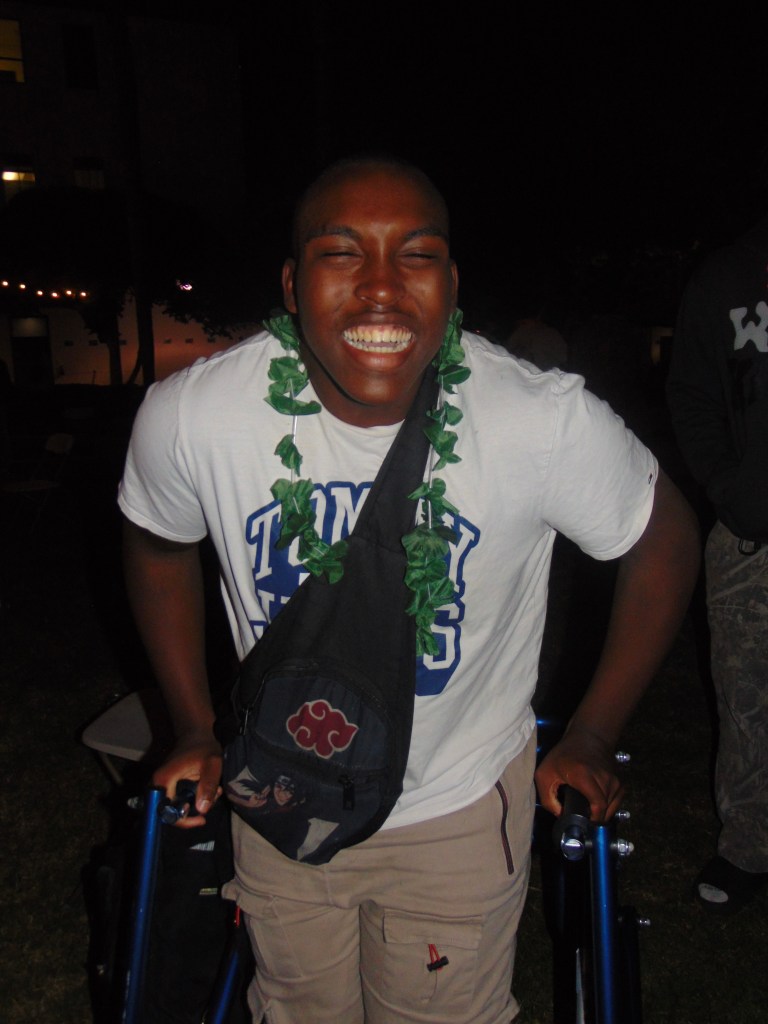
From the beginning of his freshman year until now, students and administrators have walked past As’ad Kashim without knowing exactly the adversity he has overcome in his life. He believes that his story embodies what it means to truly be a Brave at St. John Bosco High School.
Photo by Kijani Dumas
As’ad was born in Nigeria in 2006 to a close-knit family. His mother worked as a public relations officer, while his father was a member of the Nigerian Navy. Alongside his older sister, As’ad grew up surrounded by love and support.
As’ad’s life was at risk from the moment he was born. Born prematurely, he spent his first days in an incubator due to underdeveloped organs. Additionally, his skin was so thin that his internal organs were visible.
After leaving the incubator, As’ad suffered from oxygen deprivation, which caused problems that would hinder his movement. At one point, doctors feared he wouldn’t survive. As’ad believes that he was able to stay alive because of the love of his family, particularly his sister.
She cried out for him, wanting her little brother to come home. Eventually, As’ad was able to find a stable pulse and develop organs strong enough to support themselves on their own.
As’ad was officially diagnosed with cerebral palsy when he was two years old. His condition was difficult to detect during infancy, but as As’ad grew older, his family began to understand the physical challenges he would face.
When As’ad was four, his family moved to India for better access to medical care and physical therapy. Despite his condition, As’ad’s parents were determined that he receive a top-tier education alongside other kids.
They enrolled him in a regular school because they wanted him to be viewed no differently from other children.
In school, however, As’ad was constantly overlooked by teachers who thought he couldn’t keep up. To prove them wrong, he memorized a small booklet and recited it aloud in class, showing his ability to comprehend and speak fluently.
During this time, As’ad struggled with physical therapy because of the limited flexibility in his legs. Noting his struggles, his mother proposed a deal: he could see his other family relatives when he could walk efficiently with his walker.
Motivated by this challenge, As’ad became proficient with his walker—which he uses to this day.
Before moving to the United States, As’ad’s family took a brief vacation to Dubai. His favorite memory from this trip was playing in the sea for the first time with his uncle. During the trip, he and his family paid a visit to Mecca, a spiritual experience for As’ad, who practices Islam. While there, he prayed for better days, hoping that life would improve for him and his family.
Medical tests during this time revealed that As’ad’s knee was shattered, so he was scheduled to undergo surgery. Due to visa delays, however, he could not stay in Mecca for further treatment.
His mother then spoke to a family friend, who helped convince the family to move to the United States for better medical care.
A little before his tenth birthday, As’ad visited California with his family for a month to explore the possibility of living in the U.S. permanently. A year later, they decided to make the move to Los Angeles.
Through his aunt, they connected with a hospital specializing in cerebral palsy treatment. The Luskin Orthopaedic Institute for Children (LuskinOIC) became a staple in As’ad’s journey through adversity.
It was there that As’ad met his first surgeon, Dr. Anthony Scaduto, the President and CEO of LuskinOIC. Feeling extremely nervous as the doctor entered the room, As’ad greeted him with a formal good morning. It was a gesture that impressed Dr. Scaduto, who had never received such a greeting from someone As’ad’s age.
As’ad shared his desire to walk, and Dr. Scaduto assured him that although it was possible, it would require a long journey. He then asked if As’ad would be ready to take that journey.
As’ad, with immense faith, confidently responded, “Yes, I am prepared. I’m going to do whatever it takes.”
In May, a month after their initial meeting, As’ad underwent surgery. The procedure focused on correcting the growth in his knees to prevent further complications. The surgery, which lasted 6-8 hours, marked a turning point in As’ad’s life.
“Although I was extremely nervous for the operation, I knew I was going to wake up from the surgery as someone new,” said As’ad. “It was a feeling [I had] never felt before—being so afraid, [yet so] excited for the future ahead of me.”
For three days, As’ad couldn’t move, and special therapy was required to help him adjust to moving again. Nurses and therapists used a sheet to transfer him between his bed and his wheelchair, helping him become accustomed to the pain and regain mobility. These movements happened multiple times a day to ensure As’ad adapted.
When As’ad was cleared from the hospital, he took a year-long break before starting school again. He dedicated that break to intensive physical therapy sessions.
Once it was time to enroll, As’ad and his family had difficultly finding a school for him to attend. Many schools denied him based on his physical handicaps. One school that accepted his enrollment, however, was Marcus Garvey School in Los Angeles.
Entering school as a young teenager, As’ad felt a wave of sadness overcome him when he watched kids play basketball from a distance. Eventually, kids included him in their activities and made him feel like one of the guys.
“[Although] some people out there have some type of animosity against you, there are bound to be people out there willing to help and support you regardless of your situation,” As’ad said.
After moving into his new school and house, it was time for As’ad’s second surgery. This second surgery was a more robust procedure than his first. But this time around, As’ad felt little to no pain at all.
A quick recovery allowed As’ad to travel back and forth from America to Nigeria to get his visa.
After recovering, getting his visa and finishing middle school, As’ad was set on attending one high school: St. John Bosco.
As’ad toured Bosco during the pandemic where he fell in love with the school watching the basketball team studying together. Seeing players and coaches working together painted a picture that he felt epitomized the Bosco brotherhood.
During his freshman year, As’ad felt the changes of transitioning to high school.
“It was extremely difficult. Even though I trained, the distance I had to cover was a lot. I even used an electric scooter. [Regardless,] I was still ten minutes late to my classes,” As’ad said.
At first, the adjustment was rough. His family would have to be with him throughout the day to make sure he was supported in getting from class to class.
An incident where As’ad fell to the ground playing Jenga made him feel supported—not by his family, but by his Bosco brothers. Instead of being ridiculed and made fun of, like As’ad anticipated, his peers lifted him and still kept including him in games they played at lunch.
By his junior year, As’ad was fully acclimated to life in high school. A feeling to reach new heights in his life was introduced by CIF finalist in the 400m, senior Kendal Handy. One day, while doing his daily walk on the track, he jokingly called Kendal out to race him. Kendal, being the competitor that he is, didn’t try to sugar coat the situation and said he was going to beat As’ad.
As’ad ran with his walker and was able to find a new drive within himself, eventually being able to beat Kendal.
“It made me realize the different personalities at Bosco. Everyone made me want to better myself into who I am,” As’ad said. “[I felt good] when I beat Kendal, regardless [of whether or not] he tried. The different backgrounds everyone at Bosco [comes] from [has] motivated me to be stronger.”
Now entering his senior year, As’ad’s aspirations for himself have never been higher. As’ad used to think of himself as a dreamer, but he’s finally realized through his drive and determination that he’s an achiever.
Asad’s current goals are to walk across the stage at graduation without his walker and to attend either USC or UCLA next fall.
“What I’m most grateful for in my time at Bosco, and by far what I’ll miss the most, is the environment. So many different [people,] from teachers to students, all did their best to show me [how] to be the best version of myself,” As’ad said.
As’ad never felt like he was alone at St. John Bosco and genuinely believes he has found a home in Bellflower. He knows the kind-hearted people at Bosco only want him to succeed and feels they’re responsible for the joy he’s felt over the past few years.
Through all the highs and lows, and the never-ending wave of adversity, Kashim As’ad Kashim—the achiever—knows what it truly means to be a Bosco Brave.
Mental health matters, but what exactly do we know about it? Learn how to regulate emotions, create a positive perspective and how happy you are.
Photo by Cuahutemoc Solorzano
Mr. Basil Totah, St. John Bosco’s Lead Counselor shines some light on what mental health is.
“Mental health to people is having a positive and beneficial thought process – having a healthy mind,” said Mr. Totah. “Which means not [fixating] on negative aspects of your life or becoming trapped with anxiety.”
Mr. Totah expands on how anyone, not just a student here at Bosco could recognize the state of their mental health. Just ask yourself a simple question.
“How happy are you?”
Mental health doesn’t mean always being happy in life. It’s important to recognize all emotions in order to healthily deal with them.
“Everybody goes through certain things,” said Mr. Totah. “There’s no perfection. There’s no such thing as feeling happy all the time; it just doesn’t work that way.”
St. John Bosco’s Coordinator of Youth Ministry and theology instructor, Dr. Francesca Po, brings some more light on what shapes one’s mental health.
“What you eat and the people you surround yourself with and the activities you put in your life also add on to the stability of your mind, emotions and spirit,” Dr. Po said.
Mental health is influenced by external influences, but that also means your physical health is affected by your mental health.
“Your physical health could be affected by your mental health and your mental health can affect your physical health,” Dr. Po said.
Positive mental health allows an individual to create healthy routines and makes them more likely to have a positive perspective and improve their physical health, according to Dr. Po.
There are ways to mold positive mental health. Breathing exercises are a quick and easy way to get started.
“There is a lot of scientific research that demonstrates meditation brings your blood pressure down; it gives you mental clarity,” said Dr. Po. “The most basic aspect of meditation are breathing exercises – taking big deep breaths through your nose and slowly letting it out through your mouth.”
St. John Bosco’s Counseling Partners of Los Angeles (CPLA) intern counselor Octavio Campos provided some more insight on how physical health can be affected by mental health.
“Many people have different [indications] of anxiety: stomach pain, butterflies in their stomach or headaches,” said Mr. Campos. “There are coping skills. A lot of people listen to music or binge-watch a series – something to get them distracted.”
Though, there are instances when someone can’t change or fix what is causing them anxiety. In these situations, acceptance is vital to form a positive perspective.
Bosco science instructor Mr. Brian Miller, who has taught for decades, believes your mental health evolves over time.
“Your perspective changes throughout your life. Your perspective changes with each and every relationship. Your perspective changes based on who you’re with and when [you’re with them],” Mr. Miller said. “My perspective on things changed completely when my wife passed away. I value each and every day all the more.”
Loss is a part of life that everyone experiences and acceptance is the key to grow from it. But there are times when we feel overwhelmed by life. During these times, our mental health is tested, and it’s important to realize that these feelings are normal.
“It comes down to understanding it’s okay to have a problem. It’s okay to feel a certain way, and we don’t all have to be strong all the time,” Mr. Miller said. “[Emotions] are valuable. We have to accept the fact that we all have to experience [emotions] and [we] have to understand how to deal with them in our way.”
The steps toward forming positive mental health are difficult because it means facing our sources of anxiety, which can vary from person to person, and the first step can be the most difficult for people. When you’re dealing with a truckload of tasks or the most difficult part of your life, it’s important to remember: it only takes one action toward growth to form a healthier perspective and subsequently a healthier mindset.
“You can’t reach the top of the mountain unless you take your first step. Sometimes, when you have twenty things to do, you have to choose one thing to do and get it done,” said Mr. Miller. “Too often people see the mountain and think they have to climb it all at once.”
It’s important to focus on the present and be grounded in reality. The past has already happened, nothing can change it. The future will happen when the time comes, and there’s no way of predicting it, so there’s no point in worrying about it.
“Tomorrow may not come, so you have to make the best of today,” said Mr. Miller.
Issues surrounding mental health are being recognized now more than ever. But perspective matters. An anonymous senior student reveals his own thoughts on the recognition of mental health.
“I feel as though students among my age, mental health isn’t commonly talked about. I don’t think a lot of them have been told by their parents that it is okay to do so,” said the anonymous senior.
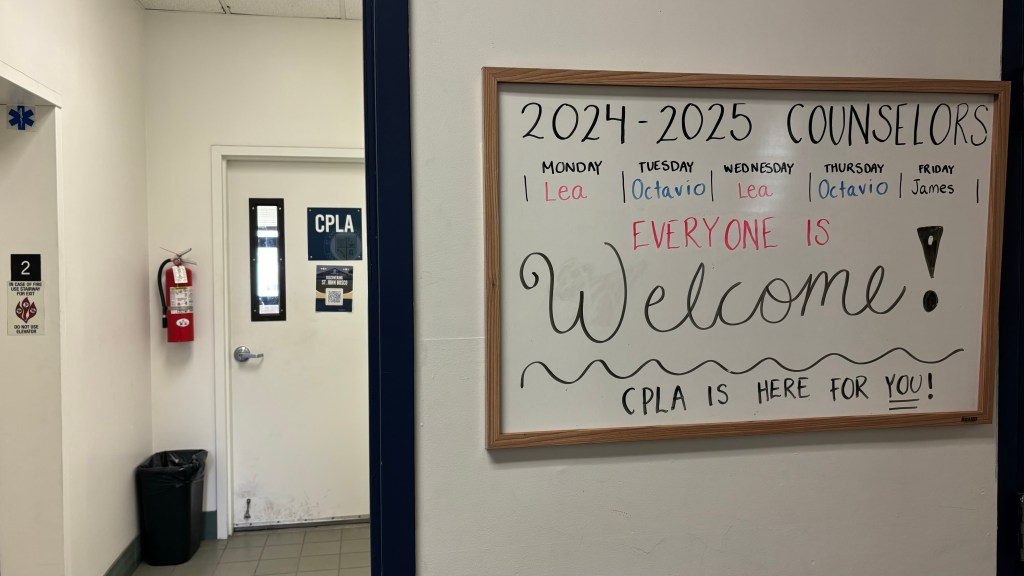
The CPLA counselor’s office is located within the 200 building on the second level and beside the elevator. The counselor in the office alternates each day, and there will be a different counselor there everyday of the week. There is no need to set a schedule with the CPLA counselors, all that is required is that you knock before you enter. It is open during school hours.
The academic counseling office, located on the first floor of the 200 building across from the Front Office is commonly open during break and lunch hours. You can always feel free to reach out to your academic counselor via email and schedule a time to meet.
Dr. Po’s office is located in room 238 on the third floor of the 200 building near the center of the hallway. You can knock or enter if the door is open to talk about mental health or spirituality.
All of these sources are avenues for any students who want to talk about their mental health or get help in general.
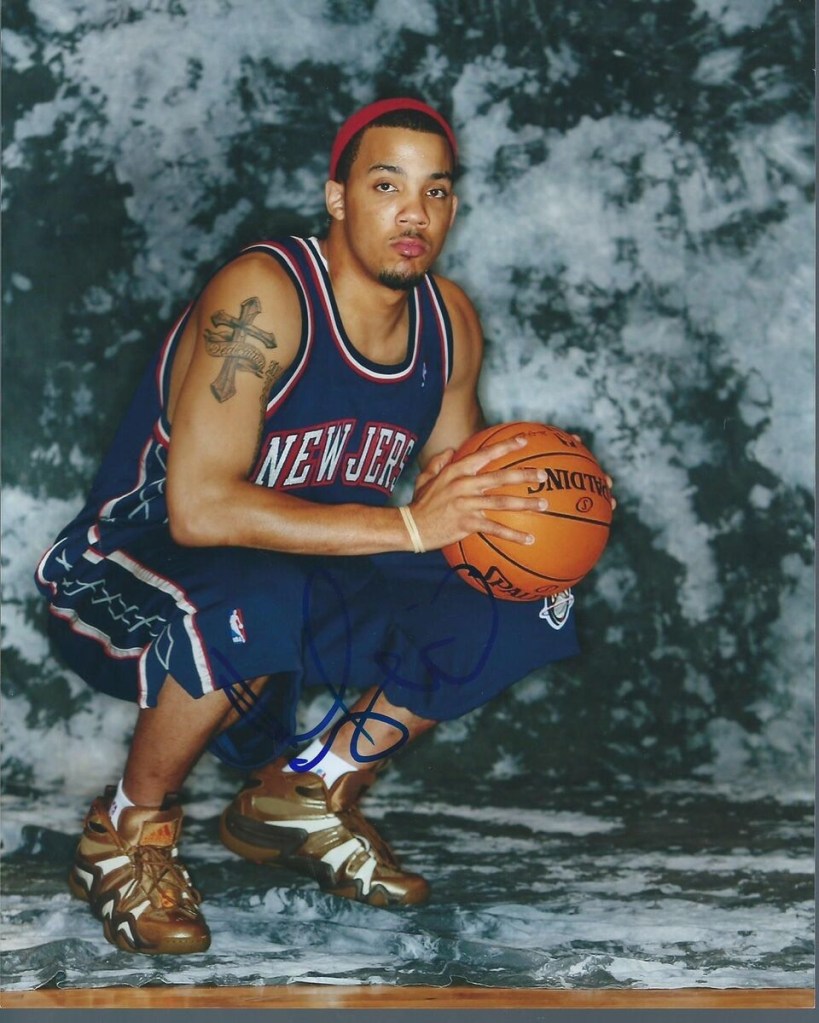
Mr. Marcus Williams, referred to as “Coach Williams’’ by students and faculty, looks to step into the St. John Bosco spotlight as the new Dean of Students after spending the last two years serving an off-campus assistant coach for the varsity basketball team. Following a fruitful career playing in the National Basketball Association (NBA) and across Europe, Coach Williams looks to make an impact at Bosco on and off the court.
Photo by Jesus Biag, co-Editor-in-Chief
Coach Williams was born and raised in Los Angeles, where he attended Crenshaw High School. He attended Crenshaw from his freshman year all the way through the end of his junior year. While at Crenshaw, he excelled in the game of basketball and became a nationally ranked prospect.
As his basketball prowess soared in his final year of high school, he moved across the country to Mouth of Wilson, Virginia, where he attended Oak Hill Academy. Oak Hill is considered a prestigious boarding school, reputable not only for its academics, but for its basketball program’s achievements. Oak Hill has been the catapult for the professional careers of NBA legends such as Kevin Durant and Carmelo Anthony.
Coach Williams called it a “no-brainer” when the opportunity presented itself to play at a level he had only dreamed of as a young athlete.
His 12th grade season on the court launched him into early stardom. His play would eventually lead him to receive a scholarship to the University of Connecticut (UConn). At the time of his scholarship opportunity, UConn was at the highest level of collegiate competition in the sport of basketball.
“Choosing to attend UConn was an easy decision for me. UConn’s basketball program has always been at the top and has a history of success,” said Coach Williams. “As someone who’s been on the court at the highest levels, I appreciated a program that valued excellence and had a record of producing both players and teams.”
Coach Williams officially committed and was on the finalized roster for UConn’s 2003-2004 Men’s Basketball team. However, he was no stranger to self-inflicted adversity. He shared an incident in which he was suspended from the team for a short amount of time for not upholding a sufficient grade point average.
“When I look back on my freshman year at UConn, I see it as a mix of both challenges and motivation. It was easy to get distracted and overwhelmed by college where the expectations were both high on the court and in the classroom.” Coach Williams said. “It was a tough year no doubt, but it taught me about resilience and time management. I felt the lessons I learned then carried over into life outside of basketball.”
After struggling to adjust to college life as a notable athlete his freshman year, he was able to achieve some remarkable accolades the following year. At the conclusion of his sophomore season, he was named the Big East Most Improved Player.
After coming off a stellar season in his sophomore year, Coach Williams was knocking on the door to achieving his dream of playing in the NBA. His junior season was his biggest in terms of production on the court.
He averaged 12.3 points, 8.6 assists and shot 86% from the free throw line. In a game against Notre Dame, he recorded the sixth triple-double in UConn basketball history when he scored 18 points, dished out 13 assists and grabbed ten rebounds.
In the 2006 NCAA March Madness Tournament, he averaged 20 points, 8.8 assists, while shooting 52% from the field, 56% from three-point range, and 96% from the free throw line. Coach Williams scored a career-high 26 points in a memorable 98–92 overtime Sweet 16 win against Washington on March 24, 2006.
Coach Williams’ time playing basketball at UConn reached an end after the NCAA tournament, where he and his team would suffer a heart-breaking overtime loss to George-Mason University, 86-84.
But as the door for college basketball began to close, his aspirations to continue playing at the next level flourished. He opted out of his senior year at UConn and declared for the 2006 NBA draft.
The New Jersey Nets selected Coach Williams with the 22nd overall pick in the first round. During his time on the team from 2006 through 2008, he shared the court with NBA Hall-of-Famers Jason Kidd and Vince Carter.
Following his two-year stint with the Nets, Coach Williams would end up playing for the Golden State Warriors for a season and the Memphis Grizzlies the following year. His time in the NBA would ultimately end in 2010, but the opportunity to keep playing basketball presented itself once again.
In August 2010, Coach Williams signed a one-year contract with the Russian team Enisey Krasnoyarsk. Quickly becoming the leader of his new team, he helped Enisey qualify for the playoffs for the first time in the club’s history. He was named “Player of the Month” in the Russian PBL League in November and December and was also selected to the All-Star 2nd team.
There was a great transition between the NBA and overseas for Coach Williams, both mentally and physically.
“The change from the NBA to Europe was pretty wild both on and off the court. Physically the games are different in terms of pace and style. You don’t see the same amount of flash as you do in the NBA. European teams play a bit slower and put an emphasis on fundamentals,” Coach Williams said.
“Mentally, the adjustment was more about lifestyle. It was a huge cultural shock: different food, different languages, and the overall vibe was different. But it was a great change embracing new experiences and learning a new style of basketball.”
For the next eight years, Coach Williams went back and forth from playing basketball on teams in Russia and Asia. He would officially end his time playing professional basketball after his 1 year contract for the Stockton Kings in the NBA G-League.
“I started thinking about [life beyond basketball] pretty early on,” Coach Williams said. “I felt like it was a smart idea to have somewhat of a plan in store. I was set on giving back to the game as well as school. I felt like based on my own experiences I can be a beam of support for the youth.”
After years of being removed from the sport as an athlete, Coach Williams now puts emphasis on the balance of being a student and an athlete. The strength to excel in both is found in one’s “ability to to maintain focus and energy,” he says.
He’s found a new life now hired as Bosco High School’s Dean of Students and assistant varsity basketball coach.
Fellow assistant coach and English instructor, Mr. Vince Vigil, believes that Coach Williams will bring a great contribution to the school.
“I believe with his world experience and stout professionalism, he will be able to bring a new sense of discipline amongst students and reinstate what the Bosco brotherhood means. Having a role model like Coach Williams goes beyond just the basketball court,” Mr. Vigil said.
Junior Dominic Perfetti, a member of the varsity squad, believes that Coach Williams will have an impact both on campus and on the court.
“Having the opportunity to be under a mentor like that is huge. I feel like he can be more personable with students than deans we’ve had in the past. On the court though, coming off a state title, having him as a coach really proves to us there are no limitations on our team’s expectations,” Dominic said.
Coach Williams looks to make an immediate impact on all of Bosco. He calls it a “full circle” type of opportunity, finding himself just a dribble away from Los Angeles where his love of basketball first began.







 The Brave News