Category Archives: News/Op-Ed

News/Op-Ed: The History Behind Israeli and Palestinian Conflict

by Josue Sanchez, co-Editor-in-Chief

The recent ceasefire in the regionas well as its collapsehas been a result of tensions simmering for several decades. How did these tensions begin, and how have they changed over time?

Edited photo. Original by Mohammed Salem at Reuters

The escalation in the Israel-Palestine conflict that began in October 2023 has been a significant affair in the realm of recent global events. Since October 7th of that year – when Hamas, the main Palestinian nationalist group operating in the Gaza Strip, sent a barrage of attacks against Israel – about 72,000 people have been reported missing or dead due to the conflict, with the vast majority on the Palestinian side.

Most recently, on January 19th, Israeli Prime Minister Benjamin Netanyahu agreed to a ceasefire between Israel and Hamas, mediated by the nations of Qatar, Egypt and the United States.

This ceasefire lasted approximately two months before, on March 18th, Israel resumed ground and air campaigns against the military forces in the Gaza Strip, escalating the conflict further.

This recent situation—as well as the broader conflict—can be understood best by diving into the history of the region, and how these conflicts have evolved over time.

The conflict over the region begins with culture—the nation of Israel is a predominantly Jewish state, which has claimed the region as its own for several decades, citing its historic links to the land under Jewish belief.

For centuries before that, however, there had been a large Arab majority in the area. This region had been mainly Arab, even through its occupation by the Ottoman Empire in the early twentieth century. By 1915, both populations had some representation in the area.

The situation escalated, however, upon the arrival of the First World War in Europe and the Levant. The Ottoman Empire now found itself as an enemy of the Entente powers, including the United Kingdom. As such, the territory was occupied by the UK. In order to gain support during the war, the UK decided to issue the Balfour Declaration in 1917, which guaranteed the creation of a Jewish state in what was then known as Palestine.

This began tensions amongst the people who already lived there; however, the UK still promised that there would be an appropriate solution for both peoples.

After the end of the war, the territory was consolidated into the British Mandate for Palestine—the territory would be run by the United Kingdom, whilst adding parts of the Balfour Declaration.

Nearly 30 years after the Balfour Declaration, after the end of the Second World War, the status of the region was reorganized once more. Following the atrocities carried out by the Nazi German government against European Jews, many Jewish refugees had since migrated to Mandatory Palestine, leading to the resurgence of a Zionist movement—one advocating for the creation of an actual nation-state for the Jewish population.

In 1947, the United Nations (UN) drafted a plan to divide the nation. The plan would create both Jewish and Arab states, each having approximately half the land in the region. By 1948, the State of Israel was established, and conflict immediately began with the Arab-Israeli War that year.

By 1949, the newly founded state was able to control and defend its claimed territory.

From that point, the two peoples became pawns in the Cold War that emerged after 1945 between the United States and the Soviet Union. Specifically, the Six Day War in 1967 allowed the US-backed State of Israel to expand its territory, and the later Yom Kippur War put it in conflict with other neighboring Soviet-backed Arab states.

Throughout this time, the state also occupied formerly Arab (now Palestinian) territories. The two main tracts of land, the Gaza Strip in the west and the West Bank in the east, have been surrounded by the State of Israel.

The nation was also allegedly encroaching on Palestinian land within these tracts, which would be illegal under the 1947 decision by the UN.

During all of these conflicts, the Palestinian Liberation Organization (PLO) was founded, seeking to achieve the creation of a Palestinian state in the region. It used both diplomatic and military plans in order to achieve this goal. Hamas was also formed in the 1980s, as another military organization with a similar goal.

Conflict reached a high point in 1987, when a popular uprising sprung up against Israel, specifically in Palestinian territories. This happened after the increased occupation of Palestinian territories by Israeli forces and lasted six years. Organizations like Hamas, as well as various smaller groups, were heavily involved in the conflict, which was called the First Intifada (coming from Arabic “انتفاضة,” meaning “uprising.”)

The situation changed during the 1990s. Three years into the decade, the Oslo Accords were agreed upon, establishing a process of peace between the two sides and ending the First Intifada.

The Accords also agreed upon the creation of the Palestinian Authority, a government body that would control Palestinian territories for five years, after which official discussions would once again be held to decide the situation.

However, the Accords did not result in any long-lasting peace between the two sides, and the troubles continued. In 2000, the Second Intifada began, once again worsening tensions between both sides. The Intifada would continue on for five years before peace was made between Israel and the Palestinian factions.

By 2007, Hamas would occupy the entirety of the Gaza Strip, wresting it from the Palestinian Authority which managed the West Bank.

The situation has remained tumultuous since then, with numerous peace deals proposed, yet never enacted. It is inaccurate to say that the conflict has a simple solution, and it is likely that we will see the impact of these recent escalations, as well as the larger conflict, for years to come.

News/Op-Ed: Defiance Arises In L.A. With Protests Of President Trump’s Deportation Policies

by Andy Ortiz, Managing Editor, and Nicholas Valenzuela

Immigration and Customs Enforcement (ICE) officers have been sent throughout the country in a sweep of deportations started by President Donald Trump. In the city of Los Angeles, people have been feeling the effects of deportations, and protests have risen in response.

Photo by Eric Thayer, Associated Press

Nearly as soon as he took office, President Trump signed executive orders sending ICE officers throughout various cities in the United States with the goal of finding and arresting illegal immigrants to send them back to their countries.

Mass deportations have mostly been taking place in large sanctuary states such as California, New York and Arizona. The main cities being impacted by ICE raids have been Chicago, Dallas and most notably LA.

The amount of arrests and deportations have spiked under the new executive orders. The Associated Press reports that the average daily ICE arrests under former president Joe Biden were 311 in one year. In the first week of ICE raids, they have reported that the numbers have gone up to 710 daily immigration arrests.

The local LA community has felt the deportations most heavily because of the high immigrant population in the city. According to the California Community Foundation, immigrants make up about 35% of the whole city.

A clinical social worker, who works at a hospital in the L.A. area, has expressed very deep sadness for the distressed families that have been going through heaps of fear and confusion due to the public operations of ICE.

“We have definitely witnessed the fear and uncertainty in the lives of our patients,” said the social worker. “Our social workers are asked daily by patients about how this will impact the care of their children.”

The social worker says that more families have been coming to her expressing worry that they may be stopped and even arrested by immigration officers, scared over the frenzy being caused by the deportations.

“When I see the names and faces of the children, it brings profound anguish. I can only try to imagine how scary it must be,” said the social worker.

With the deportations greatly affecting the L.A. community, many people have expressed various opinions about whether they are justified or not. Bosco parent and police officer, Anthony Valenzuela, believes that the law should be followed when it comes to legal immigration.

“Those who are here illegally and that have been here some time have had ample opportunity to start the process of becoming a U.S. Citizen or apply for resident status,” said Mr. Valenzuela. “I have empathy for those who are here to work and live a better life, but the laws we have exist for a reason.”

Due to President Trump’s deportation policies following his inauguration, protests erupted across the country, most notably in Los Angeles where a protest took place on 101 Freeway.

According to The Associated Press, the protesters gathered on Olvera Street, a historic street showcasing Mexican culture, before marching to City Hall blocking the 101 Freeway for several hours.

Some of the rhetoric they used included chants like “nobody is illegal” and “immigrants make America great.” Bosco senior Luiz Azamas attended the protest.

“I went to fight for people like my parents who are hard working individuals who want nothing more than a better life for their family,” Luiz said.

There have been many different opinions expressed on the major protests happening in LA. Mr. Valenzuela believes that as long as protests remain peaceful, citizens should feel free to stand up for what they believe in.

“Once people who are protesting become violent and vandalize property, the laws that protect them protesting, now become laws that can incarcerate them,” said Mr. Valenzuela. “I support lawful protests; it’s part of what makes America great.” 

The clinical social worker also believes in the freedom to peacefully protest, but worries that people may use it as a shield to cause more chaos and violence.

“​​In the past, unrelated opportunistic groups hid in these protests and caused chaos and violence,” said the social worker. “Ultimately, the freedom of expression shouldn’t be silenced as long as it’s done in a safe manner.”

Despite protests, President Trump and his administration has not slowed down the deportations of illegal immigrants, and most likely will not back down anytime soon.

News/Op-Ed: Daylight Saving Time – Why Do We Have It?

by Cuahutemoc Solorzano

What’s the point of daylight saving time (DST)? Will it still be here years from now, and when was it implemented?

At the start of daylight saving time, the clocks are sprung forward an hour. Then, at the end of DST, the clocks are moved back one hour – to their original position. 

The foundation of daylight saving time was created by George Hudson, a New Zealand entomologist. He argued to the Wellington Philosophical Society that more time in a day would allow individuals more time for activities. In Hudson’s case, he wanted to have more time to collect his insects, according to the BBC

Hudson was initially rejected, and it wouldn’t be until World War I that daylight saving time would be established in the US. Daylight saving time has a complicated past. It was implemented and repealed various times, and certain aspects of it have changed. 

Because of daylight saving time’s complicated past, many individuals are wondering why it is still implemented. However, there is debate whether or not daylight saving time should still be implemented within the US.

According to a survey conducted by the American Academy of Sleep Medicine conducted in 2020, 63% of US citizens prefer daylight saving time to be abolished.

Initially, daylight saving time was implemented across the US in order to conserve energy and increase efficiency during war time, according to Newsweek. 

However, daylight saving time practices across the US have only saved 0.5% of energy usage, according to a 2008 report from the US Department of Energy.

A study in 2005 by the Massachusetts Institute of Technology says there was a seven-percent decrease in crime with days with more natural light. 

According to the American Academy of Sleep Medicine, the US should abolish daylight saving time due to it disrupting sleep habits. A disruption in sleep will cause an individual to become prone to certain health risks. 

Many individuals don’t enjoy losing an hour of sleep, especially since most lives revolve around a schedule that may become disrupted due to daylight saving time. 

The Uniform Time Act states that while the US is required to use daylight saving time, states are given the option to not recognize it. Yet, the Uniform Time Act doesn’t allow states that want to implement daylight saving time year-long, as it only allows states to use standard time year-round.

In the past six years, 20 states have passed legislation to have daylight saving time year-round. The state of Arizona (save for the Navajo reservation within it) and Hawaii do not recognize daylight saving time, according to Forbes. 

Daylight saving time began yesterday on March 9th, moving from 2:00 a.m. to 3:00 a.m. It will end on November 2nd, thrusted back an hour from 2:00 a.m. to 1:00 a.m., according to the Time and Date website.

News/Op-Ed: Year 2025 Commences With Series Of Tragic Oddities

by Josue Sanchez, co-Editor-in-Chief

The first quarter of the century concluded with the arrival of January earlier this year; however, it seems like there hasn’t been a single week without the emergence of some unusual event.

On January 1st, like every year, millions of people from both major cities and rural communities celebrated the arrival of the New Year. Many traditions were kept; fireworks lit up the skies of major cities including Auckland, Dubai, London and, of course, across cities in the United States.

Soon after the initial celebrations, however, the year has been beset with a barrage of notable (if for all the wrong reasons) events spanning across the first two months.

Many of these events have had a direct impact on the United States, and within the confines of Los Angeles county as well. Perhaps most notable in this regard was the outbreak of wildfires that sprang up throughout the county in early January.

The first of these was the Palisades Fire, which began shortly before noon on January 7th in the Pacific Palisades community in the west of Los Angeles. By the end of the day, the fire had spread across many of the region’s notable parks and landscapes, including Santa Ynez Canyon and Topanga State Parks.

Fueled by the power of strong katabatic winds, other fires began to pop up across the county. The Eaton Fire, named for its origin, the Eaton Canyon Natural Area near Pasadena, ended up consuming about 14,000 acres of land north of Pasadena, including the community of Altadena in the north of Los Angeles.

Several other fires began, the causes of which varied depending on the incident in question. By the end of January, most of the fires were placed under control, with the largest Palisades and Eaton fires finally being placed under 100% containment on January 31st.

Weather occurrences haven’t been limited to California, however. January was both a month of fire and ice, as shown by the snowstorms that swept the South in the latter half of January. On the 21st, the historic snowstorm engulfed much of the region, particularly affecting the states of Texas, Louisiana and Georgia, among others.

Major cities in the region, including New Orleans, LA and Mobile, AL were severely affected, halting road traffic across the cities, and according to the National Oceanic and Atmospheric Administration, this particular snowstorm broke snowfall records that had been kept for approximately 130 years.

Some speculate that this could be a sign of more drastic weather and climate events due to the impact of climate change.

2025’s unusual events haven’t been limited to the weather, however. Things began to occur since the very first day of the new year, as shown by the two vehicular attacks that occurred on New Years’ Day.

The first happened in the city of New Orleans, following New Years’ celebrations occurring in the very center of the city. Three hours after midnight (Central Standard Time,) a Ford truck rented by American-born Shamsud-Din Bahar Jabbar was driven into the city’s Bourbon Street, one of the most crowded parts of the city. There, 57 people were injured, with 15 additional people killed, including the perpetrator, who was killed after a shootout.

The second attack occurred approximately eight hours later across the country in the metropolitan area of Las Vegas, Nevada. At that time, a Tesla Cybertruck driven by Matthew Alan Livelsberger arrived at the main entrance of the Trump International Hotel. Shortly after it arrived, it suddenly exploded, killing Livelsberger and injuring seven others. 

Due to the timing of the two events, as well as some similarities in how they were conducted (involving the same car rental platform, Turo), initial reports proposed the idea that the two attacks were linked. 

However, more recent information seems to confirm that these two incidents were unrelated; the former was reported as a case of domestic terrorism while the latter was seen as a provocative political message, as it came mere weeks before the inauguration of the 47th President of the United States.

One of the more widespread trends, notable in the first few months of this new year, has been the rise of aviation incidents beginning in January. On the 29th, American Airlines flight 5342 collided with a Black Hawk helicopter operated by the United States Army near Washington D.C’s Ronald Reagan Washington International Airport. 

The collision happened in the skies over the Potomac River, likely due to a lack of proper communication between the two aircraft. As of March 2nd, it seems that both aircraft were aware of each other upon arrival in Washington; however, the aircraft did not maintain distance from each other, leading to a collision approximately 100 meters off the surface of the Potomac.

Unfortunately, all 67 passengers in both the helicopter and the American Airlines flight were killed.

While this was the first notable aviation incident seen across national news broadcasts in 2025, others have followed. As January turned into February, crashes occurred in both the city of Philadelphia (January 31st) and in northern Alaska (February 6th.)

Perhaps the most notable of these incidents happened on February 17th. On that day, Delta Connections Flight 4819, flying from Minneapolis, MN to Toronto, Canada, was flipped upside down upon its arrival at Toronto Pearson International Airport. This particular incident was likely caused by unfavorable weather conditions, although the incident is still under investigation. The incident had no casualties.

Many have linked these recent incidents to one of the actions taken against the Federal Aviation Administration (FAA). Shortly after the inauguration of President Donald Trump on January 20th, several hundred employees were fired from the FAA.

This year has already brought on a variety of unusual events within its first two months, and more is bound to come. If anything, the variety of odd events showcases how weird the start of this year has been — as well as how much weirder it could potentially become.

News/Op-Ed: Individual Games Continue To Shake Up The Scene

by Nicholas Valenzuela

Despite competition from gaming industry giants like Nintendo and Ubisoft, individual games continue to take over the market.

Photo by Steam

Gaming has become a large part of this world’s culture. It is no longer a thing for nerds who sit in the basement and play alone; it has become part of mainstream media. The gaming industry is absolutely massive and worth lots of money.

Unfortunately, companies see this and just want a quick buck, leading them to put out soulless slop disguised as games. On the contrary, independent game developers, called indie developers, have been flooding the scene with beloved games made with passion.

Since the beginning of 2024, there have been many high-profile flops for many game companies. One of the biggest companies to flop was Ubisoft, with their live service pirate game, Skull and Bones. 

Skull and Bones was said to be one of the first quadruple-A games. When It came out, however, it was riddled with bugs and microtransactions that annoyed the players of the game – especially since the game already had a high price. It drew inspiration from Assassin’s Creed IV: Black Flag

Following its release, a Ubisoft Executive commented that “one of the things [Ubisoft] saw is that gamers are used to […] having and owning their games. That’s the consumer shift that needs to happen.”

It sparked a lot of controversy online, with many online users feeling angry that the idea was suggested, with some even saying that “if buying isn’t owning, pirating isn’t stealing.”

Some of the most popular games of this decade, including League of Legends, Valorant, and Fortnite, are known as “massively multiplayer online” (MMO) games, which require live servers for online play. If the companies behind these games decide to shut down the servers, the games will be unavailable to players and users. 

For free games, this isn’t a huge issue. However, it becomes a huge disadvantage when users pay over $60 for a game only for it to be unplayable. 

Another controversy in the gaming world has to do with gaming subscriptions. These include Nintendo’s online subscription, which is needed to play certain multiplayer games on Nintendo consoles. If a user doesn’t opt into the subscription, they cannot play the game if it’s all multiplayer. Other game companies offer a monthly price for a library of playable games, costing $10-20 on average.

Modern gaming companies like Ubisoft and Nintendo often see games or series as cash cows, producing many games in the series in very little time. Most notably, Nintendo would often release a new Pokémon game every other year, and have now shifted to adding downloads called “downloadable content” (DLC), which adds even more money on top of the money users are already spending.

On top of this, sports games such as NBA 2K are known for very greedy behaviors when it comes to video games. Most sports games have a new game released every year, but the only notable changes to the games are the new name and updated rosters. People still buy the games, leading to the companies thinking that it’s acceptable to pump them out constantly.

The biggest competition to triple-A games aren’t other companies; it’s indie games. Indie games are often developed by a single person or a small team of artists, programmers and others. The big difference between indie games and complete games is the passion.

When indie games are produced, the work by a small team or a single person having to put in so much time, effort and money into a singular game shows in the result. One can feel the love and hard work put in, since these games focus on making fans happy, leading to huge groups of supporters for the developers. 

A good example of this is Stardew Valley, which came out in 2016. It was developed by one man, Eric Barone, and has sold over 41 million copies in its lifespan. Despite being an older game, it keeps receiving constant updates that have effectively doubled the playtime at no cost for the player. Although he’s working on a new game, Eric Barone continues to update his game and show love to his community.

Indie games really started entering the main scene with the game Lethal Company. Lethal Company is a cooperative horror game, where the player takes the role of an employee working for a company, going to abandoned moons of planets to collect materials to sell to meet an assigned quota. The horror of the game comes from the monsters that inhabit the moons and planets. They range from a bug who steals stuff from players to a giant robot who tries to blow the player up. The range of different enemies makes sure that something unexpected can happen in every play session.

The game quickly blew up and became an overnight hit, gaining traction as a fun game with friends, with many online content creators making content on the video game. Indie games often advertise through content creators, who often shine a huge light on games that would otherwise be shunned or hidden from view.

The Game Awards have a whole section dedicated to indie games, showing how indie games are making a wave in the gaming industry. The biggest stand out from The Game Awards in 2024 was an indie game and one of the biggest hits in recent history, Balatro.

Balatro was made by a single person in Canada. It takes inspiration from poker, having a standard 52-card deck and making the player use poker hands to get chips and defeat bosses. The player can edit the decks by adding or taking cards and can get jokers that improve the number of chips one gets.

It won three awards at the aforementioned ceremony: Best Independent Game, Best Debut Indie Game and Best Mobile Game. Additionally, it was nominated for two other awards. It was a huge success and gained traction very quickly for its addicting, surprisingly complex gameplay and the mesmerizing music. 

Indie games continue to shake up the gaming scene and show what true passion can lead to. It can lead to money and fame, but most importantly, it leads to millions of people enjoying one’s hard work, and that’s a beautiful thing.


News/Op-Ed: President Trump Inaugurated For Second Time, Promises ‘thrilling new era’

by Andy Ortiz, Managing Editor

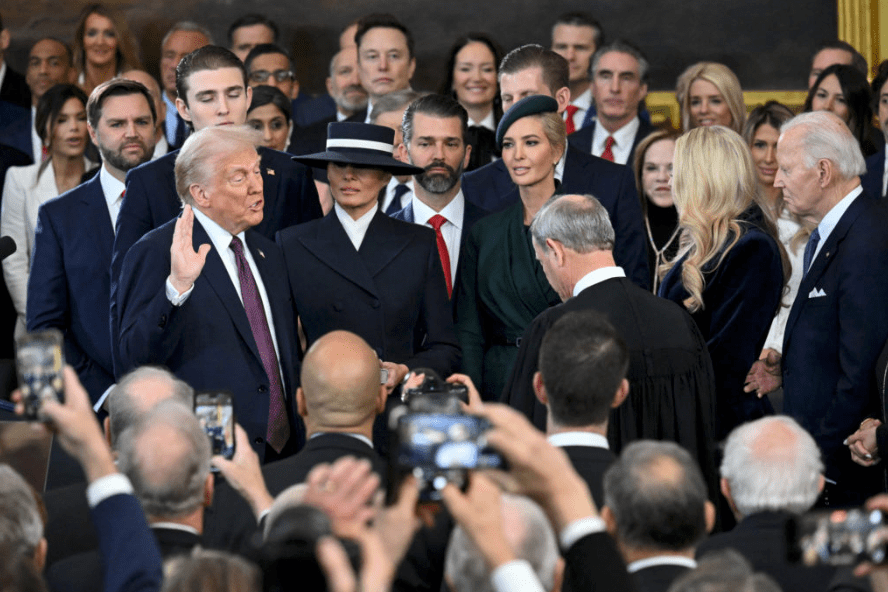
After a highly turbulent and climactic election, President Donald Trump was sworn in as the 47th President of the United States, promising an American golden age full of flourish and patriotism.

Photo by PBS News

Earlier this week, President Trump was sworn into office alongside his Vice President, J.D. Vance. The inauguration took place in the Capitol Rotunda, attended by all living former presidents.

Throughout his 2024 campaign, President Trump promised an end to inflation and high prices on groceries and gas, as well as stricter immigration policies.

“From this day forward, our country will flourish and be respected again all over the world,” said President Trump in his Inaugural Address. “We will be the envy of every nation, and we will not allow ourselves to be taken advantage of any longer.”

According to the Associated Press, most of his promises had to do with cutting prices on energy, increasing oil drilling, ending the Russia-Ukraine war, conducting large deportations across the country, imposing tariffs on imports from neighboring countries and closing the Department of Education.

Just hours after having taken office, President Trump already began signing dozens of executive orders and policy actions. His goal has been to redirect the government to, in his own words, “reclaim [America’s] rightful place as the greatest, most powerful, most respected nation on earth.”

The President has already fulfilled some of his major promises. According to the Associated Press, the President has signed orders withdrawing the U.S. from the Paris Climate Agreement, pardoning those convicted in the Jan. 6, 2021 attack on the Capitol and spurring more oil drilling projects.

Throughout the week, there has been progress on terminating state emissions waivers, bar refugees from Gaza and “uprooting the deep state.” All of these promises have been labeled as “in progress” by the Associated Press.

Alongside those actions, the President has also been focusing efforts on reducing the influence of diversity, equity, and inclusion (DEI) across the federal government. With that, Presidential actions have also targeted various climate change efforts.

As written on the official White House website, “Climate extremism has exploded inflation and overburdened businesses with regulation.”

President Trump has also revoked many Biden-era executive orders. These include many old COVID-19 response policies, as well as strengthening the Affordable Care Act and the establishment of a Climate Change Office. These and more are listed on the official White House website.

One of the biggest stops President Trump has put on the previous Biden administration was the closure of the Customs and Border Protection (CBP) One app. This app was used by the federal government to give legal pathways for asylum seekers, but was quickly closed under the new administration, leaving nearly thousands stranded at the Mexican border without an appointment to enter the U.S.

The second Trump presidency has been in power for just over a week, yet there’s no end in sight for the flurry of policies and presidential actions being signed. Some are concerned for potential future policy initiatives, while others have been more or less satisfied so far with the direction of the new administration. Only time will tell what other plans President Trump has for the United States in the next four years.

“I return to the presidency confident and optimistic that we are at the start of a thrilling new era of national success,” said the President in his Inaugural Address.

News/Op-Ed: Fires Continue To Rage In Southern California

by Nicholas Valenzuela

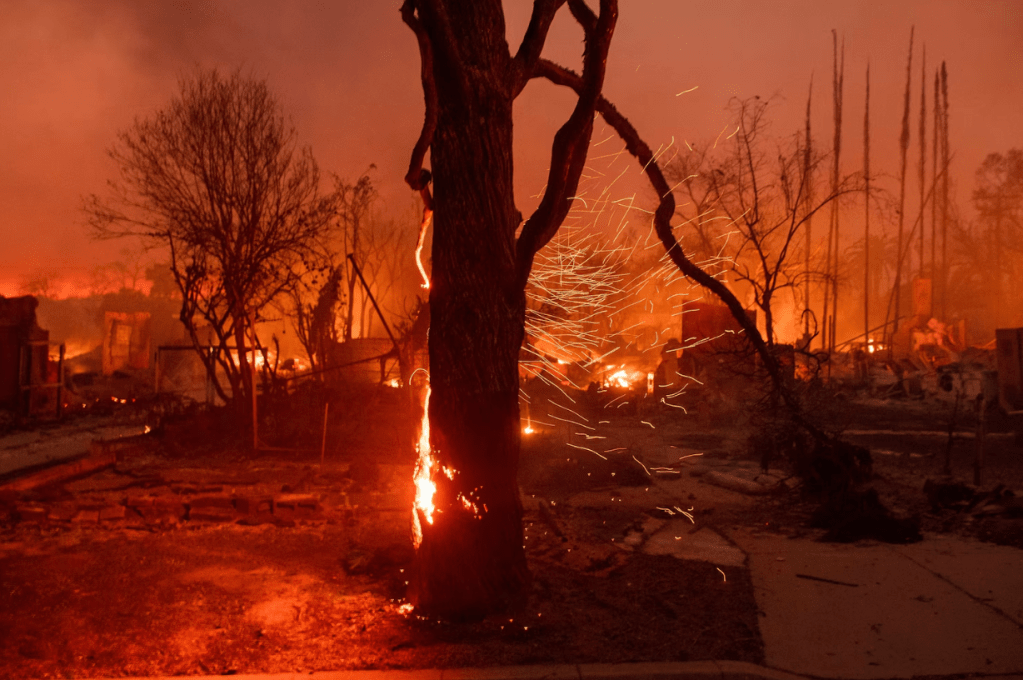
Despite local law enforcement and firefighters’ fervent efforts, California wildfires continue ravaging the mountainside.

Photo by ABC News

On January 7th, 2025, Los Angeles County experienced a daunting start to the new year with three separate wildfires raging in the area. The Palisades Fire, Eaton Fire, and Hurst Fire started, with the Lidia Fire and Sunset Fire starting the next day, January 8th. 

According to CAL FIRE, The main wildfire right now is the Palisades Fire, which has burned more than 23,000 acres with 39 percent containment. The Eaton Fire also has 65 percent containment with more than 14,000 acres burned as of now. The Hurst, Lidia and Sunset fires have been contained at the moment.

As of January 8th at 7:00 PM, at least five people have passed away, and more than 1,000 structures including homes, shops and other buildings have been destroyed, according to the Associated Press. As of January 17th, the number of fatalities has risen to 24.

One of the major factors in the fires were the Santa Ana winds, as California received a sudden windstorm, spreading embers and fanning the flames of the fire. According to NBC Los Angeles, the gusts on the morning of January 8th were reaching 60 to 70 miles per hour with mountaintop winds reaching up to 100 miles per hour. 

The Santa Ana Winds are unique to the Los Angeles and Southern California area due to the geography of the local area. The reason is that the Santa Ana winds are katabatic. What that means is that high-pressure air from up high on the mountain starts to flow down the mountain, picking up speed, much like how an avalanche on a snowy mountain works.

California’s mountainous terrain has allowed the winds to become a dangerous factor in the wildfires. They are one of the reasons this area is known for wildfires, creating a perfect, deadly recipe for wildfires to spread quickly and ravage the area, just as they are doing right now.

Something that has affected everyone is the smoke from the fires. The thick smoke has spread rapidly in and around Los Angeles County, lowering the air quality of the entire Los Angeles area. 

The wildfires emergency has also caused controversy in its wake. According to Forbes, the Los Angeles City Mayor Karen Bass had cut funding to the Los Angeles Fire Department (LAFD) by $18 million. The reason there is controversy is because of Los Angeles and California’s history of wildfires in general. It comes off as an ill-informed move to cut the funding to the LAFD. There will most likely be more information about this in the coming weeks after the fire.

While the Mayor is under fire because of this PR nightmare, it’s important to remember to stay safe and to take precautions. While the fires may not directly impact everyone, the ash in the air is harmful to breathe in; if you must go outdoors when the air quality is low, wear a mask and stay safe.

News/Op-Ed: Harris and Trump Let Down Independent Voters In Debate Of Style Over Substance

by Josue Sanchez, co-Editor-in-Chief

Last Tuesday’s Presidential Debate between current Democrat Vice President Kamala Harris and former Republican President Donald Trump presented competing perspectives for the United States going forward, especially as the Presidential Election on November 5th quickly approaches.

Photo by the Associated Press

This debate occurred in the shadow of the many significant events that have impacted the 2024 election cycle, affecting both parties involved in the debate.

On July 13th, there was an assassination attempt on former President Trump. On July 21st, current President Joe Biden withdrew from the 2024 presidential race, endorsing Vice President Harris as his successor. This occurred in the aftermath of the first Presidential Debate on June 27th, which was widely considered to be a poor showing on President Biden’s part. This drastically impacted the discourse around his mental acuity and affected his chances to win the race.

That most recent Biden-Trump debate seemed more like a spectacle, lacking the professionalism and content that a formal Presidential Debate should require.

Since then, Vice President Harris has rallied support for her campaign and chosen Minnesota Governor Tim Walz as her vice presidential candidate. Since the end of the Democratic National Convention (DNC) in late August, she has been able to maintain a level of support that President Biden could not attain, and her campaign generally seems to be stronger than what the president had to offer.

Many things have also occurred within the Republican Party, led by the former 45th President. Former President Trump’s appeal amongst the party has remained high even after his loss in 2020, an election that saw him earn more votes than he did in 2016 when he beat former Secretary of State Hillary Clinton. His opponent’s poor showing in the first Presidential Debate this year further maintained this appeal, leading him to be viewed as the favorite for a majority of the Summer.

His campaign has not been without tumultuous events, however. Earlier this year, the former president was charged by a New York jury on 34 felony counts of falsifying business records. He was, of course, also the target of an assassination attempt carried out on July 13th while holding a campaign rally in Pennsylvania.

On September 10th, former President Trump and Vice President Harris met at the National Constitution Center in Philadelphia to hold the debate, which was also the first time the candidates had met. The debate was moderated by current ABC News anchors David Muir and Linsey Davis, each with more than 15 years of experience in the field of journalism.

Across a span of 90 minutes, the two candidates were asked about topics ranging from the economy to foreign policy. The two candidates expressed their current stances regarding the ongoing conflicts in Gaza and Ukraine and presented visions for bolstering an inflation-ridden economy.

This debate presented a stronger image of American politics when compared to the last debate.

Still, it is impossible to not notice a trend that has persisted in the recent discussions even prior to the election: the lack of policies or discussions pertaining to them. This was generally present amongst both candidates, who were seen dodging specific questions pertaining to policies they wished to implement.

Current St. John Bosco High School Social Studies Department Chair and Instructor, Ms. Megan Fennell, watched the debate live. As an instructor of various history courses for sophomore and senior students, she observed this same lack of discussion regarding actual policies.

“It wasn’t so much focusing on policy or procedures,” said Ms. Fennell. “It was all about who could get the soundbite.”

She also commented on the relative lack of fact-checking that occurred on the debate – on both sides.

Some of the exceptions to this general theme included Vice President Harris’ closing statement, where she gave a vague idea of the types of plans she would implement into her campaign.

Echoing the struggles that Americans have faced in the past four years, she said she intends “to create an opportunity economy, investing in small businesses, in new families, in what [the Democratic Party] can do around protecting seniors, what [the Party] can do that is about giving hard-working folks a break in bringing down the cost of living.”

Despite this, both candidates stayed away from mentioning specific policies. Rather, they appealed to the broader themes that exist within each of their political parties.

Vice President Harris, for example, continued the Democratic Party’s strategy by emphasizing the potential issues found within the opposing Republican Party. This can best be seen with the extensive mention of “Project 2025,” the 900-page document made by the Heritage Foundation, outlining many of its future policy aims.

These beliefs have been considered outrageous and threatening by Democrats, making Harris’ use of the document effective among her base of support. However, former President Trump has not endorsed the project, distancing himself from its more radical proposals.

“What you’re going to hear tonight is a detailed and dangerous plan called Project 2025 that the former president intends on implementing if he were elected again,” the vice president said.

She also attempted to showcase the issues within the opposing party, citing examples of actions that the former President took when he was in office.

This, again, seemed effective at capturing her core audience—Democratic voters—by trying to showcase the potential dangers that could result from the Republican Party gaining power. Her appeals to emotion and anecdotes also helped in reaffirming the beliefs of Democratic voters.

Some, however, have seen these appeals as not enough to sway independent voters over to her side, as many felt that her performance lacked the additional policies needed to earn pivotal votes in swing states.

Former President Trump took a similar strategy when it came to the debate, despite more bombastic execution. His emphasis was also mainly based on attacking the opposing party. However, much of his attention was directed towards President Biden, in an attempt to tie the vice president to the unpopular administration to which she currently belongs.

This was especially noticeable toward the end of the debate when the former president stated that Vice President Harris was trying to distance herself from President Biden and his policies to positively impact her image.

“She is Biden. She’s trying to get away from Biden,” said Trump. “I don’t know the gentleman, she says. She is Biden.”

This approach also resonated well within his base of support. In the months prior to the debate, issues regarding the economy have plagued President Biden’s approval rate. Due to the relative recency of Vice President Harris’ campaign, this strategy was one of the more effective things they could do to retain their voter base.

Former President Trump also emphasized the economic and immigration issues that have occurred under the Biden Administration.

This debate was not without its tense moments. At approximately 25 minutes into the debate, before the candidates began their discussions regarding immigration, both candidates talked over each other, trying to counteract the statements made by the other candidate regarding abortion issues.

A majority of pundits have assessed Vice President Harris as the victor last Tuesday, but in large part due to her style. That being said, it is unlikely that the debate will change the minds of many across the nation, given the overall lack discussion around policy.

Both candidates doubled down in favor of a more emotional, persuasive approach, which led to both candidates trying to fault the other side constantly. This type of debate tends to favor the rise of partisanship, where both candidates appeal to their loyal fanbases and leave independents voters feeling ignored.

By now, most eligible voters are committed to voting for a particular candidate, and the few independents that remain would likely have not been fully captured by either side as a result of the lack of concrete ideas for voters to assess.

Despite its somewhat anticlimactic short-term results, the second Presidential Debate of 2024 still presents a view into the future of elections in the United States—a view which shows greater reliance on partisan ideas, groups and identities to gain the favor of voters. This is something important to watch, especially as the people of the United States become more affected by the polarization entrenched in our political systems.

Ms. Fennell is one voter that hopes for the emphasis on policies to return.

“We can go back to focusing on the facts, focusing on policy. Essentially being grown-ups, even if it is boring.”

New/Op-Ed: AI “Art” Stealing From Real Artists – Why Should You Care?

by Andy Ortiz

As Artificial Intelligence (AI) has improved over the past few years and exploded in popularity on the internet, it has been used more and more to create artificial “art” that steals from human beings’ work. As a result, AI is becoming a tool to replace human ingenuity, though it could be used as a tool for advancing it and keeping art uniquely human.

AI isn’t a new thing, you could trace it back to the first computers, and there were functional programs that behaved as assistants for people. 

Now, we’re in the year 2024, and AI has gone far past that. You’ve probably heard of fun programs like ChatGPT or Midjourney. They are generative AI programs that can generate responses and images, respectively, according to what a user prompts it to create. It started as a fun thing, and it should have stayed a fun thing.

But starting in 2022, as services became popular, many issues began to form. You see AI “art” running rampant on social media sites such as X (formerly Twitter), where prominent accounts pump out AI images every other hour while people eat it up.

It isn’t just popping up in internet culture, however. About a month and a half ago, there was an incident that went viral. “Willy’s Chocolate Experience,” an event inspired by Willy Wonka, was a supposed “real life” experience targeted for children that was advertised with AI imagery. It falsely advertised a “fantastical dreamscape,” but it ended up just being an empty warehouse with a highly underwhelming display for its high admission price of $40.

Why is this such a bad thing though? St. John Bosco High School’s animation teacher, Mr. Issac Sanchez, understands the pressing implications.

“It’s quite disheartening. The industry as a whole already struggles with workers rights and artist compensation issues,” said Mr. Sanchez. “So to see something emulate an artist and take the place of human work feels as lazy as the change that is promised for those working conditions.”

In today’s world, visual artists and writers aren’t being given that much importance anymore. In a bygone era, the process of creation was so long and arduous that you would have to pay artist and writers for that time. Nowadays you don’t have to pay anyone because AI can make something that looks appealing in a matter of seconds. Demand for 2D artists was already six feet under, and now it has fully ascended into the afterlife.

The moral implications of this issue have a lot to do with what art is supposed to be, namely a human endeavor. Art is supposed to evoke a reaction and emotion in someone. It takes a lot of time to create something that stands out and means something, coming up with ideas to project your intentions on a canvas, paper or digital screen. Art is something that exists everywhere. Bosco art teacher, Mr. Tommy Johnson, recognizes up how prevalent art is in our daily lives.

“Art is everywhere and in everything! From our clothes to our homes, not just what we hang on the wall, but the walls themselves,” said Mr. Johnson. 

Things you think aren’t art actually are. Architecture is art. The vase that holds your flowers has a beautiful design that was made by an artist. Pottery and ceramics possess creative and colorful designs. Carpets are full of colors and unique designs and patterns that serve to present your house in a bright and, most importantly, uniquely human way.

Art is a timely process, AI generated images give you a breathtaking piece of “art” from a glance, but you couldn’t say you feel much from it. People should begin thinking about whether art simply exists for you to see it once to say, “Wow, that’s so cool,” or if it’s here to ultimately serve as a symbol of human ingenuity.

Although, one may well think that if AI images are so prevalent in today’s internet culture, they must certainly be good. But that’s not exactly the case. AI, in general, takes from anything and everything on the internet to create a response or generate an image. One piece of an AI canvas takes from many random peoples’ works to suddenly create one singular this piece of artwork that is really a discombobulated mixture of other peoples’ works.

“AI art is only as good as the art it emulates. Those ‘cool’ images were definitely made from the borrowed ideas of others. However, unlike the human concept of homage, this is purely analytic and not based in admiration,” said Mr. Sanchez.

Artificially generated imagery can only get as good as how real people can do it. You could look at an AI “artwork” and not tell the difference. But as with any bad artworks, if you look far away enough and squint your eyes it looks like a masterpiece. On closer inspection, however, the fingers go every which way, the background details smush into each other, the lighting is so intensely bright and the texture is weirdly plastic. Yep, that’s AI.

“An AI artist and I did the same athlete and my art took a month. Yet his took an hour. Both pieces were great, to me the difference between my art and AI is the texture. At least with my art,” said Mr. Johnson. “The question is: what does the consumer like or can afford?” 

Since AI imagery is becoming more commonplace, do people actually care about the implications of AI? Obviously not. In the age of social media and the world wide web, people want results quicker. We don’t have time or the want to sit down and practice drawing everyday to get good at it, so why should we? There’s the option to ask Midjourney to make a painting for you at the snap of a finger.

“I think the new generation wants results right away. Thinking of new ideas fast, quick and easy. And they slap a price on it and call it art,” said Mr. Johnson.

For a concerning amount of people, it doesn’t really matter if the AI images have slight imperfections, if they are done quickly and look good at a glance it works. This problem with AI goes far beyond just the realm of art and creativity though.

“Why replace the entertainment industry when you can replace the news, or government, or the historical contexts of visual imaging. It will be used to push artists down, much like the music industry has been benefiting. But I think in practice, it’s beyond the realm of ‘art’,” said Mr. Sanchez.

You can see artificial intelligence in other places too. On social media, there are new and improved deep fake videos of influencers used for scamming. In school, students use ChatGPT to generate essays out of thin air, taken from all sorts of sources throughout the web. We made AI into an everywhere issue, and at this point, there’s no getting rid of it.

“AI has already replaced the real artist because it can be done in a second,” said Mr. Johnson.  

So instead we can start to remedy the problem by overturning our use of generative programs from stealers to assistants.

“I do think it could supplement a visual development cycle, much like the ‘mood board’ does. It’s visual media that is in the early stages of development,” said Mr. Sanchez.

For example, one may generate an image to use as a reference photo, or spend time correcting the mistakes that the image has to make it truly their own. Originality comes from taking inspiration from something that exists and making it in your own style. While bearing that in mind, if more people could use artificial intelligence with more honesty and responsibility, we wouldn’t have to worry about fake imagery and the potential end of human art.

News/OP-ED: The Catholic World Mourns The Tragic Death Of Bishop David O’Connell

by Brett Baligad, Senior Editor

The late Bishop David O’Connell presided in Los Angeles for over forty years and brought relief to underrepresented communities. The Irish native used his platform to serve the Los Angeles community and manifested Catholic values throughout his respected pastoral career.

On Saturday, February 18, Auxiliary Bishop David O’Connell was found dead in his Hacienda Heights home with a gunshot wound to his upper chest. This discovery was made apparent as Bishop O’Connell was found unresponsive to a fellow deacon attempting to contact him. The accused murderer, Carlos Medina, is the husband of one of Bishop O’Connell’s longtime housekeepers and is being charged with first-degree murder.

The recent tragedy to the Catholic community has garnered much support from parishioners across the county. Over the past week, hundreds of people have paid their respects to Bishop O’Connell by hosting prayer services and placing flowers outside his Hacienda Heights home. Along with this, prominent Los Angeles Catholic icons have expressed their grief for the death of Bishop O’Connell.

Archbishop Jose Gomez released a statement saying, “Every day [Bishop O’Connell] worked to show compassion to the poor, to the homeless, to the immigrant and to all those living on society’s margins. He was a good priest, a good bishop and a man of peace. And we are very sad to lose him.”

Born in 1953, Bishop O’Connell lived a life of service and empathy to the people of the Greater Los Angeles Area. Beginning his pastoral career in 1979, the Irish immigrant served as an associate pastor for nearby St. Raymond Catholic Church in Downey, California. After assisting other parishes over the years, it would not be until 1988 that he would head his own church, St. Frances X Cabrini, in South Los Angeles. From there, he would serve St. Frances X Cabrini and other South Los Angeles parishes for the majority of his pastoral life. 

Using his platform, Bishop O’Connell fought on issues regarding workers rights, gun violence and immigration. Most notably, Bishop O’ Connell helped mediate racial violence and gang activity in his community. During the Los Angeles Riots of 1992, he was a key contributor to help rebuild his community. One way he achieved this was by rebuilding the relationship between his community and law enforcement.

“That was part of our work as a Church, to try to provide spaces for conversations. And we thought we really had achieved a lot of progress. There was a trust built up between LAPD and residents,” said Bishop O’Connell in a 2020 interview with the Angelus News.

Being named bishop was not a role he always had in mind for much of his pastoral career. As a man for the people, Bishop O’Connell felt that his work was best fit on the front lines with the people that needed his support most. This is emphasized by the fact that the Irish-born pastor is fluent in Spanish. By speaking Spanish in a heavy Latino region, this was one more way Bishop O’Connell demonstrated relatability to his parishioners. In 2015, he proudly accepted the role of Auxiliary Bishop for the San Gabriel Region.

Bishop O’Connell was known by many within the Salesian community. Over the past three years, Former Salesian Provisional and current Spiritual Director of St. John Bosco High School, Fr. Ted Montemayor, shared membership on Don Bosco Technical Institute’s school board with Bishop O’Connell.

“He was very interested in assisting Don Bosco Tech because of its Salesian values and the uniqueness of the school. His goal was to help bring financial aid to kids that needed it and wanted the opportunity to get a Catholic education,” said Fr. Ted.

Don Bosco Technical Institute is St. John Bosco High School’s brother school located in Rosemead, California. Being the Auxiliary Bishop for the San Gabriel Valley, Bishop O’Connell found it to be a great necessity to continue the growth of an all boys learning environment along with the unique STEM learning integrated within the school’s curriculum.  

Bishop O’Connell’s legacy in the Catholic world will not go forgotten. Over the past week, parishioners have flooded social media with personal stories and interactions with Bishop O’Connell over the years. All stories aligned in agreement with his willingness to help the needy and sense of humor. O’Connell was not only an iconic Catholic figure, but also a well respected man within the Los Angeles area for all of his philanthropy performed over the years. 

“He [O’Connell] was a humble man and a good listener. He was not afraid to be vulnerable, which not every leader has the capability to do. David really had a care for helping the poor, the immigrant and the kids,” said Fr. Ted.

On Friday, March 3, a funeral mass will be open to the public at the Cathedral of Our Lady of the Angels in Los Angeles at 11:00 am. 

« Older Entries