Colorado has been going through three of the worst wildfires in the state’s history, damaging structures, more than 300 homes, and approximately $195 million dollars worth of damages.
Smoke mixed with blazes of fire drift through the trees and skies from the East Troublesome Wildfire making its way through the town of Granby on Thursday, Oct. 22.
The Colorado Fires started on August 13th and have continued to get worse due to the hot and dry weather. Although the cause of the actual fires is still unknown, it is currently being investigated by Colorado officials.
Last week state officials mentioned that the East Troublesome Fire was burning through a build-up of “beetle-killed” pine trees that were boosted due to the weather conditions.
These three wildfires are the three largest to date in the state’s history. The fires have taken place in areas where beetles have already been through. There is speculation and evidence that these beetles have been playing a role in accelerating the wildfires by leaving dead trees, which help contribute to the rapid spread of flames.
However, the real enemy of forests is the changing climate, which is likely the reason behind these devastating wildfires in the state of Colorado and elsewhere.
Due to the hotter and drier climate, more beetle infestations are also contributing to the start and spread of wildfires. Without change, the problems will only become worse with wildfires like the ones seen in Colorado only being the first of more to come.
In good news, the wildfires were not as active on Sunday with the Cameron Peak fire remaining at 208,663 acres and is now up to 64% contained, and the East Troublesome fire remaining at 193,774 acres and is now up to 37% contained.
Due to the recent wet and snowy conditions, the firefighter’s lines are holding up even as winds increase. As the new-fallen snow melts, firefighters will now be allowed to move into areas that were inaccessible before and will be able to work in areas where the fire is still producing large amounts of heat and smoke.
Wildfires in Colorado are not unique to just Colorado. This year, unfortunately, wildfire rates in other states and areas have picked up as well. California has been experiencing wildfires for the better half of 2020 due to the effects of climate change, Beetle infestation, and unremoved dead trees and brush have had on the environment.
More than half of the acres burned in the Western United States each year are attributed to climate change, according to the Proceedings of the National Academy of Sciences. There are also bigger and more dangerous wildfires adding to that number each year as dry weather has doubled in California since the 1980s.
With the increasing effects of greenhouse gasses, California and other western states could see a rise of more than 78% in total area burned by 2050, unless measures are put in place to combat these problems.
This issue has been a hot topic and debated largely in the past, but now it is becoming a real and dangerous threat to the world, and without action being taken, there will be major consequences.
The evidence is there that these wildfires are getting worse due to the change in the climate which is also due to the effects humans have had on the environment. Without measures being put in place to help combat these effects, these will only be the first of many more dangerous wildfires to come.
As the Amazon continues to burn down to ashes, much of the world’s focus is on the future of the planet, while politicians keep beating around the bush when discussing the topic.
Fire decimating the environmental ecosystem in the Brazilian border of the Amazon.
The Amazon is one of the world’s most important oxygen producers as well as the largest rainforest that spans through most of South America. The Amazon covers territory shared by nine countries.
Majority of the Amazon is under Brazilian jurisdiction, accounting for 60%; followed by Peru at 13%, Colombia at 10%, and small amounts under the control of Bolivia Ecuador, French Guiana, Guyana, Suriname, and Venezuela.
The Amazon accounts for the most biodiverse tract in the world, with over 390 billion trees and divided into 1600 species. The Amazon is a very important part of the world’s ecosystem and has existed for at least 50 million years, although it does not guarantee a protection status.
The Amazon rainforest has always been prone to fires, but this year the fires have surpassed those of last year. According to The Conversation, “In July 2020 the Amazon fires have increased by 28% and the fires in the first week of September were double those numbers.” The fires may even increase drastically due to international agreements to prioritize funding COVID-19 relief incentives before the well-being of the rainforest.
The Brazilian government tried to keep the Amazon fires a secret and presumably lied to the people of Brazil, constantly insisting that there were no more fires.
The Amazon is a rainforest, meaning it is extremely wet and damp throughout the year, where fires are almost non-existing in normal circumstances, while other forests, similar to those found in California, are dry and accommodate to regenerate with fires.
The fires have increased catastrophically, with 10 fires in only one part of the rainforest in the Brazilian state of Pará. The state of Pará is also considered the most deforested part of the Amazon and has majorly changed the ecosystem.
There were a total of 28,892 wildfires in the area, according to NASA. The fires have been moving into farmland, ranches and also into nearby forests that are not a part of the Amazon; such as the Virgin forest. The rainforest has been getting drier and drier, as deforestation continues, making it more prone to fire.
In some areas, fires have been horrific by how large they are. According to Sky News, “fires are as big as 84,000 square kilometers of land which is as big as the country Scotland, and one fire team has to contain that amount of land, and there are 5 other fires just like that.” The fire teams do not even stop the fire, they just try to contain them before the fire restarts again and grows bigger.
The Amazon Fire has been named the worst fire by many of the firefighters that have worked for over 20 years.
Fire control has told people if it does not rain it will be very hard to try and contain all of the fires. The fire teams have been working as hard as they can to put out the fires and try and control and prevent them from getting into the deeper rainforest.
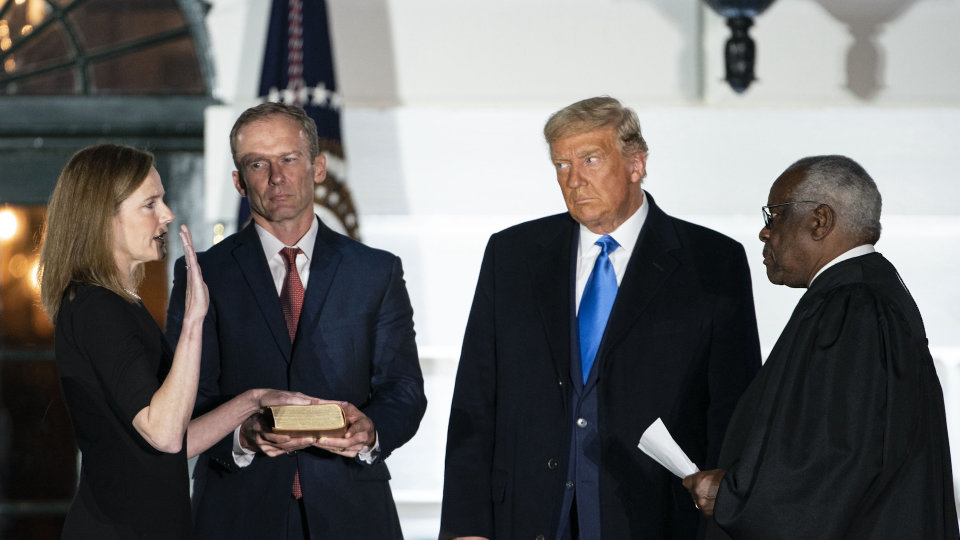
After the death of Associate Justice Ruth Bader Ginsburg on September 18th, President Trump announced the nomination of Amy Coney Barrett on September 26th to fill the vacancy in the Supreme Court a mere thirty-five days before election day. On October 26th, Barrett was officially confirmed in a 52-48 vote by the Senate.
Amy Coney Barrett (far left) completed her first of two swearing-in ceremonies at the White House Monday’s night after she was confirmed by the Senate, with Justice Clarence Thomas doing the honors alongside President Donald Trump.
In the immediate aftermath of Justice Ginsburg’s death, Democrats called for the Supreme Court seat to stay vacant until after the election was decided. The Democrats, as well as Democratic Presidential Nominee Joe Biden, were sparked by Justice Ginsburg’s final statement on her deathbed, “My most fervent wish is that I not be replaced until a New President is installed.”
After President Trump nominated Amy Coney Barrett, a Judge of the United States Court of Appeals for the Seventh Circuit, Democrats nationwide were outraged due to the proximity of the election, as well as the hypocrisy in which Senate Republicans acted once she was officially nominated to fill the vacancy.
The outrage felt by Democrats was largely due to the fact that Republicans seemingly violated the precedent they established in 2016, when Senate Majority Leader Mitch McConnell (R-KY) blocked hearings for then-President Obama’s nomination of Merrick Garland after the death of Justice Antonin Scalia more than nine months before the end of President Obama’s term and the 2016 General Election.
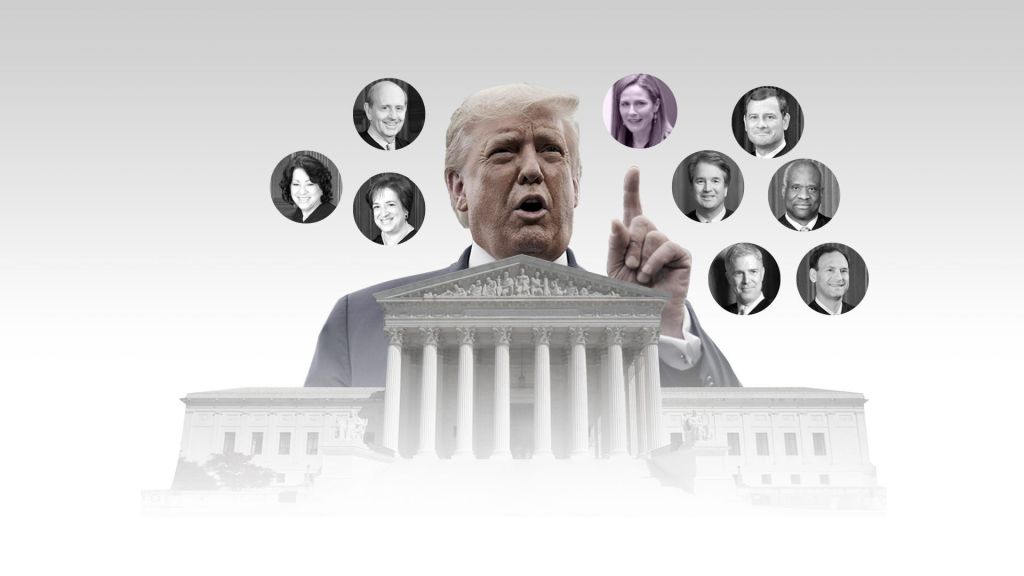
Furthermore, the official confirmation of Amy Coney Barrett to the U.S. Supreme Court means that President Trump and Senate Republicans have confirmed their third conservative justice in just four years, which has shifted the balance of the Supreme Court to the “right” for generations to come. Justice Barrett joins Justice Gorsuch and Justice Kavanaugh as President Trump’s successful Supreme Court nominations.
A longstanding dispute has since arisen on whether Senate Republicans have politicized the federal courts and whether the Supreme Court should be politicized in the first place, as many Democrats fear that Justice Barrett will further advance President Trump’s agenda and work with her 5 Supreme Court Republican colleagues to declare the Affordable Care Act – or Obamacare – unconstitutional, a desire that the Trump Administration has long carried to follow through with.
Furthermore, Democrats have become fearful that Justice Barrett would rule in favor of President Trump should a situation arise with the election results such as in the highly contested, notorious 2000 Election between George W. Bush (R-TX) and then Vice President Al Gore (D-TN), which came down to the Gore Campaign contesting results in Florida – which the Supreme Court ruled in favor of Bush by blocking a recount in Florida, giving Bush all electoral college votes from Florida, and thus the Presidency.
In a situation that can very well happen given the uncertainty in 2020, Democrats fear Justice Barrett and her Republican Justice Colleagues would rule in favor of President Trump over former Vice President Biden should such a situation arise, thus securing the President’s reelection.
Despite the opposition from House and Senate Democrats, as well as 2020 Democratic Nominee for President Joe Biden, the Senate Republicans, led by Lindsey Graham (R-SC) and Majority Leader McConnell pressed forward with confirmation hearings and, of course, the official confirmation vote, which has come a mere eight days before the 2020 Presidential Election.
The confirmation of Amy Coney Barrett – and the 35 days between her nomination and the presidential election – has marked the shortest span of time between a nomination to the Supreme Court and a presidential election in the history of the United States.
The seismic, unforeseen shift in the balance of the Supreme Court to the right – and the increased proliferation, polarization, and politicization of the federal courts – have cemented themselves as defining points of contention in the conservative legacies of President Trump and Senate Majority Leader Mitch McConnell.
As expected, all Senate Democrats voted against the confirmation of Justice Barrett, with only one Republican Senator – Susan Collins of Maine – joining the Democrats in voting against Barrett’s confirmation to the highest court of the land.
On the flip side of the hot button issue, longtime Senator, former Vice President, and Democratic Nominee Joe Biden has consistently maintained that he does not support “packing the court”, a solution offered by many Democrats to expanding the number of justices and filling those vacancies with liberal justices in order to combat the shift of balance in the court brought upon by President Trump and Leader McConnell.
However, in a 60 Minutes interview with Norah O’Donnell, Vice President Biden did state that if he were elected President, he would formulate a bipartisan commission to analyze the federal court system and make recommendations to Biden on how to reform the courts as a direct alternative for the progressive calls to “expand the courts”, which also may very well be an attempt by Biden to depoliticize the federal courts.
Notwithstanding the foregoing information, it is critical to understand the fact that no matter what happens one week from today in the presidential election, nobody can reverse a Supreme Court Confirmation and remove a Justice simply as a political “gotcha”. Justice Barrett is here – no matter what America may think of her – and is here to stay for the next few decades.
Despite opposition from Democrats and growing speculation that Justice Barrett will serve as a tool for President Trump’s agenda on health care and the revoking of rights of LGBTQ people and women, one thing is clear – the power of the U.S. Supreme Court has shifted dramatically for the next generation due to the efforts of President Trump and Leader McConnell, and it may stay that way until a vacancy needs to be filled, barring any unforeseen changes to the federal court system by a potential Biden/Harris Administration.
As California strikes to make powerful statements on climate change, Governor Newsom released a plan that could affect the future of the state.
When it comes to banning all gas powered cars by 2035, Governor Newsom has become a celebrity when talking on the subject. Regardless of his silence when discussing California’s serious problems of homelessness, environmental protection laws have covered a big focus of Newsom’s agenda.
Newsom framed the plan as California’s answer to climate change and as an opportunity to benefit the state economically.
“This is the next big global industry,” Governor Newsom said referring to clean-energy technology, “And California wants to dominate it”.
Part of Newsom’s plan has set a goal for all heavy-duty trucks on the road in California to be net zero-emissions by 2045. He also plans to end all new permits for hydraulic fracturing by 2024, earning the criticism of oil and gas companies and their workers, who have called for an end to his plans as they threaten the stability of working people in the state.
Cathy Reheis-Boyd, President of the Western States Petroleum Association, said she believed the Governor’s “ambitious” plan did not provide enough information about how the state would pay to build up infrastructure for electric vehicles, or how it would handle for how expensive gas would become for people who can’t afford to buy a new electric car.
“I don’t see where A plus B equals C,” said Boyd.
Neither does the plan cover the transition for workers of the oil and gas production into green jobs, leading to her saying that there needs to be a serious conversation about relative pay.
The Governor acknowledged that not everyone would embrace the 100% zero-emissions goal, but stated that nothing in his plan would prohibit Californians from owning gas-powered cars or buying or selling them.
“We’re not taking anything away,” Newsom said, “We’re providing an abundance of new choices and new technology, being agnostic about how we get to zero emissions, but being committed to getting to zero emissions by 2035.”
The Governor stated that the public’s action will help encourage greater innovation for clean energy vehicles by creating a broader market and will drive down the cost of those cars and trucks. More than 1.63 million new cars and trucks are expected to be sold in the state in 2020, according to the California New Car Dealers Association.
Newsom added that California is home to 34 manufacturers of electric vehicles, and that just under 50% of all the electric vehicle purchases in the country are in this state. Getting rid of manufacturing for gas-powered cars would ultimately help California’s economy and bring more jobs to California, contrary to belief.
Climate scientists and advocates say the world must stop the production of gas and diesel powered vehicles by 2030 in order to keep global warming at tolerable levels. California and other governments across the world are seeking to achieve carbon neutrality by 2045, most likely taking years for vehicles to turn over and be replaced by zero-emission models.
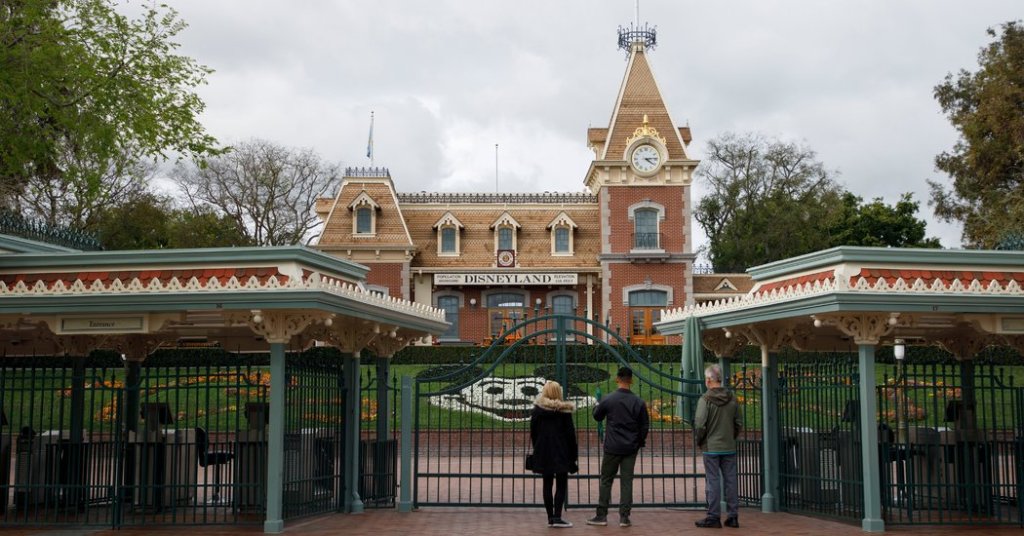
Disneyland Park in Anaheim is struggling to reopen their doors due to the most recent Covid-19 requirements, or restrictions, released by the State of California. This marks only the third time in Disneyland history that the theme park has been closed.
In March of this year, Disneyland closed their doors “Out of Abundant Precaution” due to the current COVID-19 Pandemic. Disneyland Parks in Anaheim, Disney World in Florida and Disney Paris were among the first Disney parks to close its doors. Following suit due to rising infection rates, the remaining parks and resorts throughout the entire world also closed their doors.
Fast forward to 7 months later, all other Disney Theme parks and resorts in the entire world have managed to reach their state, county, or country’s mandated requirements to safely open and get back to business. The one outlier, though, is Disneyland in Anaheim due to California’s struggles to contain the virus.
During a recent press conference, Governor Newsom discussed the reopening requirements. While the California government is working with the theme parks operations team, there is “ No Hurry in putting out guidelines” regarding theme parks until public health goals are met. However, Disney Resorts President Ken Potrock isn’t having any part of it, stating that the new guidelines are “Unfair” and “Unworkable”. The Mayor of Anaheim has also joined in with his opinion stating that “These guidelines fail working families and small businesses. As painful as this is, Disney and the City of Anaheim will survive. But too many Anaheim hotels, stores and restaurants will not survive another year of this”.
Chairman of Disney Parks, Josh D’Amaro recently announced that 28,000 employees from the Parks in Anaheim and Florida and other Disney segments “at all levels” will be laid off. This is due to the long duration of Covid-19 with the limited capacity restrictions and social distancing required to reopen. D’Amaro also stated that this layoff for the Anaheim location is also “ Exacerbated in California by the State’s unwillingness to lift restrictions that would allow Disneyland to reopen”.
The current requirements to reopen for Orange County, where the theme park is located, must reach the highest of four tiers and must also limit guest capacity to 25% allowed in the park at any given time once the park reopens.
The status to reopen Disneyland is still in limbo. President Ken Potrock stated that “These state guidelines will keep us shuttered for the foreseeable future, forcing thousands more people out of work, leading to the inevitable closure of small family-owned businesses, and irreparably devastating the Anaheim/Southern California Communities”.
As park goers, employees and business owners wait around for the state and theme parks to somehow work out a fair and safe agreement, the Happiest Place on Earth sits uncomfortably dark thinking only “Happy Thoughts” and crossing their fingers that someday soon Mickey and his gang will welcome them back with open arms to the Happiest Place on Earth.
As tensions keep rising inside the government due to the nomination for the vacancy in the Supreme Court, the question of loyalty versus honest service alarms the American people.
“He [the president] shall have Power… [to] appoint Ambassadors, other public Ministers and Consuls, Judges of the Supreme Court, and all other Officers of the United States.” US Constitution Article II, Section 2, Clause 2.
Included as one of the presidential powers, the appointment of a nominee for the Supreme Court is heavily discussed, as Presidents will most likely favor members of their political party.
It is no surprise really that President Trump would do the same, as a Supreme Court position is vacant after the death of former Supreme Court Justice Ruth Bader Ginsburg.
In historic events, the second President of the United States, John Adams, appointed 42 judges to both circuit courts and the Supreme Court on his last day as president in what is referred to as the “midnight judges”, in order to keep his political party’s interests dominant for a while.
The job of a Supreme Court Justice is essential for the American government, as they hold great authority over the law and order in the country, having the power of judicial review, where they can literally change or add a change to the Constitution, creating a whole new system.
But, what is the problem when parties take over the system to look over their interest instead of the people’s interest? Is judicial review too much power for a person to have, and should the people elect Supreme Court Justices, instead of the president having the full power to appoint someone from within party lines?
Well, while many theories can be created on whether the system is rigged, or possible changes to the system, the problem is obvious, as it is one that has granted presidents to keep their power going even after they leave office through the Supreme Court Justices they nominated to stay politically loyal.
The nine Justices that serve on the highest court are all selected at one point in a presidency, by whoever is President when a vacancy needs to be filled, whether it is a conservative or liberal president. They decide on cases based on the ideologies of their parties and try to support their claims by deeming something constitutional or unconstitutional as their power allows them to.
Now, if taken into consideration that human rights and the well-being of a state has nothing to do with power and political loyalty, why is this still a big part of the US system?
The short answer would be power, money, and hierarchies, but the answer as a whole is way more complex and has to do with history and the foundations that lay out the powers of government, the Constitution.
In a heavily politicized world from the beginning, the Constitution was created to settle the responsibilities of the government, and what is deemed legally right, and what is not.
Whether they were based on principles of truth or not, the United States was divided between federalists and anti-federalists, which influenced the decision making into what the constitution was and how everything was modeled after.
Now, to discuss what could have happened in history is not the point, but rather how society can move on from the past and look into the future.
In a system where the courts decide on the future of a nation, politics has nothing to do with the decision-making process.
Looking for loyalties in order to keep a job defeats the purpose of Democracy, of a Republic and a legitimate state.
Nominees for the Supreme Court and any other high circuit courts in the nation should be nonpartisan and defend the constitution and the right of the people, and whatever that means for everyone is up to interpretation – but they should not show allegiance to a particular party.
Whether more justices from a nonpartisan perspective are added, or all nine justices are remodeled to defend the law without any worries of political strategy, the system needs to be changed, and if it doesn’t change, peace around the country is only a utopian dream rather than a reality.
Cases such as Roe v. Wade show that it is possible to break party lines when deciding cases, as the majority of the Court was conservative, yet they decided to put those values aside and interpret their best version of law without putting party loyalties before the country.
Rights are established, they are not controlled by a single party or the mentality of a single person, rather by what neutral law explains, which is that the sense of freedom and what is needed for life to be enjoyable are the qualities a government offers to the people but never controls.
Even as nominees can now serve as a way to entertain the people on whether the candidate answers something wrong, and then people mock them, it is really a decision of life and death. If the nominee does not serve for the country over their party, it can move a regime from democracy to authoritarianism in a manner that is technically considered legal under the Constitution.
George Washington, the first President of the United States, advised the people to not make these mistakes in his farewell address by saying that political factions can only be effective when destroying the integrity and unity of the nation, while preventing the branches of government from working to help the people.
It is not a matter of left or right, blue or red, or right versus wrong; it is about country, the United States, and the powers of the Supreme Court are greatly influential in the system of the creating order, which may spur political parties to work hard and prevent success from happening in this vast nation.
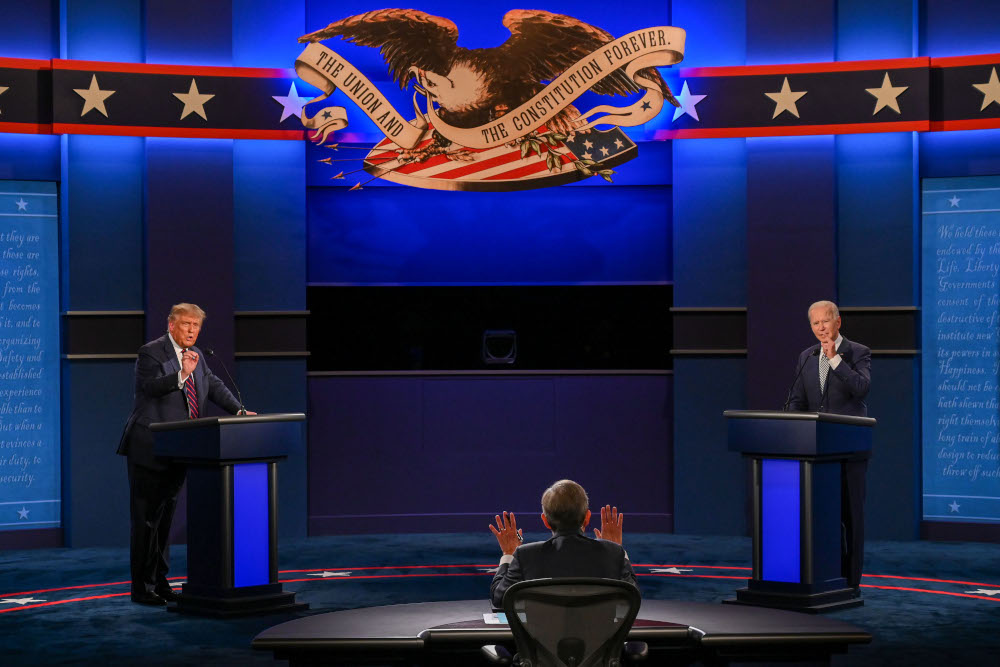
On Thursday night, President Trump and former Vice President Joe Biden clashed in the first debate since September 29th and the President’s COVID-19 diagnosis, with new regulations set by the Debate Commission in order to prevent the difficult conundrum and vitriol faced in the first debate.
US President Donald Trump and Democratic Presidential candidate and former US Vice President Joe Biden clash during the final presidential debate at the Curb Event Center at Belmont University in Nashville, Tennessee, on Thursday, October 22, 2020.
Since the first presidential debate on September 29th in Cleveland, Ohio, the campaigns of President Donald Trump and former Vice President Joe Biden have embarked on two completely different paths as the country nears Election Day. Just two days after the first presidential debate, on October 1st, President Trump, his wife Melania, and youngest son Barron all tested positive for COVID-19. After roughly two weeks of recovery and a controversial stay at Walter Reed National Medical Center, the President has gone back to holding campaign events and downplaying the virus in order to maintain a stranglehold on his base of support.
On the flip side, former Vice President Joe Biden has continuously tested negative for COVID-19, while exhibiting extreme caution and hosting either socially distanced or virtual campaign events as he holds on to a national lead in the polls and in various battleground states.
While the campaigns of both candidates have continued to operate in their usual different ways, both President Trump and former Vice President Biden have taken outside hits with alleged corruption scandals. On the Democratic side, Vice President Biden has faced a myriad of criticism from the President and the GOP after reports that his son, Hunter Biden, received $3.5 Million dollars from Russian and Ukranian shady business deals, which Vice President Biden allegedly knew about, though reports are conflicting, with former intelligence officials believing the scandal – first reported by the New York Post – to be Russian disinformation.
Meanwhile, President Trump has had his fair share of corruption accusations and scandals levied against him in the past few weeks. Recently, a report from the New York Times revealed that the President had a Chinese bank account, which resulted in the President paying almost $200,000 in taxes to the Chinese government. Furthermore, Rudy Giuliani, the former Mayor of New York City and a member of President Trump’s legal team, has been mired in controversy after he was egregiously caught making a seemingly obscene advance toward a woman in a scene from the mockumentary comedy film “Borat 2”, as well as delving heavily into the investigation of Hunter Biden’s purported Ukranian corruption.
On Thursday, October 22 at the Curb Event Center at Belmont University in Nashville, Tennessee, the collected and settled Biden and the unpredictable, unorthodox Trump sparred once again in a much more controlled debate due to changes made by the Debate Commission three days before the debate. The Debate Commission, after the chaotic first debate, ruled that the two candidates would have their mics muted while the other candidate delivered their two minute opening remarks to each one of the questions from the six debate topics, as well as any interruptions made by either candidate counting against their allotted speaking times.
In the actual debate itself, the American people received what they didn’t in the first debate – a decent and controlled debate in which both candidates were able to debate policy and visions without hapless, cynical remarks and interruptions. The moderator, Kristen Welker of NBC, did a fantastic job handling the two personalities and ensuring each candidate was able to speak in their allotted times.
In turn, the mere atmosphere of the debate for every American viewing at home was much less polarizing and contentious, and most certainly less of an anomaly than what Americans saw unfold last month in the first debate.
In every facet, the debate commissions rule changes, as well as moderator Kristen Welker’s conviction to uphold those rules, revitalized, even if in a very small way, the integrity of the debates, and allowed the American people to sit back, relax, and listen to the two candidates debate policy rather than deliver ineffective, mudslinging one-liners.
The egregious debacle faced by Moderator Chris Wallace in the first debate was quelled by the compliance of the two candidates, the commission’s formatting changes, and Welker’s upholding of the integrity of the event.
While critics may contend that the debate commission needing to make such changes is reflective of how traditional debate etiquette has gone awry, it may be a format the commission may continue to employ in future years to limit on-stage mudslinging, which may galvanize candidates into debating policy rather than engage in political food fights.
Most notably, President Trump appeared much more controlled and reserved than he was in the first debate, while former Vice President Joe Biden once again cleared the very low bar set on him by the President and right-wing media outlets by speaking directly to the American people and discussing his policies in detail.
Despite the foregoing compliments on both candidates, it is imperative to understand that while the debate was controlled, it did not come without intensity and mudslinging. At the very beginning of the debate, when moderator Kristen Welker asked the candidates about COVID-19, President Trump instead touted the economy while also promising a vaccine to be distributed by the military “within weeks” while also saying that the virus is “going away”, to which the former Vice President responded by saying that the President does not hold himself accountable, nor does he have an adequate plan to reopen the economy, combat the virus, and put America back on track.
Much like the first debate, there was a clear difference in rhetoric between the two candidates, with President Trump blaming Democrat Governors and “blue states” such as New York for their “failures” in controlling the virus, while the former Vice President said that he does not see the states as “red” or “blue”, but as simply the United States of America.
Then, when it came to talks of foreign policy and protecting the elections from foreign interference, the mudslinging truly began, even if in a much more controlled manner than in the first debate.
The former Vice President stated that if he were President, Russia and Iran would pay the price for interfering with American sovereignty and meddling with elections, while calling out President Trump for his ineptitude in responding to Russia and Vladimir Putin’s interference in the 2016 election. In response, President Trump erroneously claimed that Russia and Iran did not want him to win reelection, basically hinting at the fact that if the election results were meddled with, it would be skewed in favor of Vice President Biden, not him.
Furthermore, President Trump levied an attack on the former Vice President as well as his son, Hunter Biden, on the aforementioned purported claims that the former Vice President used his position of power in order to benefit his son and the rest of the Biden family, receiving millions of dollars from Russia for shady business deals.
One of the highlights of the night came when President Trump was talking about his great relationship with the Supreme Leader of North Korea, Kim Jong Un and touting his foreign policy handlings because there “is no war” and there hasn’t been any nuclear tests, to which Vice President Biden responded, “We had a good relationship with Hitler before he invaded the rest of Europe.”
The difference in vision was evident, with the President once again promising a health care plan that has seemingly gone astray throughout the President’s first term, while attacking Obamacare and saying that the former Vice President is turning to “socialized medicine.”
Nearing the end of the debate, President Trump slightly loses his cool, bringing up New York Representative Alexandria Ocasio-Cortez and Vermont Senator Bernie Sanders for their Environmental and Health Care plans, to which the former Vice President responded that the President is running against him, not them.
The final question of the debate from Kristen Welker asked both candidates what they’d say to Americans who didn’t vote for them on Inauguration Day in January, and both candidates answered in a way that has reflected the way each has campaigned in 2020 and have spoken to the American people rhetorically throughout their political careers.
Vice President Biden responded by saying he would be sure to highlight that he is an American President and will represent all Americans in every state, while being a President who unifies by choosing hope over fear and science over fiction. President Trump responded by saying that success would bring people together, but still did not provide words of unity, continuing the divisive rhetoric he has relied on throughout his Presidency and campaign.
The presidential debate cycles are over – if there is anything to take from them, it’s that both candidates were galvanized to speak policy when it mattered most, engendering them to make a last push for the votes of the American people and secure the Presidency.
Just two days after the first presidential debate in Cleveland, and only one day after a campaign rally in Duluth, Minnesota, President Donald Trump and his wife, Melania Trump, announced on Twitter late Thursday night that they both tested positive for COVID-19, were quarantined and beginning their process of recovery.
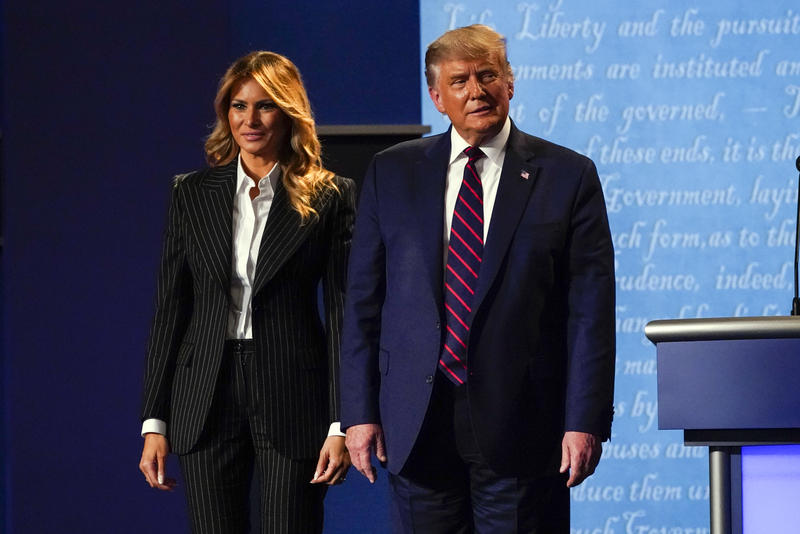
President Donald Trump stands on stage with first lady Melania Trump after the first presidential debate with Democratic presidential candidate former Vice President Joe Biden Tuesday, Sept. 29, 2020, at Case Western University and Cleveland Clinic, in Cleveland, Ohio. (AP Photo/Julio Cortez)
The bombshell announcement comes merely hours after the announcement that one of the President’s top aides – Hope Hicks – tested positive for COVID-19 and had been exposed to the President numerous times, as she accompanied he and his team on Air Force One numerous times throughout the week.
Per usual for President Trump and his administration, the fundraising event in Minnesota – while outdoors – featured no social distancing, with the President failing to inform the crowd that he had been exposed to the COVID-19 positive Hicks.
After criticizing Democratic presidential nominee and former Vice President Joe Biden at the debate on Tuesday for his consistent mask wearing as well as his socially distanced and virtual campaign events, the President has now contracted the same virus he’s been “downplaying,” according to interview recordings by journalist Bob Woodward, since its initial onset.
On Friday, former Vice President Joe Biden stated on Twitter that he and his wife, former Second Lady Jill Biden, tested negative for COVID-19, while continuing to champion the same trust in science during the pandemic that has not been proactively vocalized by the President’s reelection campaign.
I’m happy to report that Jill and I have tested negative for COVID. Thank you to everyone for your messages of concern. I hope this serves as a reminder: wear a mask, keep social distance, and wash your hands.
Throughout the year 2020, President Trump and his administration have remained consistent in their flagrant refusals to wear masks publicly, hosting indoor and outdoor campaign events with little to no social distancing and calling for cities to reopen the economy and scale back on restrictions brought upon by the pandemic. Most recently senior Trump officials were the only one’s in Tuesday night’s debate hall at the Cleveland Clinic to ignore mask wearing guidelines. Unlike some of the President’s family and closest advisers, who arrived at the debate without masks, First Lady Melania Trump was seen wearing a mask entering the debate hall, yet took it off after taking her seat.
Vice President Mike Pence tested negative for the virus on Friday morning and is still in good health. Furthermore, Amy Coney Barrett, the Supreme Court Nominee put forward by Trump to replace the late Justice Ruth Bader Ginsburg, has also tested negative for the virus.
In just one month, the American people will head to polling locations and cast their ballots on Election Day. Over a million roughly have already voted. Heading into the final stretch of campaigning for President Trump and former Vice President Biden, it’s a disastrous development for a Trump Campaign that is attempting to weather low approval ratings and slipping poll numbers. Not to mention that there are two more debates coming up – one, as of now, scheduled on President Trump’s final day of quarantine.
On Friday, White House Chief of Staff Mark Meadows continued to emphasize the fact that President Trump was still handling business as usual while recuperating from the virus at the White House. Originally, the President’s staff thought he’d be able to recover from the West Wing, but after experiencing mild symptoms Friday, President Trump was checked into Walter Reed National Military Medical Center. He will remain there a few days, according to administration officials.
Meadows also admitted that the President and his staff knew about Hicks’ positive test – as well as knowing they were exposed to her and could potentially have the virus. Nonetheless, the administration chose to move forward with a Thursday fundraising event in New Jersey as well as press briefings.
All year long, the President and his administration have been attempting to quell concerns among the American people by baselessly emphasizing that the peak of the pandemic was already behind them. Nonetheless, in the best case scenario, the President, who is at higher risk of struggling more with the virus due to his age and clinical obesity, can recover and not be seriously affected by it. But the short-term is a worst case scenario for the President, temporarily halting campaign events and putting the status of the October 15 second presidential debate in Miami in jeopardy.
On Tuesday night, President Trump and former Vice President Joe Biden clashed in one of the most chaotic, insult-laden presidential debates in history, leaving political pundits stunned, American families appalled and the country in an untenable struggle for decency and civility.
US President Donald Trump and Democratic Presidential candidate and former US Vice President Joe Biden exchange arguments as moderator and Fox News anchor Chris Wallace (C) raises his hands to stop them during the first presidential debate at Case Western Reserve University and Cleveland Clinic in Cleveland, Ohio, on September 29, 2020. (Photo by Jim WATSON / AFP)
Throughout the past few months, Democratic presidential nominee and former Vice President Joe Biden has been subject to a litany of insults from President Donald Trump and his administration, who have directly attacked the former Vice President’s mental acuity as well as his record as a senator and the eight years he served under President Barack Obama. Despite the personal attacks and insults that Former Vice President Biden and his family have faced at the hands of the President, the former Vice President has maintained a stranglehold on his leads in the polls, while his opponent has continued to ignite his base despite low approval ratings.
On Tuesday at Case Western University and Cleveland Clinic in Cleveland, Ohio, the seasoned, veteran debater in the form of Joe Biden and the unpredictable, unorthodox debater in the form of President Trump had the opportunity to put the months of insults to rest and appeal to the American people by discussing policy, visions, and providing a semblance of unity through their rhetoric in a time where the country is experiencing tremendous political polarization.
Instead of getting a civil, decent, and controlled debate, the American people witnessed a nightmare unfold right before their very eyes. The moderator, widely respected Fox News Sunday Anchor Chris Wallace, seemingly struggled to control the personality of President Trump, who continuously interrupted the former Vice President more times than Biden was even able to speak. Rather than employ a message of unity, optimism, and leadership, the President continued to evoke rhetoric that was divisive, despicable and abrasive – yet another trampling over norms of presidential etiquette by an administration that has continually embraced the unconventional, regardless of cultural backlash.
This debate, amidst all the issues currently going on throughout America and on the global stage, could have been huge. One may argue that perhaps this debate could have been the one to change poll numbers, make undecided voters commit to a candidate or even change the tightly held perceptions some people have regarding the character of both candidates. The debate had all the potential in the world, and certainty all the subject matter that America cares about during this election cycle. The topics that were supposed to be discussed in detail, chosen by Wallace, were as follows: the Supreme Court and Trump’s nomination, the COVID-19 Pandemic that has killed 200,000 and counting, the state of affairs in America economically, the battles for racial justice, and the integrity of the election itself.
The debate could have been memorable, an opportunity for both of the candidates to be a shining star during a time in our country where everything is bleak – but the American people were left with more questions than answers. Immediately following the debate, Americans on Twitter, reporters on CNN and Fox News, and many politicians were quick to discuss what they had just seen.
The debate had no clear winner. President Trump rarely followed the rules agreed upon by the campaigns, driving the discussion into tangents of low-blow attacks against the former Vice President, while Biden cleared a very low bar set by months of smears against his mental acuity.
In every way possible, no matter how people now and in the future decide to digest and analyze this debate, one thing is clear – the losers in this debate are the American people, as well as the integrity of our Democracy that is being taken down and overthrown by thuggish rhetoric. The people are suffering because of the utter embarrassment and shame that comes with seeing two grown American men – who are in a battle to run the free world – unable to engage in a debate that should have been civil, informative and unifying for a country that is bleeding for hope and leadership.
After everything the American people have been through in 2020, Tuesday served as an opportunity to provide optimism in a better direction for the future and ignite the bases of two campaigns that have many flaws. Instead, it was the American people who suffered and were left with nothing to cheer for, nothing to feel proud of, nothing gained in terms of who has a better vision for our nation.
In lieu of finally getting an opportunity to see what former Vice President Joe Biden would do differently than Trump as President to fix the economy, healthcare, the environment and social injustice, the American people weren’t able to hear his words over President Trump’s consistent interruptions, side comments and insults. The highlights of the debate for former Vice President Biden came in the form of him telling the President to “shut up, man” as well as calling him a “clown.”
On the flip side, President Trump had a debate performance that can only be described as unpresidential. Entering this debate amidst slipping poll numbers, President Trump truly needed a magical – or, at the very least, adequate – debate performance in order to give more fight and direction to his reelection campaign. Yet, he failed to do so.
All night, the President butted in, hurling insults toward the former Vice President in an attempt to get his challenger to make a big mistake – but it never happened. It almost seems as if Biden, the 47-year political veteran, the elder statesman in government is immune to the mudslinging and diabolical rhetoric that the President and his campaign choose to employ day-to-day on the campaign trail. When former Vice President Biden brought up his deceased son Beau Biden’s military service, the President brushed it off, choosing instead to insult Biden’s living son, Hunter.
Furthermore, the President chose not to condemn white supremacists and far right extremist groups when asked to do so, instead telling the Proud Boys – a far right extremist group that promotes violence – to “stand by.”
In the midst of a pandemic and increased racial tensions, President Trump offered no solutions – only insults and green lights to alt-right militia groups – saying that the reason former Vice President Biden did not host in-person rallies and campaign events was not due to COVID-19 concerns, but because “no one would show up.”
Instead of raising the bar for a man he calls “sleepy” and “unfit for the job” of president, he has lowered it, while making the former Vice President look competitive for telling the President to “get out of his bunker.” All the while, former Vice President Biden has furthered the concerns amongst Americans that he is not energetic enough to truly bridge the divide between the left and the right and excite Americans enough to get tremendous voter turnout.
As both of their respective campaigns continue to play out, the former Vice President has continued to tout that the country is in “a battle for the soul of America.” Meanwhile, the President has continue to maintain a stranglehold on his base of support by promising to take down the “radical left” and to “Keep America Great.”
But, if the debate is any indication of what is in store for this country in the next few weeks, rhetoric will not be a reliable source of optimism, and traditional etiquette in American Democracy might be a thing of the past.
As the United States persists months into the pandemic, people have continually adapted to an ever-changing “new normal.” Places in the U.S. then began to open up, and then some inevitably began to close again. Some cities around the country are in a perpetual state of cautious phased reopening, while other places remain open as if a pandemic weren’t occurring at all. Around the world, other countries have responded differently to the virus.
Some countries now appear to be over the hump, while others are resisting a second wave of cases. Some places have returned to nearly normal, others are on their way, and some expect a return in a distant future. Quick and enforced policy appears to have been the key element to striking the problem early, as can be seen throughout the world.
Let’s take a closer look at Taiwan. An extensive list published by the American Medical Association shows that Taiwan was one of the first countries to initiate protocols regarding the virus, with health screenings on flights from Wuhan beginning as early as December 31, 2019. In the months following, Taiwan began more extensive travel restrictions and public safety measures in response to the virus. Tours and transiting to China were soon suspended.
Places like Taiwan would likely be cautious regardless of public policy. Taiwanese citizens are no strangers to being in the worldy neighborhood of deadly viruses. The effect of the SARS outbreak in the early 2000s, for example, which also originated in mainland China, likely remains in their memories.
By February 1st, roughly 4 million masks were being locally manufactured and sent out, with a set price of about $0.20 per mask, making them widely accessible. A few days later, the mobilization of resources, provided by government and private organizations, allowed for ten million masks to be made per day.
By the beginning of February, a break in quarantine protocol for positive cases could warrant up to a $10,000 fine. An extended winter break allowed for preparation of returning students. As the months progressed, enforced entry bans and mandatory quarantining led to a relatively minimal effect from COVID-19. According to the CDC, as of last week, Taiwan currently has a reported 509 total cases, with seven deaths nationwide.
These swift actions have had beneficial repercussions to the country. A minimal effect was felt on education especially, and other than a two week buffer in February during winter break, no other time was lost for in-person instruction. School began as normal this school year as well.
For a large time, Taiwan had launched the only professional baseball season in the entire world. And now, you can even catch a game in person at Taichung Intercontinental Stadium in Taipei after a temperature check and taking your seat in adequately spaced stands. Catching a live baseball game is a rare sight anywhere in the world, and as the MLB begins to enter the postseason in the US, it is a sorely missed sight.
New Zealand has also been notably effective in controlling the virus and is finally in the stages of reopening. Their COVID-19 response is obviously unique, as they are an island nation. Spikes in new cases have been minimal for the past few months, likely due to their strict lockdown measures. From May to August, new cases were extremely rare, and despite a small spike since then, it appears that New Zealand has the virus relatively under control.
As of September 30th, New Zealand’s Ministry of Health states that there have been 1,480 cases, only about 200 in the last month, and 25 deaths total. Until Wednesday, September 23rd, citizens were not allowed to gather in groups greater than ten. Since April, new daily cases have been kept under 20, and cities are beginning to lift restrictions; the current plan is to slowly lift them and eliminate them completely within two weeks.
Egypt’s COVID-19 response, on the other hand, has been deemed ineffective by many. The World Health Organization states that the North African nation has accumulated over 103 thousand cases with over 5,900 total deaths to date. Toward the beginning of the pandemic, Egypt’s measures apparently failed to effectively contain the virus, which was comparable to other countries at the time, such as the U.S., United Kingdom, Italy, and others.
According to the U.S. Embassy in Egypt, a government-mandated lockdown was initiated in March, when there were less than 500 cases reported. Public areas such as restaurants and mosques, as well as schools were promptly shut down, and a curfew and flight restrictions were put in place. Yet due to a number of factors, these actions were partly in vain. It is alleged that Egypt did not record data properly, inferring that a large number of cases went unreported and therefore void from precautionary measures.
In addition to inaccurate numbers, many places in Egypt did not have proper resources available, especially in rural and urban areas, where clean water and proper sanitation is not adequate. A lot of effort by the government focused more on preserving the economy, namely in their oil, gas, and Suez canal infrastructure, and a failed social safety net has thrown many into poverty. The amalgamation of fragile healthcare, ineffective and ill-directed policy, diverse socioeconomic statuses, and contrasting geographic areas have all led Egypt down an undesirable path.
There is no faultless way to deal with a worldwide virus, especially in this day and age, where international travel has never been so conventional. The success of a pandemic response varies from country to country. Coming up with a standard worldwide response would be utterly futile, as effectiveness is contingent upon how a specific society functions.
The United States is a demonstration of this: states, counties, even cities are reacting to COVID-19 policies differently. Some areas embrace the ideas of social distancing and mask wearing, while others are repulsed by the idea and see the virus as a hoax.





 The Brave News