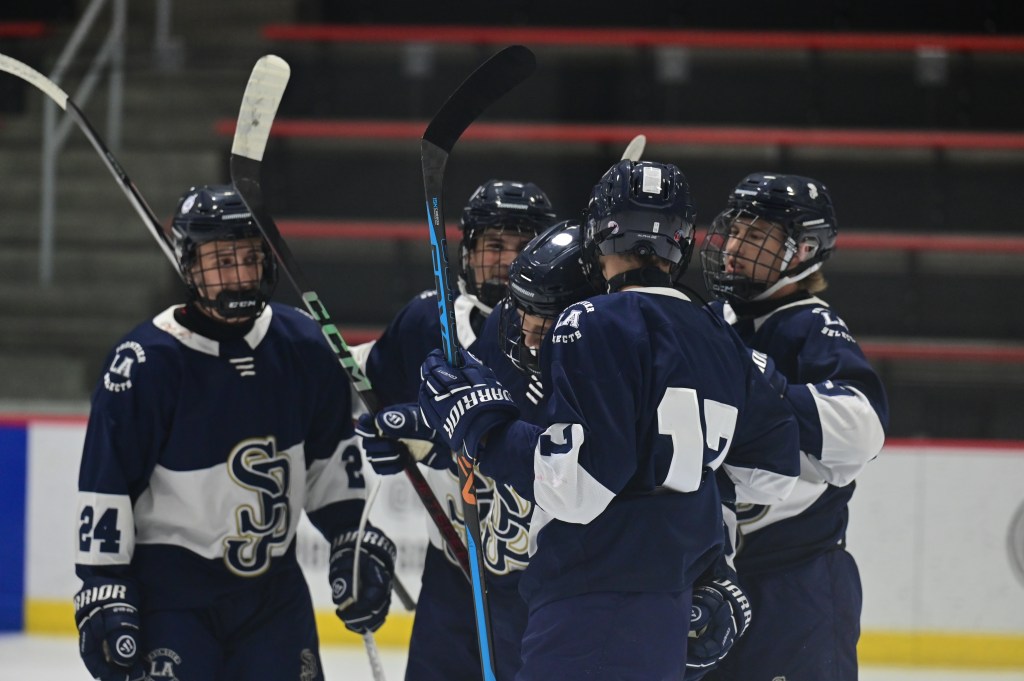
The Frontier Select LA/St. John Bosco hockey team is kicking off their debut season under the guidance of a familiar face, Head Coach Tomas Kapusta. They have demonstrated potential in a short time with their hard work and team chemistry, as they aim not only to compete in the league but also to create a lasting legacy.
“As a first-year [with the Frontier Selects LA/Bosco] team, we want to be the best we can be, showing everyone the right pathway to becoming a prep school team,” said Coach Kapusta. “We are still working on strengthening the team.”
The team started off their season strong with two wins in the IMD High School League, one of which was a tough overtime victory that really set the tone for the games ahead. They’re feeling confident after these successes but are also aware that there’s more work to do.
In a recent tournament at the Sin City Showdown, Frontier Selects LA/Bosco managed to secure two wins, but also suffered two close losses that emphasized the importance of staying focused in crucial moments.
“So far, we’ve played good games, but there’s still a lot of room for improvement,” said Coach Kapusta. “Every game is a learning experience, and the boys are starting to understand what it takes to win consistently at this level.”
Coach Kapusta has been instrumental in guiding the players through this developmental phase.
“The players are beginning to understand their roles on the team,” said Coach Kapusta. “The team is not just composed of players who score goals, but also players who fulfill specific roles. That’s the only way to be a successful hockey team.”
A major obstacle the team is dealing with involves creating a bond among players who have different backgrounds and skill levels. Coach Kapusta has highlighted the significance of teamwork and effective communication to ensure that every player understands their role and how they contribute to the team’s success.
“We have players at different levels of development, and the only way we’ll be successful is by working together and respecting each other’s contributions,” said Coach Kapusta. “[It’s] important that we create the right atmosphere on and off the ice, and [that’s] something we’re working on every day.”
The team’s primary goal for the future is to secure a spot in the 2025 USA National High School Championship tournament scheduled for March in Irvine. Frontier Selects LA/Bosco is currently familiarizing themselves with the competition and assessing their position, but both players and coaches are hopeful about their goals to compete at the highest level in the playoffs.
“The goal is to make it to the National Championship, and we’re going to do everything we can to get there,” said Coach Kapusta.
Senior left-wing Lucas Cilan echoed his head coach’s determination.
“We want to show everyone that we belong here and that we have what it takes to compete at the highest level,” Lucas said.
Apart from their performance on the hockey rink, the team is also dedicated to thriving academically. They strive to find a balance between their studies and sports responsibilities, which is a crucial aspect of the program.
“We’re building something special here,” said Coach Kapusta. “We’re focusing on the community, the school and ensuring all students succeed academically so they can focus on hockey.”
Throughout the progression of the season, Frontier Selects LA/Bosco is anticipated to develop and advance as a team. Their goal of aiming for a National Championship in their inaugural season and their dedication to establishing a program that can leave a lasting legacy at Bosco indicate that this new team is ready to represent Brave Nation with pride.
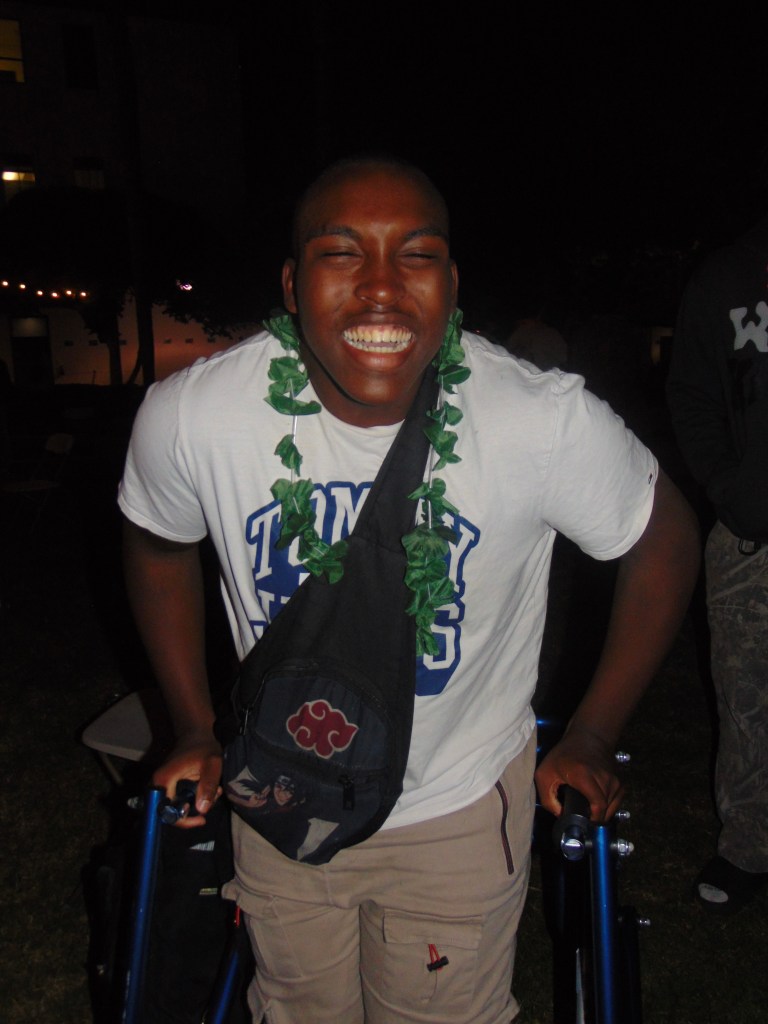
From the beginning of his freshman year until now, students and administrators have walked past As’ad Kashim without knowing exactly the adversity he has overcome in his life. He believes that his story embodies what it means to truly be a Brave at St. John Bosco High School.
Photo by Kijani Dumas
As’ad was born in Nigeria in 2006 to a close-knit family. His mother worked as a public relations officer, while his father was a member of the Nigerian Navy. Alongside his older sister, As’ad grew up surrounded by love and support.
As’ad’s life was at risk from the moment he was born. Born prematurely, he spent his first days in an incubator due to underdeveloped organs. Additionally, his skin was so thin that his internal organs were visible.
After leaving the incubator, As’ad suffered from oxygen deprivation, which caused problems that would hinder his movement. At one point, doctors feared he wouldn’t survive. As’ad believes that he was able to stay alive because of the love of his family, particularly his sister.
She cried out for him, wanting her little brother to come home. Eventually, As’ad was able to find a stable pulse and develop organs strong enough to support themselves on their own.
As’ad was officially diagnosed with cerebral palsy when he was two years old. His condition was difficult to detect during infancy, but as As’ad grew older, his family began to understand the physical challenges he would face.
When As’ad was four, his family moved to India for better access to medical care and physical therapy. Despite his condition, As’ad’s parents were determined that he receive a top-tier education alongside other kids.
They enrolled him in a regular school because they wanted him to be viewed no differently from other children.
In school, however, As’ad was constantly overlooked by teachers who thought he couldn’t keep up. To prove them wrong, he memorized a small booklet and recited it aloud in class, showing his ability to comprehend and speak fluently.
During this time, As’ad struggled with physical therapy because of the limited flexibility in his legs. Noting his struggles, his mother proposed a deal: he could see his other family relatives when he could walk efficiently with his walker.
Motivated by this challenge, As’ad became proficient with his walker—which he uses to this day.
Before moving to the United States, As’ad’s family took a brief vacation to Dubai. His favorite memory from this trip was playing in the sea for the first time with his uncle. During the trip, he and his family paid a visit to Mecca, a spiritual experience for As’ad, who practices Islam. While there, he prayed for better days, hoping that life would improve for him and his family.
Medical tests during this time revealed that As’ad’s knee was shattered, so he was scheduled to undergo surgery. Due to visa delays, however, he could not stay in Mecca for further treatment.
His mother then spoke to a family friend, who helped convince the family to move to the United States for better medical care.
A little before his tenth birthday, As’ad visited California with his family for a month to explore the possibility of living in the U.S. permanently. A year later, they decided to make the move to Los Angeles.
Through his aunt, they connected with a hospital specializing in cerebral palsy treatment. The Luskin Orthopaedic Institute for Children (LuskinOIC) became a staple in As’ad’s journey through adversity.
It was there that As’ad met his first surgeon, Dr. Anthony Scaduto, the President and CEO of LuskinOIC. Feeling extremely nervous as the doctor entered the room, As’ad greeted him with a formal good morning. It was a gesture that impressed Dr. Scaduto, who had never received such a greeting from someone As’ad’s age.
As’ad shared his desire to walk, and Dr. Scaduto assured him that although it was possible, it would require a long journey. He then asked if As’ad would be ready to take that journey.
As’ad, with immense faith, confidently responded, “Yes, I am prepared. I’m going to do whatever it takes.”
In May, a month after their initial meeting, As’ad underwent surgery. The procedure focused on correcting the growth in his knees to prevent further complications. The surgery, which lasted 6-8 hours, marked a turning point in As’ad’s life.
“Although I was extremely nervous for the operation, I knew I was going to wake up from the surgery as someone new,” said As’ad. “It was a feeling [I had] never felt before—being so afraid, [yet so] excited for the future ahead of me.”
For three days, As’ad couldn’t move, and special therapy was required to help him adjust to moving again. Nurses and therapists used a sheet to transfer him between his bed and his wheelchair, helping him become accustomed to the pain and regain mobility. These movements happened multiple times a day to ensure As’ad adapted.
When As’ad was cleared from the hospital, he took a year-long break before starting school again. He dedicated that break to intensive physical therapy sessions.
Once it was time to enroll, As’ad and his family had difficultly finding a school for him to attend. Many schools denied him based on his physical handicaps. One school that accepted his enrollment, however, was Marcus Garvey School in Los Angeles.
Entering school as a young teenager, As’ad felt a wave of sadness overcome him when he watched kids play basketball from a distance. Eventually, kids included him in their activities and made him feel like one of the guys.
“[Although] some people out there have some type of animosity against you, there are bound to be people out there willing to help and support you regardless of your situation,” As’ad said.
After moving into his new school and house, it was time for As’ad’s second surgery. This second surgery was a more robust procedure than his first. But this time around, As’ad felt little to no pain at all.
A quick recovery allowed As’ad to travel back and forth from America to Nigeria to get his visa.
After recovering, getting his visa and finishing middle school, As’ad was set on attending one high school: St. John Bosco.
As’ad toured Bosco during the pandemic where he fell in love with the school watching the basketball team studying together. Seeing players and coaches working together painted a picture that he felt epitomized the Bosco brotherhood.
During his freshman year, As’ad felt the changes of transitioning to high school.
“It was extremely difficult. Even though I trained, the distance I had to cover was a lot. I even used an electric scooter. [Regardless,] I was still ten minutes late to my classes,” As’ad said.
At first, the adjustment was rough. His family would have to be with him throughout the day to make sure he was supported in getting from class to class.
An incident where As’ad fell to the ground playing Jenga made him feel supported—not by his family, but by his Bosco brothers. Instead of being ridiculed and made fun of, like As’ad anticipated, his peers lifted him and still kept including him in games they played at lunch.
By his junior year, As’ad was fully acclimated to life in high school. A feeling to reach new heights in his life was introduced by CIF finalist in the 400m, senior Kendal Handy. One day, while doing his daily walk on the track, he jokingly called Kendal out to race him. Kendal, being the competitor that he is, didn’t try to sugar coat the situation and said he was going to beat As’ad.
As’ad ran with his walker and was able to find a new drive within himself, eventually being able to beat Kendal.
“It made me realize the different personalities at Bosco. Everyone made me want to better myself into who I am,” As’ad said. “[I felt good] when I beat Kendal, regardless [of whether or not] he tried. The different backgrounds everyone at Bosco [comes] from [has] motivated me to be stronger.”
Now entering his senior year, As’ad’s aspirations for himself have never been higher. As’ad used to think of himself as a dreamer, but he’s finally realized through his drive and determination that he’s an achiever.
Asad’s current goals are to walk across the stage at graduation without his walker and to attend either USC or UCLA next fall.
“What I’m most grateful for in my time at Bosco, and by far what I’ll miss the most, is the environment. So many different [people,] from teachers to students, all did their best to show me [how] to be the best version of myself,” As’ad said.
As’ad never felt like he was alone at St. John Bosco and genuinely believes he has found a home in Bellflower. He knows the kind-hearted people at Bosco only want him to succeed and feels they’re responsible for the joy he’s felt over the past few years.
Through all the highs and lows, and the never-ending wave of adversity, Kashim As’ad Kashim—the achiever—knows what it truly means to be a Bosco Brave.
by Macade Maxwell and Owen Stelzer, co-Sports Editors
The St. John Bosco’s historically strong cross country team embarks on another season with high hopes for maintaining the program’s culture of excellence.
Photo by @Bosco_XC_TF via X, formerly known as Twitter
As the Cross Country season gets underway, veteran Head Coach Tim McIntosh and his team have made significant strides this year through hard work, dedication and a strong core of young runners.
“Like always, our goal is to win league. Last year we finished third in Trinity League so we hope to perform better this season,” said Coach McIntosh.
The team has already competed in four competitive events: the Seahawks CC Relay in Redondo, the Cumming/Latham Invitational in San Diego where they finished in fourth and fifth, the Woodbridge Invitational in Irvine where they finished in first place and their most recent the Trinity League Preview race where they placed first again.
The team has already proved themselves to be contenders for CIF later in the season, and after a successful showing at the Trinity League Preview, Coach Mac’s squad showed that they are true competitors for a league title.
Alongside Coach McIntosh is assistant Coach Ruben Solorza, a Bosco alumnus and Cross Country CIF Champion back in 2012.
“They are starting to develop a ‘game day’ mentality where I trust them to go out and get the job done,” said Coach Solorza. “They are realizing how far their hard work has gotten them, and I’m excited to see what they do as the postseason comes closer.”
At the heart of the team is senior captain Alex Leon. His leadership and experience provides guidance for the younger runners on the squad.
“I’m a varsity returner and being the only senior on the team, I have a big role and have to be a leader,” said Alex. “I want to finish my last year off strong and leave an impact for this program.”
The Braves still have ways to go as there are six potential remaining events, with the next Clovis Invitational coming up on October 11th in Fresno.
“We want people to know that we have a strong core of runners and have what it takes to compete with the best,” said sophomore Edward Medina.
Expect this young team to make some noise later in the season, as they strive to achieve their goal of winning it all this year in Trinity League and CIF.
St. John Bosco High School’s Student Ambassador Program draws in prospective students and represents the whole student body.
Photo by Nels Nelsen
”I would just say [they] are the leaders of our school and the community,” said Mrs. Becky Ellison, the Dean of Enrollment.
The Student Ambassadors go out to different middle schools, mainly in the Los Angeles area, to reach out to the junior high students that will become the next generation of Braves.
“The goal of the ambassadors program is [that] it’s a group of students who will represent our school outside of our campus,” said Coach Matt Dunn, who is an Admissions Community Partner that helps coordinate the Student Ambassador Program.
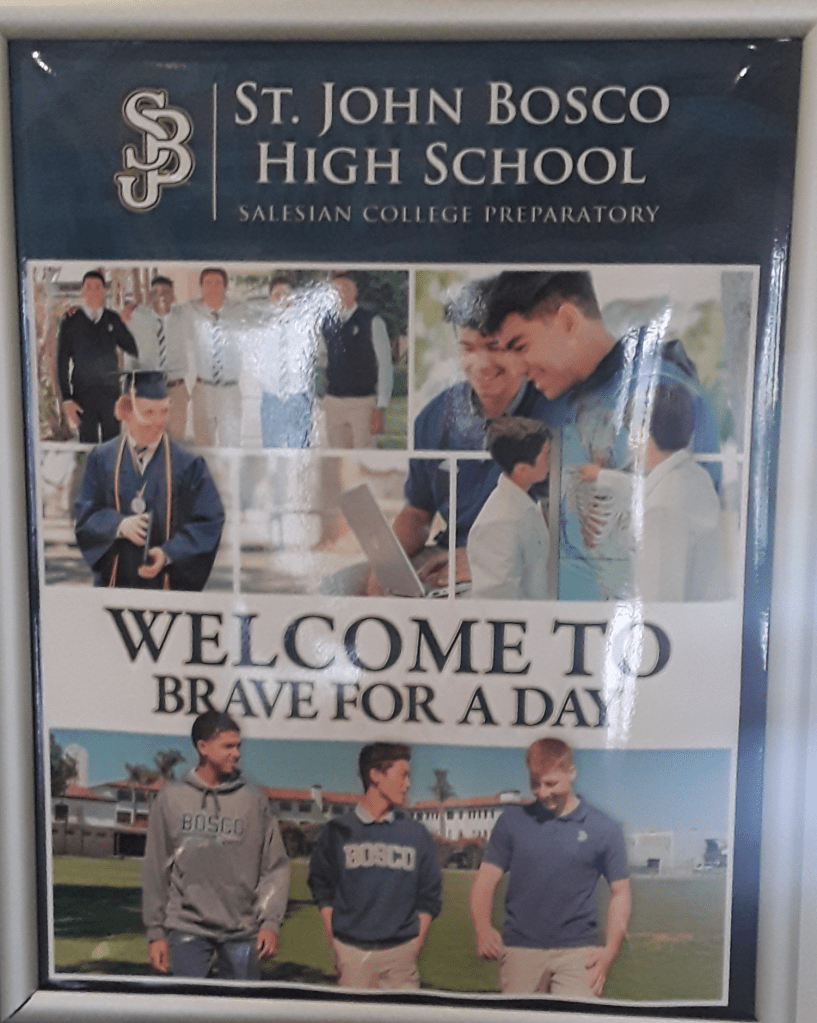
Students go out into the community and give presentations at local middle schools. They also help with Open House and are instrumental in the Brave for a Day “shadow” visits.
“Shadow” days are when seventh and eighth grade students spend a day on the campus shadowing a current Bosco Brave. They are even matched with a student with the same interests as them, for example a shadow who would want to do theater would be matched with a student who does theater.
The “shadows” spend the day with their assigned student and sit in class with them, go on a tour of the school and are fed lunch. The shadow students arrive at the beginning of the school day and leave between 1:00-1:30 pm.
The impact shadow days serve at Bosco is that they are the best way to recruit new students. This is because it shows prospective students the active and engaging campus experience firsthand, as they get to see what an all-boys school is really like. The Student Ambassadors have a great impact because the junior high students have someone they can relate to.
Mrs. Patty Lozcano is the Admissions Coordinator here at Bosco, and she thinks the Student Ambassadors are an important factor when it comes to the admissions process.
”We use [them] when we do high school fairs and presentations at night to a bunch of different middle schools,” said Mrs. Lozcano. “And we also take [them] to actual middle schools when we do a class presentation during the day.”
Because the Student Ambassadors go out to speak to large groups of people, it actually improves professional skills like public speaking.
”It’s a great opportunity for students to learn to communicate with adults and parents at different situations,” Mrs. Lozcano said.
The Student Ambassadors speak about their personal experiences and time at Bosco to encourage middle schoolers to become St. John Bosco Braves.
Some common questions the Student Ambassadors receive from shadows are things like: How is it being at an all-boys school? Are there any interactions with an all-girls school? What are the teachers like? What clubs and activities are there?
Many students deciding whether or not they want to go Bosco also like asking about the different Pathway Programs.
“For me, I’ve gotten a lot of kids who are interested in the Computer Science Pathway,” said senior Student Ambassador Connor Gallagher.
Being part of the Student Ambassador Program is more optimal for students who have been at Bosco for some time because they have more experiences they can share.
The Student Ambassadors also help with “Youth Night” at Panish Family Stadium, which is where fifty seventh and eight grade students get on the football field and meet the coaches, get a meal and enjoy what it is like to be a Bosco Brave at a football game.
Last Thursday, September 19th, St. John Bosco High School partnered with Cedars-Sinai Hospital to organize the first of at least two blood drives this school year.
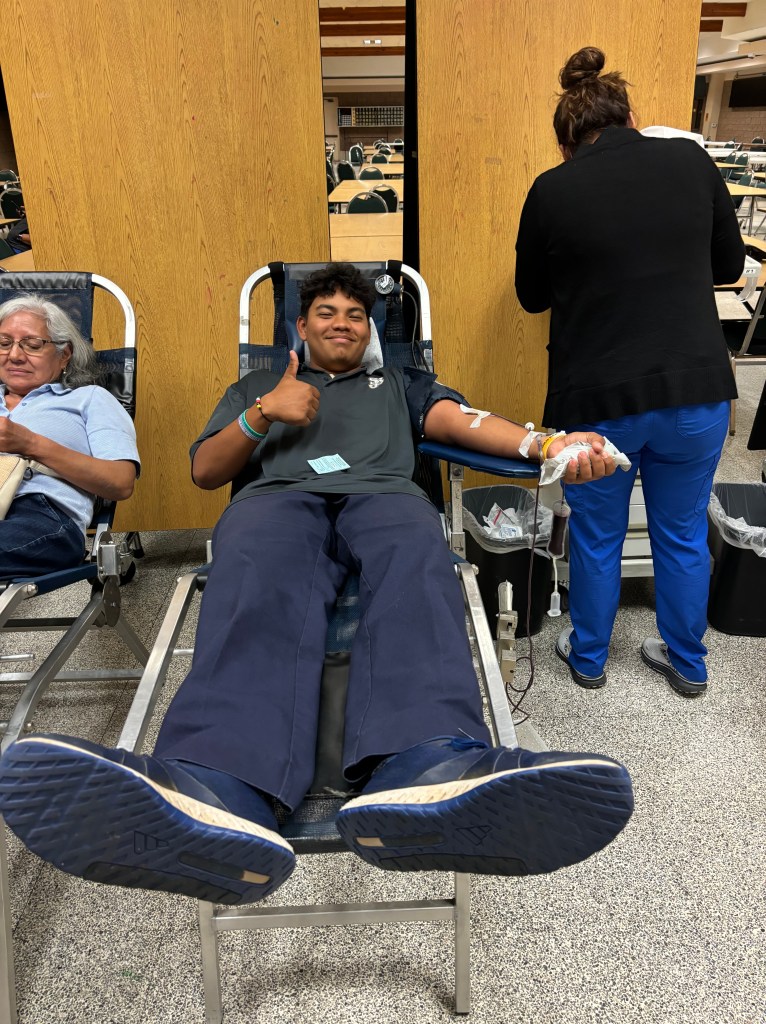
Senior Jaden Wright gives blood. (Photo by Jesus Biag)
Due to turnover in Bosco’s Campus Ministry, Ms. Jen Schnorr, Vice Principal of Student Affairs, stepped up this year to help coordinate the blood drive with the hospital. In years past, assisting in coordinating the blood drive was a role reserved for the school’s Coordinator of Youth Ministry (CYM).
Working closely with Ms. Schnorr and helping her along the way, however, was Ms. Darlene Garcia, Cedars-Sinai’s Blood Drive Coordinator, who has coordinated the blood drive at Bosco since 2016.
Ms. Garcia’s connection with the school stems back to her two sons, Sammy, Class of 2019, and Emilio, Class of 2022. Both of them were heavily involved in Bosco’s baseball program—and still actively participate in the sport today.
Her close relationship with Bosco makes organizing the blood drive at the school all the more rewarding.
“I feel so incredibly blessed to work in a field where I get to make a difference in so many people’s lives,” said Ms. Garcia. “I’m honored to partner with the Bosco family to help save [those] lives.”
Donors last Thursday gave blood in the multi-purpose room (MPR) from roughly 8:00 am to a little past 2:00 pm. For participating, they were given a gift card to In-N-Out and a free t-shirt.
Students that wished to donate needed to be at least 110 pounds, 17 years old and in good health. A 16-year-old student would still be able to donate if they had signed parent consent and weighed at least 135 pounds.
One of the Braves that donated blood was senior Jaden Wright, a member of the baseball team. This being his first time giving blood, Jaden had some concerns as he was donating.
“Walking in here, I wasn’t scared. But when I sat down, I got a little nervous. [I] had to hit a little prayer real quick,” Jaden said. “In the middle [of the process], I really wasn’t worried too much.”
Jaden credits the staff drawing his blood, who took good care of him and were extremely patient and encouraging, for calming his fears.
Another first time donor, who didn’t have quite as many fears, was Mr. Albert Soliguen, new Biology and Environmental Science teacher. Donating blood was incredibly moving, as it allowed him to recognize his own personal blessings.
“It felt great [to donate]. I’m grateful for my own life and the people around me. [Those things] drove me to come out today and donate blood,” said Mr. Soliguen.
The whole experience was rewarding for Mr. Soliguen, who said with confidence that we would donate again.
People from around the community, such as Mr. Raul Vallejo, a staple at St. Dominic Savio’s church, where the Braves go for school Mass, also came to donate blood.
Although last Thursday was his first time donating blood at Bosco, he’s participated in several blood drives organized by Cedars-Sinai at Savio, where he serves as a lector and eucharistic minister. Mr. Vallejo’s primary motivation to donate blood was to make a difference in the lives of those in need.
“I wanted to donate because I know that there’s a need for blood,” Mr. Vallejo said. “[I feel] like I’m doing something good for whoever needs it.”
Mr. Vallejo and all of those who donated blood last Thursday made huge differences. According to Ms. Garcia, while 38% of the American population is eligible to give blood, only 2% of Americans actually go out and donate.
The blood given to Cedars-Sinai will be used for anyone who needs a transfusion. Reasons for needing a blood transfusion vary, but people need it for trauma care in the case of an accident, cancer treatments or surgery. At the hospital, they use over 60,000 blood products a year, primarily using them during organ transplants.
This year, the Fall Blood Drive saw 30 people participate and provide 27 pints of blood, which was within range of their post-COVID-19 standards. Comparing it to the two blood drives held during the 2023-2024 school year, which saw a combined total of 60 donors and 51 pints of blood collected, Bosco is on track to donate more blood and save more lives than last year.
Ms. Garcia and Cedars-Sinai will be at St. Joseph’s High School, Bosco’s sister school, for the first time on October 24th. Bosco’s Spring Blood Drive is set to take place on Thursday, March 27th, 2025.
Mental health matters, but what exactly do we know about it? Learn how to regulate emotions, create a positive perspective and how happy you are.
Photo by Cuahutemoc Solorzano
Mr. Basil Totah, St. John Bosco’s Lead Counselor shines some light on what mental health is.
“Mental health to people is having a positive and beneficial thought process – having a healthy mind,” said Mr. Totah. “Which means not [fixating] on negative aspects of your life or becoming trapped with anxiety.”
Mr. Totah expands on how anyone, not just a student here at Bosco could recognize the state of their mental health. Just ask yourself a simple question.
“How happy are you?”
Mental health doesn’t mean always being happy in life. It’s important to recognize all emotions in order to healthily deal with them.
“Everybody goes through certain things,” said Mr. Totah. “There’s no perfection. There’s no such thing as feeling happy all the time; it just doesn’t work that way.”
St. John Bosco’s Coordinator of Youth Ministry and theology instructor, Dr. Francesca Po, brings some more light on what shapes one’s mental health.
“What you eat and the people you surround yourself with and the activities you put in your life also add on to the stability of your mind, emotions and spirit,” Dr. Po said.
Mental health is influenced by external influences, but that also means your physical health is affected by your mental health.
“Your physical health could be affected by your mental health and your mental health can affect your physical health,” Dr. Po said.
Positive mental health allows an individual to create healthy routines and makes them more likely to have a positive perspective and improve their physical health, according to Dr. Po.
There are ways to mold positive mental health. Breathing exercises are a quick and easy way to get started.
“There is a lot of scientific research that demonstrates meditation brings your blood pressure down; it gives you mental clarity,” said Dr. Po. “The most basic aspect of meditation are breathing exercises – taking big deep breaths through your nose and slowly letting it out through your mouth.”
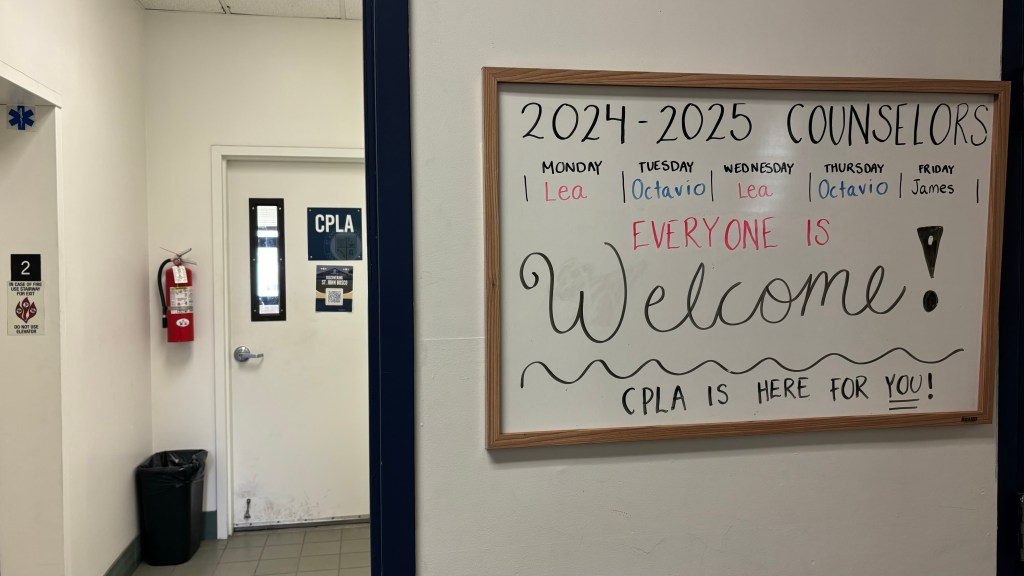
St. John Bosco’s Counseling Partners of Los Angeles (CPLA) intern counselor Octavio Campos provided some more insight on how physical health can be affected by mental health.
“Many people have different [indications] of anxiety: stomach pain, butterflies in their stomach or headaches,” said Mr. Campos. “There are coping skills. A lot of people listen to music or binge-watch a series – something to get them distracted.”
Though, there are instances when someone can’t change or fix what is causing them anxiety. In these situations, acceptance is vital to form a positive perspective.
Bosco science instructor Mr. Brian Miller, who has taught for decades, believes your mental health evolves over time.
“Your perspective changes throughout your life. Your perspective changes with each and every relationship. Your perspective changes based on who you’re with and when [you’re with them],” Mr. Miller said. “My perspective on things changed completely when my wife passed away. I value each and every day all the more.”
Loss is a part of life that everyone experiences and acceptance is the key to grow from it. But there are times when we feel overwhelmed by life. During these times, our mental health is tested, and it’s important to realize that these feelings are normal.
“It comes down to understanding it’s okay to have a problem. It’s okay to feel a certain way, and we don’t all have to be strong all the time,” Mr. Miller said. “[Emotions] are valuable. We have to accept the fact that we all have to experience [emotions] and [we] have to understand how to deal with them in our way.”
The steps toward forming positive mental health are difficult because it means facing our sources of anxiety, which can vary from person to person, and the first step can be the most difficult for people. When you’re dealing with a truckload of tasks or the most difficult part of your life, it’s important to remember: it only takes one action toward growth to form a healthier perspective and subsequently a healthier mindset.
“You can’t reach the top of the mountain unless you take your first step. Sometimes, when you have twenty things to do, you have to choose one thing to do and get it done,” said Mr. Miller. “Too often people see the mountain and think they have to climb it all at once.”
It’s important to focus on the present and be grounded in reality. The past has already happened, nothing can change it. The future will happen when the time comes, and there’s no way of predicting it, so there’s no point in worrying about it.
“Tomorrow may not come, so you have to make the best of today,” said Mr. Miller.
Issues surrounding mental health are being recognized now more than ever. But perspective matters. An anonymous senior student reveals his own thoughts on the recognition of mental health.
“I feel as though students among my age, mental health isn’t commonly talked about. I don’t think a lot of them have been told by their parents that it is okay to do so,” said the anonymous senior.
The CPLA counselor’s office is located within the 200 building on the second level and beside the elevator. The counselor in the office alternates each day, and there will be a different counselor there everyday of the week. There is no need to set a schedule with the CPLA counselors, all that is required is that you knock before you enter. It is open during school hours.
The academic counseling office, located on the first floor of the 200 building across from the Front Office is commonly open during break and lunch hours. You can always feel free to reach out to your academic counselor via email and schedule a time to meet.
Dr. Po’s office is located in room 238 on the third floor of the 200 building near the center of the hallway. You can knock or enter if the door is open to talk about mental health or spirituality.
All of these sources are avenues for any students who want to talk about their mental health or get help in general.
Originality in Hollywood has been decreasing over the last few years, specifically with Disney, whose new content is largely live action reboots and sequels.
While it is always fun to see what happened after a story, it quickly gets stale when it’s just a remake. One must innovate, not reiterate. Stories quickly become repetitive if overused.
Newer stories help enhance the library of media, while remakes and sequels leech off of former success and nostalgia. Even when a story isn’t supposed to be “original”, and it comes from another intellectual property (IP), it is important to faithfully and accurately display the IP.
The biggest culprit of the overuse of old IPs is Disney. They constantly put out unoriginal shows on their streaming service, Disney+.
“Maybe it’s to appeal to a sort of nostalgia, or to come back to their origins to keep the original idea of the company in mind,” said junior Gian Paredes.
The Acolyte is one of Disney’s new Star Wars shows that was released on their streaming platform and poorly received by many fans. One of the reasons was for the lackluster special effects and the plot holes. Some Star Wars fans have said that Disney is running out of ideas with many new characters feeling “phoned in.” The show was canceled and will not return for a second season.
Another issue is Disney’s recent trailer of the Snow White remake. It has already garnered the ire of many fans. The trailer’s view-to-like ratio is one like for every 103 views, and the movie has received a lot of backlash. Its poor production looks like a movie no one would pirate, let alone spend money on. The movie debuts on March 21st, 2025.
The movie The Wild Robot is a movie coming out in September by Universal Pictures. It’s based off of the book series by Peter Brown. The trailer’s view-to-like ratio is one like every 92 views, which unsurprisingly outpaces Disney’s Snow White. It’s seems audiences view new concepts more positively than other shows and movies that are derived from an IP.
Mr. Isaac Sanchez, the animation teacher and the moderator for the Braves’ Creative Guild, shares the opinion that remakes specifically can be rather stale.
“So as a working professional animator and editor, I think remakes are a bit of a double edge sword. There’s no real reason to have a remake other than making money on an existing IP,” said Mr. Sanchez. “I can see the value of some ‘remakes’ fostering a creative change and hiring the talent and skills of many people like myself. But it still makes them cheap to me. I don’t care for a remake. it is what it was; that’s all it ever needed to be.”
Junior Andrew Iona-Tuiviati echoed Mr. Sanchez critique.
“They are blatantly redundant because they are usually a poorer original version. Of course, there is the occasional good live action [film] which can be refreshing, but for the most part, the decline of quality writers has led to bland storytelling,” Andrew said.
Disney and other companies are turning away from animation and leaning more into live action remakes. Despite this, animation is what built these pioneers of the industry. Animation is a huge industry. According to the Academy of Animated Art, the global animation market is predicted to reach $400 billion by the end of the year.
Originality in media and especially in animation are crucial, as it’s what has allowed it to capture consumers and bring in money. It’s important that big media companies don’t forget this, as originality is the secret ingredient to success in the industry.
Students have been alerted that international villain, Mr. McGueber, and his trusty sidekick, Squaddle, have been lent St. John Bosco High School’s Thunderdome to power their Ultimate Doomsday Device of Evil.
Photo by Augustus Rodriguez
This cartoonishly large mechanical device has already been installed by Mr. McGueber and his crew and is being used to rip open the sky into another unknown universe.
Basketball Head Coach Matt Dunn feels incredibly misled by the device’s installation.
“We thought Mr. McGueber would install a froyo machine in the gym. Instead, he installed this massive doomsday device,” said Coach Dunn. “Now, we just have this big machine, impending doom and no froyo.”
Mr. McGueber has been nonstop bragging about how he was able to mislead everyone.
“I can’t believe I was able to finesse my ultimate doomsday device into this high school’s gym,” said Mr. McGueber. “Nobody is going to stop me from executing this plan.”
The gym, though dubbed the “Thunderdome,” ironically didn’t have enough electricity to power this big device. As a result, Mr. McGueber turned to using exactly 6,504 hamsters to power it.
This solution was later shot down after outcry from the Occupational Safety and Health Administration (OSHA) and People for the Ethical Treatment of Animals (PETA).
Despite being tricked into having the gym be used for his evil plan, Bosco will allow students to run on the comically large hamster wheels for credit in their Strength and Conditioning classes.
Squaddle also had a hand in helping Mr. McGueber execute his plan.
“The whole thing was very easy. I just told Coach Dunn that we were going to add a froyo machine into the gym,” said Squaddle.
Issues have arisen, however, regarding the device’s function.
“We tried to fire it two separate times but [the Doomsday Device] stopped because of how hot the gym got during a rally,” said Squaddle.
Students have somehow found a way to stay relaxed despite knowing about the device’s sinister possibilities.
“We are so doomed, but I don’t really care,” said senior Jacob “Brice” Huxen. “[The Doomsday Device] was sort of just sitting out there for the whole rally. At the end, I even saw Mr. McGueber come out and yell at someone for no reason.”
Sources report that the Doomsday Device runs on the outdated Windows 98 computing system and Bosco Wi-Fi, which is the main reason why it takes such a long time to load up.
“I received money for the Doomsday Device, but not enough for a good operating system. Times are tough out here,” said Mr. McGueber. “I’ve been trying to funnel money from Bosco’s clubs, but that’s kind of illegal.”
“And I don’t do illegal things. Nor do I do anything wrong,” Mr. McGueber added with a wink.
Despite Mr. McGueber’s device being a literal world-ending machine, students have found ways to play certain video games on it.
“I got bored during gym class, so I installed Fortnite on the Doomsday machine and started cranking out 90s,” senior Jose Cruz said.
Upon hearing this, Mr. McGueber displayed visible confusion.
“How do you even install the game? My machine doesn’t even have a screen on it. How in the world are you getting kills?” said Mr. McGueber.
While most students don’t seem to take Mr. McGueber and his threats of ending the world very seriously, he’s extremely serious about his plan.
“You may think this Doomsday Device is nothing but a front for not paying my taxes, but I will show you the power of this big hunk of metal,” said Mr. McGueber.
After Mr. McGueber’s statement, he was hit with a door, which then made him fall down three flights of stairs.
Consequently, his current plans of destroying the world have been halted. However, he is expected to make a speedy recovery from his mighty fall and continue his quest for world domination.
Last Tuesday’s Presidential Debate between current Democrat Vice President Kamala Harris and former Republican President Donald Trump presented competing perspectives for the United States going forward, especially as the Presidential Election on November 5th quickly approaches.
Photo by the Associated Press
This debate occurred in the shadow of the many significant events that have impacted the 2024 election cycle, affecting both parties involved in the debate.
On July 13th, there was an assassination attempt on former President Trump. On July 21st, current President Joe Biden withdrew from the 2024 presidential race, endorsing Vice President Harris as his successor. This occurred in the aftermath of the first Presidential Debate on June 27th, which was widely considered to be a poor showing on President Biden’s part. This drastically impacted the discourse around his mental acuity and affected his chances to win the race.
That most recent Biden-Trump debate seemed more like a spectacle, lacking the professionalism and content that a formal Presidential Debate should require.
Since then, Vice President Harris has rallied support for her campaign and chosen Minnesota Governor Tim Walz as her vice presidential candidate. Since the end of the Democratic National Convention (DNC) in late August, she has been able to maintain a level of support that President Biden could not attain, and her campaign generally seems to be stronger than what the president had to offer.
Many things have also occurred within the Republican Party, led by the former 45th President. Former President Trump’s appeal amongst the party has remained high even after his loss in 2020, an election that saw him earn more votes than he did in 2016 when he beat former Secretary of State Hillary Clinton. His opponent’s poor showing in the first Presidential Debate this year further maintained this appeal, leading him to be viewed as the favorite for a majority of the Summer.
His campaign has not been without tumultuous events, however. Earlier this year, the former president was charged by a New York jury on 34 felony counts of falsifying business records. He was, of course, also the target of an assassination attempt carried out on July 13th while holding a campaign rally in Pennsylvania.
On September 10th, former President Trump and Vice President Harris met at the National Constitution Center in Philadelphia to hold the debate, which was also the first time the candidates had met. The debate was moderated by current ABC News anchors David Muir and Linsey Davis, each with more than 15 years of experience in the field of journalism.
Across a span of 90 minutes, the two candidates were asked about topics ranging from the economy to foreign policy. The two candidates expressed their current stances regarding the ongoing conflicts in Gaza and Ukraine and presented visions for bolstering an inflation-ridden economy.
This debate presented a stronger image of American politics when compared to the last debate.
Still, it is impossible to not notice a trend that has persisted in the recent discussions even prior to the election: the lack of policies or discussions pertaining to them. This was generally present amongst both candidates, who were seen dodging specific questions pertaining to policies they wished to implement.
Current St. John Bosco High School Social Studies Department Chair and Instructor, Ms. Megan Fennell, watched the debate live. As an instructor of various history courses for sophomore and senior students, she observed this same lack of discussion regarding actual policies.
“It wasn’t so much focusing on policy or procedures,” said Ms. Fennell. “It was all about who could get the soundbite.”
She also commented on the relative lack of fact-checking that occurred on the debate – on both sides.
Some of the exceptions to this general theme included Vice President Harris’ closing statement, where she gave a vague idea of the types of plans she would implement into her campaign.
Echoing the struggles that Americans have faced in the past four years, she said she intends “to create an opportunity economy, investing in small businesses, in new families, in what [the Democratic Party] can do around protecting seniors, what [the Party] can do that is about giving hard-working folks a break in bringing down the cost of living.”
Despite this, both candidates stayed away from mentioning specific policies. Rather, they appealed to the broader themes that exist within each of their political parties.
Vice President Harris, for example, continued the Democratic Party’s strategy by emphasizing the potential issues found within the opposing Republican Party. This can best be seen with the extensive mention of “Project 2025,” the 900-page document made by the Heritage Foundation, outlining many of its future policy aims.
These beliefs have been considered outrageous and threatening by Democrats, making Harris’ use of the document effective among her base of support. However, former President Trump has not endorsed the project, distancing himself from its more radical proposals.
“What you’re going to hear tonight is a detailed and dangerous plan called Project 2025 that the former president intends on implementing if he were elected again,” the vice president said.
She also attempted to showcase the issues within the opposing party, citing examples of actions that the former President took when he was in office.
This, again, seemed effective at capturing her core audience—Democratic voters—by trying to showcase the potential dangers that could result from the Republican Party gaining power. Her appeals to emotion and anecdotes also helped in reaffirming the beliefs of Democratic voters.
Some, however, have seen these appeals as not enough to sway independent voters over to her side, as many felt that her performance lacked the additional policies needed to earn pivotal votes in swing states.
Former President Trump took a similar strategy when it came to the debate, despite more bombastic execution. His emphasis was also mainly based on attacking the opposing party. However, much of his attention was directed towards President Biden, in an attempt to tie the vice president to the unpopular administration to which she currently belongs.
This was especially noticeable toward the end of the debate when the former president stated that Vice President Harris was trying to distance herself from President Biden and his policies to positively impact her image.
“She is Biden. She’s trying to get away from Biden,” said Trump. “I don’t know the gentleman, she says. She is Biden.”
This approach also resonated well within his base of support. In the months prior to the debate, issues regarding the economy have plagued President Biden’s approval rate. Due to the relative recency of Vice President Harris’ campaign, this strategy was one of the more effective things they could do to retain their voter base.
Former President Trump also emphasized the economic and immigration issues that have occurred under the Biden Administration.
This debate was not without its tense moments. At approximately 25 minutes into the debate, before the candidates began their discussions regarding immigration, both candidates talked over each other, trying to counteract the statements made by the other candidate regarding abortion issues.
A majority of pundits have assessed Vice President Harris as the victor last Tuesday, but in large part due to her style. That being said, it is unlikely that the debate will change the minds of many across the nation, given the overall lack discussion around policy.
Both candidates doubled down in favor of a more emotional, persuasive approach, which led to both candidates trying to fault the other side constantly. This type of debate tends to favor the rise of partisanship, where both candidates appeal to their loyal fanbases and leave independents voters feeling ignored.
By now, most eligible voters are committed to voting for a particular candidate, and the few independents that remain would likely have not been fully captured by either side as a result of the lack of concrete ideas for voters to assess.
Despite its somewhat anticlimactic short-term results, the second Presidential Debate of 2024 still presents a view into the future of elections in the United States—a view which shows greater reliance on partisan ideas, groups and identities to gain the favor of voters. This is something important to watch, especially as the people of the United States become more affected by the polarization entrenched in our political systems.
Ms. Fennell is one voter that hopes for the emphasis on policies to return.
“We can go back to focusing on the facts, focusing on policy. Essentially being grown-ups, even if it is boring.”
Head Coach Adam Lee, senior team captain Julian Almanza and freshman star Brayden Krakowski feel great after leading the Braves’ water polo team to a 5-0 record to start their season.
Photo by Edwin Bray
Coach Lee has big expectations for and a lot of confidence in his squad. The team has their eyes set on the California Interscholastic Federation (CIF) playoffs at the end of the season.
“Our main team goals are to create a culture of hard work, discipline and trust,” said Coach Lee.
Playing in the Trinity League, which is one of the most challenging leagues in the country, Bosco has a competitive road ahead.
“A big part of our process is control what you can control, and you always have to keep moving forward. It doesn’t matter how you start the game; it matters how you keep moving forward,” said Coach Lee.
Bosco’s new team captain Julian Almanza is eager to lead his team to a successful season this year in the pool.
“It feels good to know that all the work that I have put in continues to show. Going into my senior year, I am a bit nervous,” Julian said. “I am taking over a new role as team captain. Being a team captain is very new to me, so I am just trying to get the hang of things.”
Julian has set very high expectations for the team and himself. His goal of playing in college is helping to drive him to be better, and he is really looking forward to games in the Trinity League.
“I am aiming to make first team all Trinity League and MVP for the team. I plan to lead by example and always help my teammates whenever things get tough and take responsibility over the team,” said Julian.
The Braves have lit up the scoreboard in their first five games, having mostly high-scoring matchups with their opponents.
“Something right now that is really translating best is our counterattack to offense. We’ve been working extremely hard on improving it and getting it down, and I think it’s definitely showing,” said Julian.
Freshman Brayden Krakowski is excited to keep the team’s success rolling. He is excited to learn from the upperclassmen and contribute to his team.
“[It is] a really cool experience to play with upperclassmen and learn things from them, such as staying consistent and working hard,” said Brayden.
Brayden is confident in his team and their ability to make CIF together. He believes that their strength and speed in the water has improved and helped them overcome opponents.
Brayden is committed to Bosco and wants to work hard for his Bosco brothers. He and his teammates keep up an intense training schedule with two practices a day, where they emphasize working on speed and linear movements in the water as well as team strategy and game planning.
You can support Bosco Water Polo by attending games at the Bellflower Aquatic Center – directly across the street from Panish Family Stadium – and contributing to their online fundraiser. The Braves next game is at home tomorrow against Cerritos High School at Bellflower Aquatics Center. The game starts at 3:15 pm.






 The Brave News