Category Archives: Life of a Brave

Lampoon: The Good, the Bad and the Ugly of Online Learning

by Pedro Ochoa

If someone last year told you that we would be doing all of our classes on our bed via ZOOM, would you have believed them? Of course not. Isn’t it weird that most of the time in our physical classes, our teachers would tell us that we had to put our electronics away? And now, they ask us to open our electronics, because if we don’t, then we will get marked absent. How things have changed in 2020!

Waking up five minutes before class, in your bed, and in your pajamas is amazing right? Can you imagine being in front of a screen for more than ten hours a day? Well stop imagining it, not only are you doing this now, but most of you were doing it before the pandemic (stop shaking your head – you know I’m right).  

Online learning has a lot of positives and negatives. First and foremost, every quarter is different for everyone. There have been many students that are pulling their hair out because they are taking their hardest classes in the first quarter, while some students are sleeping and dreaming of those sheep jumping on clouds because they have free periods. I know this because I was one of those sheep dreamers first quarter, while now I am starting to grow white hairs. 

The best part of online learning has been when the teachers tell us that our mental health matters, and to put some time to ourselves, because there is so much happening in the world right now. We deserve it, after all, they say. Then they tell us not to forget that we have a paper due the next day in MLA format, while also having twenty assignments, and don’t forget that big test at the end of the week that is worth 50% of your grade. How are we supposed to make time for ourselves when we have assignments due every day at 11:59 pm? Not only the students, but also the teachers who end up grading all this stuff. 

Some people are loving life right now, while some do not. Some students have the everyday routine of sleeping for more than fourteen hours a day, including naps, while some barely sleep six. It looks like the teachers have it worse than the students. Not only do they have to grade assignments and give lectures everyday, but they also have their own families and lives that have been turned upside down. Even though most of them have gotten the hang on how to use ZOOM, it’s pretty funny when a teacher is lecturing and there is a funny background noise coming from their microphone.

Zoom is just astonishing, right? The teachers went from telling the whole class to be quiet because we were talking too much in class, to now begging for us to turn our mics on to participate. Again, how things have changed! Also, don’t you love breakout rooms? Either we get put into a room with all of our best buds and we don’t want it to end, or we get put into a room where everyone just does not know how to unmute their mic. You either get the best breakout room or the worst, no in between.  

School ID pictures are this Saturday! Great! Saturday will show how many people are really drained because of the blue light that is projected from these screens. There will be many people with huge bags under their eyes. If you don’t want these, and want to look good for your pictures, listen up. Wet a cloth with cold water and hold it under our eyes for ten minutes. Does it work? I don’t know, I just looked it up on Wikipedia. 

By the way, teachers know when you switch tabs on Schoology and even when you sign up for Chegg.com. Don’t believe me? Read the terms and conditions and don’t just click, “I accept” next time. 

Also, make sure your microphone is muted, you don’t want to be the one that gets caught watching Tik Toks because you forgot to mute your microphone. 

Life Of A Brave: Due To Covid-19, Bosco Students Have Had To Adapt To A New Quarter System, Creating A Divide In The Community Over Learning Preference

by Nicholas Neoman

The Bosco community is experiencing a divide over the rapid change of quarters this semester, sparking dialogue on whether a quarter system is beneficial or detrimental to both students and faculty during online learning.

Teachers, as well as some students, feel the pinch of a quick turnaround. For a multitude of reasons, they believe that the three day break between quarters one and two was far too short. 

When Mrs. Michele Dolphin, a teacher for the Biomedical Pathway and Chemistry, was asked about the single-day grading period, she responded with a sentiment many other Bosco teachers may share as well.

“I ended up not meeting that deadline and so I asked for an extension because it was just impossible, I felt really stressed and overwhelmed,” Mrs. Dolphin said.

Mrs. Dolphin represents the general consensus of many teachers at Bosco. Teachers like Dolphin finished administering their finals Thursday afternoon and were expected to grade them by the end of the following day. The tight pinch between academic quarters forced teachers into a frenzy, grading at an alarming rate. Teachers were expected to grade finals within a day and start teaching their next classes a few days later. Much of the teaching staff would have benefited greatly from an elongated break to grade finals and relax before they set out to teach a new set of courses.

Noah Citek, a Junior in the Sports-Medicine Pathway, responded similarly when asked about his view on the short grace period.

“It was a weird pace to be at because you ramped up [for finals] and then you’re back starting new classes again,” Citek said.

While teachers were experiencing an overwhelming pressure to grade finals in a matter of hours, some students felt overexhaustion from the quick break between quarter one and two. After cramming every ounce of information obtained from a quickly paced quarter and pushing through finals, they were expected to regain their momentum at the start of the new quarter in a matter of days. Students and teachers alike were experiencing an increasing amount of frustration from the dismal period of time granted between quarters.

However, counselors and some students felt the quick turnaround was optimal for success during online school.

Mr. Omar Delgado, a counselor and father of two Braves, holds a sentiment in which he feels as if students benefit from a short break.

“I feel some students don’t really want a long break because then they get out of their rhythm or their routine,” Mr Delgado said.

From the experience of a seasoned college counselor, Delgado believes that the best way for students to keep their momentum is through this short break. After seeing many classes of students graduate and move on to college, from his perspective the short break benefits students. It allows them to maintain whatever tools for success as they embark on their next set of classes and challenges.

Xavier Gonzalez, a Junior in the Computer-Science Pathway, is a student who shares Mr. Delgado’s belief.

“I liked the short break because it kept me in the momentum for school and it kept my work ethic. The short break gave me enough time to recover from finals while still being capable of jumping back into the next quarter,” said Gonzalez.

Unlike other students, Gonzalez feels that he was able to produce his best work as a result of this short break. After finishing four classes, Gonzalez had an overall positive experience in preserving his study habits and methods for success via the lessened time off. Gonzalez represents a faction of the student body who benefited from the quick period between quarters. He believes that any more time would have slowed him down in trying to gain a new routine for his next classes.

The Bosco community is divided in terms of their views on the quarter system. While some responded positively to the short breaks and found that they were able to study better and do well in the next Quarter, others felt the stress and exhaustion of the quick days off. This proves how diverse the Bosco community is educationally. As Bosco houses many who are very different in how they learn, it is key to remember how difficult it is to create a system that benefits everyone.

However people feel about this quarter system, the general mood within Bosco is that the return to campus would work wonders for learning. While online learning looks to remain the future of Bosco, people from both sides of this issue would agree that the quarter breaks would be better if in-person learning resumed.

Life of A Brave: The Story of Dr. Wickstrom, A Man Of Faith, Intellect, Leadership and Citizenship.

By John Udabe

Over the summer, St John Bosco hired on a new President and CEO of the school to bring change to the Bosco community, Dr. Brian Wickstrom. 

With a rich resume, Dr. Wickstrom is an exciting and enriching addition to the Bosco community.

Dr. Wickstrom was raised and educated in the state of Kansas, along with his identical twin. As a student athlete in high school, he eventually went on to receive a full scholarship to Kansas State as a Track and Field athlete running the 400 meter. This background makes it easy for him to relate to the load many Bosco student-athletes take up in order to have an opportunity to compete at the next level, as he has experienced first-hand what that feels like.

“You have to learn to manage your time and you have to learn to survive, make friends, get along and build relationships to get through school and set yourself up to be able to have the contacts for the rest of your life,” Dr. Wickstrom said. “I think it’s very similar to going through the brotherhood of St John Bosco and the value of the relationships and the brotherhood that you make here in school.”

At Kansas State, he earned his MBA with a management concentration. After that, he earned a Masters of Sports Administration from Ohio University and later became a Doctor of Education and Educational Leadership from Eastern Michigan University.

“I just knew that I had such a great student experience and student athlete experience, that I wanted to impact students,” Dr. Wickstrom says.

Dr. Wickstrom’s family is a testament to the emphasis and importance of education on his life. 

His twin brother is an accountant, his older brother is an iMax film producer, his sister in law is the first prenatal care specialist at the University of Chicago Medical Center, and his sister is a lawyer.

“Academics has always been pretty high in my family … we’ve always wanted to be a part of successful academic programs” said Dr. Wickstrom.

And Dr. Wickstrom has indeed been part of many successful programs. Dr. Wickstrom’s career has taken him all across the country as a part of institutions including the University of Ohio, the University of Missouri, the University of California Riverside, and most recently the University of Incarnate Word, just to name a few. With about 20 years of experience working in collegiate athletics, Dr. Wickstrom is no stranger to high level positions in some of the country’s most prominent institutions and he has left a positive impact everywhere he’s been.

Dr. Wickstrom also expressed that his former roles have given him a “great broad background of all these different experiences and philosophies that have helped give [him] a full gamut of experiences to make St. John Bosco that national leader it can be.”

But what is it like moving a family of seven to different places across the country? That’s right, seven. Along with his wife Celina, together they have five children. He has four sons, James (3), David Grant (8), John Christian (9), Vince (12), and his daughter Bricelle (5).

To Dr. Wickstrom, the moves across the country have been quite a learning experience for him and his kids, “I think it’s cool, they get to learn about different parts of the country, different cultures, from eating crawfish in Louisiana to becoming a part of San Antonio… It broadens their thoughts, it broadens their viewpoints on a lot of different things in terms of different diversities, different backgrounds, different educational levels, and it’s been a great experience for them,” he says.

Dr. Wickstrom is looking forward to his family joining the Bosco community as well. His sons  John Christian and Vince are currently in 4th grade and 8th grade respectively at Dominic Savio and Vince will be going to St. John Bosco next year.

“It’s exciting to help build a school that’s going to help put our kids in a great university someday when they get to Bosco,” and he continues “and partner up with St. Josephs for our daughter Bricelle, so it’s an exciting time to watch our kids grow and be a part of this growth at St John Bosco.

Dr. Wickstrom has not been fazed either with the transition to St. John Bosco during Covid: “It’s a little bit of a blessing in terms of coming here with school not being open so we can focus on all the internal operations and not have to necessarily worry about the students,” Wickstrom admits.

Dr. Wickstrom is optimistic of making the best out of the substantial changes surrounding the Bosco community. Plenty of advancements are being made to prepare the school to acclimate to the current worldwide situation.

“We have spent almost $200,000 to get the school prepared to come back…we’re in a better position to come back than most high schools with our distancing capabilities. We have a great plan in place when the time comes.”

Dr. Wickstrom notes that St. John Bosco is currently going above and beyond, exceeding county requirements. Having one of the biggest private high school campuses has had some advantages; with 36 acres of land, students will be able to spread out outside across the campus.

Technological advancements have been made as well, exceeding increased numbers of hand sanitizer dispensers and changes and layout. One of the biggest advancements is the bipolar ionization system.

“It’s a system that uses bipolar ionization through the HVAC system in the buildings that will kill bacteria, that will kill viruses, that will kill fungi, and it’s something that we put in all the student areas already,” Dr. Wickstrom explains.

A major accomplishment for Bosco and something not many schools have the opportunity to implement yet. 

Dr. Wickstrom  is constantly working to bring new and exciting changes to the school. Take the Bosco Community Garden for example, a project in which he is working, only in his first few months at Bosco.

“Dr. Wickstrom is easy going and fun to work with, and is fitting in well at St. John Bosco,” Mrs. Ellison, the Dean of Enrollment Management says, “Dr. Wickstrom brings outstanding leadership to Bosco. He is results driven and motivates others to achieve excellence. In addition to creating an environment focused on excellence, he is also a very approachable and considerate leader who always brings a positive attitude.”

In all, Dr. Wickstrom is an invaluable and thrilling addition to the Bosco community. His goals are clear as he says, “As I progressed in my career and my wife and I have grown our family, we wanted to be able to have a major impact on our kids, their lives, and basically set all the students up that we can come into contact with to be on a great path to accomplish all their goals.”

He has an unwavering commitment to the education and the success of all the students he is involved with. With Dr. Wickstrom at the helm, St. John Bosco appears to have a bright future ahead. Wickstrom is looking forward for him and his family to grow with the Bosco family.

“We’ve already seen some great accomplishments as an institution and we are just getting started, so the fun is just beginning.”

For all of the many accomplishments he has done and the ones that are on the works, Dr. Wickstrom deserves much appreciation and respect for his work. Everyone at Saint John Bosco is excited to see what other great additions he has planned for the future.

Life Of A Brave: Juan Archuletta, a coach to Bosco wrestling, bounces back from a featherweight title fight loss by winning the Bellator bantamweight championship

by: Andrew Fierro

Juan Archuletta, a bantamweight fighter in the Bellator organization, and a role model to Bosco’s varsity wrestling team acquires the bantamweight championship with a win over Patchy Mix on September 12.

Bellator MMA

Almost exactly one year after losing his first title fight against featherweight Patrico Freire, Juan Archuletta challenges for a title once again and this time gets a unanimous decision to take home the championship. His record is now 25-2 and he has only lost one time in the past 5 years. 

Archuletta’s great ground defense became a pivotal role in his win, with him being taken to the ground early in the first round and having to defend off many submission attempts from his opponent Patchy Mix. Though once he was able to get back to his feet it was obvious that he was in control of the fight with his superior boxing. 

Archuletta commented about the difference between wrestling in a regular match and a fight, saying, “it’s different because in a fight you’re getting punched, you can’t just shoot in when you’re tired”. He cited differences in the amount of things to worry about stating “there are a lot more things to worry about when you’re fighting because it’s not only about wrestling”.

Archuletta has helped the Bosco wrestling team in the past after meeting coach Ruben and was offered to come out and help train the boys. He has been helping them ever since. The wrestlers certainly like it and they can feel the difference between wrestling just another wrestler and a professional fighter.

“It’s just a different feel, his pace is hard to keep up with since his conditioning is better than anyone in the rooms,” said Oscar Aranda, a varsity wrestler on the St. John Bosco team.

One thing that Oscar said took him by surprise was how level headed and nice Archuletta was. He commented that he was very approachable and if you had a question he was happy to answer it.

Archuletta said that his experience training with the wrestlers was great for him and it helped him work on some of his fundamentals. 

“Those guys are some of the best in the country and not just random wrestlers” said Archuletta. 

He also commented that both wrestlers and anyone pursuing a career in MMA should “stick to your game plan and do what you think is best for yourself, don’t worry about what all these other guys are doing and focus on yourself”. Archuletta also talked about how wrestling is the base of mma and it is hard to compete at a high level if you don’t have the skillset that wrestlers possess.

Archuletta stated that wrestling helped him build character and that it is a great sport to get into, not just for the wrestling experience and background but because of the life lessons you will get from it. The earlier you get into wrestling the better it will help you throughout life is what Archuletta continues to preach each day.

Life Of A Brave: Covid Strikes Again, College Scholarships Harder to Come By

by Aydn Morris

High school student athletes are now panicking as college scholarships won’t be any easy to come by this year thanks to the ongoing pandemic. 

St. John Bosco High School Athletic Director Monty McDermott, like many student-athletes and parents, is concerned about the matter. Around 500,000 students end up becoming a student athlete in college and from those 500,000 only 150,000 are under an athletic scholarship, according to Mr. McDermott. 

“Now it is even tougher to get a scholarship because the number of high school students are rising but the number of scholarships are decreasing,” said Mr. McDermott. 

Prior to the outbreak only 2% of student athletes were given a scholarship which resorted to only 15,000 students receiving one. It is no secret that it was already tremendously hard to get an athletic scholarship in general, and now it is going to reach a level of toughness we have never seen before.  

The California Interscholastic Federation (CIF) has been trying to figure out a way to let as many high school students as possible play their respective sports. They came up with the idea of reducing the sports seasons by only having Winter and Spring seasons, which allowed the fall sports to practice and try out due to not being able to during the summer. 

Of course, as the virus has proven time and time again, it is unpredictable. If no change is made regarding positive cases, it won’t be surprising if there isn’t a season in general for many states around the nation this school year. 

Unfortunately, players who have played baseball and basketball during the same year will only be able to play one now due to both sports taking place during the same season. The “two season only rule” is hitting hard for multi-sport athletes, as their chance of getting an athletic option is greatly diminished because they won’t have a secondary sport option this year to solidify their case. 

CIF has also been trying to figure out how to get teams to practice in a safe way, and they came up with “day camp” protocols. The camp protocols for practicing include social distancing, not being allowed to practice indoors and only being allowed to share a ball with a few people. In addition, schools cannot do full practices, or do scrimmages against other schools, which is important to a team’s practice success. 

The state of California won’t be allowing fans, scouts or family members to watch games, which will only add burden to athletes wanting to get recruited. This can negatively affect the way a team plays and make some dreams a longshot for kids around the nation. 

They may start giving out less scholarships because senior students in college may be getting held back for their sport because of the redshirt rule. The redshirt rule is where senior students are allowed to stay another year in school to play their sport because their season may have been cut short. 

This is like a butterfly effect because seniors who are redshirted are taking up playing time and scholarship money from freshman and sophomore players and potential incoming recruits, respectively. This can also lead them into not wanting to give a lot of scholarships or not giving any full-ride scholarships because they can’t afford to pay for a freshman to play for minimal or no playing time. This is mostly involved with schools that don’t get a lot of players that go into the professional drafts. 

Truly the impossible is possible if the desire and commitment is there and high school seniors should not see this as an excuse to not give it their all for the remainder of the school year. 

“Stay positive to our circumstances, and especially keep their grades up,” Mr. McDermott said, as he hopes parents will be supportive for their kids during a year that has not gone anyone’s way. 

Life of a Brave: Don’t Make Halloween a Pandemic Nightmare

by Nicholas Neoman

Celebrating Halloween in the midst of the COVID-19 pandemic poses a tremendous new health risk. In the wake of a spike in cases nationwide following Labor Day weekend, health experts are concerned with the implications Halloween places on the rate of transmission.

According to NBC Los Angeles, Labor Day saw a massive “uptick in virus cases.” Events such as barbecues and public gatherings on Labor Day caused a spike in the COVID-19 infection rate. According to the Blueprint for a Safer Economy, Los Angeles County’s cases are hovering around 7 cases per 100,000 people. Health experts fear the COVID-19 infection rate will see exponential growth during Halloween, which may mean the popular holiday will look different for at least 2020.

The Los Angeles County Department of Public Health has placed new guidelines for Halloween in the midst of this pandemic. Social gatherings, such as parties, are now forbidden as close interactions will surely cause a spike in cases. Other traditions like Trick-Or-Treating are strictly advised against. Everyone must be six feet apart, which is simply not realistic. While many restless children will still go door-to-door asking for candy, the Health Department strongly advises to limit the amount of contact. Even small interactions with others, like handing out candy, put people at risk of contracting the novel coronavirus.

Furthermore, the Health Department has deemed online parties and drive-in-movies as safe actions for celebrating Halloween. While many are still very sick of doing everything from a distance, one moment of close interaction can ruin what months of time have built. Halloween floods people with nostalgia of times before this pandemic. Thus, the inclination to return to “normal” will be stronger than usual. But, remember: this can be deadly. 

Sharing food such as candy can transmit the virus amongst one another. According to Healthline, as much as 42% of the infected are asymptomatic. Therefore, it is wise to take candy and other food that has not been touched or individually wrapped. While people may not experience symptoms such as coughs and runny noses, they may be carriers of this deadly virus. In the case of Halloween, like always, people will not be able to tell those who are infected based on symptoms. Thus, keep the philosophy in mind that everyone may have the virus.

On top of pandemic precautions and community restlessness, for the first time in five years, Halloween will be on a Saturday. There are no reasons for going home early – school and work do not follow as they usually did in past years. Staying out later because Halloween is on a Saturday only increases the chances of spreading the deadly coronavirus. The more time spent with someone, the larger the chances are of transmission.

The greatest fallacy the news is spreading is that cases are decreasing. While case rates may not be as colossal as they once were, this is misleading. They indicate that public gatherings are not discouraged since case rates have dropped. If people are careless and do not listen to public health and safety warnings, Coronavirus cases will leap as they did on Labor Day.

Halloween attracts many different social groups which increases interactions. Those who have been cooped up in their homes will seek to finally have some fun in months. Things like interacting with others who have not been quarantined together only increases the chances of contracting the virus. The Health Department of Los Angeles implores people to be cautious about actions that they take on Halloween. 

The Saint John Bosco community is nearing its return to campus, and a major spike from Halloween would only delay when students and faculty can come back. Halloween amidst a pandemic does not have to mean there will be a spike in COVID-19 cases. Follow the guidelines, take logical actions, preserve cleanly habits, wear a mask and stay safe.

Life of a Brave: #BraveTogether Fundraiser Shows Strength of Community in Time of Crisis

by Ryan Tavera

Since its founding in 1940, St. John Bosco High School has been committed to empowering students to develop and achieve their fullest potential, but due to the recent economic decline caused by COVID-19, St. John Bosco’s goal to serve students has been put in jeopardy. Luckily, our community has stayed #BraveTogether to make sure no one gets left behind.

maxresdefault

COVID-19 has made nearly 10 percent of our families struggle to make due and pay tuition. Furthermore, the pandemic has resulted in several major fundraising events being canceled. As a result, an estimated $250,000+ was lost that needs to be made up.

Previously, Bosco aided 60 percent of students through its tuition assistance program. Unfortunately, no additional funds are available to help these families. So during these hard times, it is stressed as a faith and school community that we exercise perseverance and offer a helping hand to our fellow Bosco families.

The Brave Together fundraiser serves as a beacon of strength and unity and to inspire others to help one another.

“We responded to the challenges our families are facing due to the economic impacts of COVID-19 by establishing the Brave Together Emergency Fund. I hope the emergency fund offers a sign of hope to our students and families who are uncertain about their futures due to this crisis. We are in this together and that’s ultimately what this emergency fund is about,” said Ms. Amy Krisch, Director of Special Events at Bosco.

Thus, the Brave Together Emergency Fund was created in the hope of giving every student the opportunity to continue their education at St. John Bosco.

download

“You’re not alone and St. John Bosco High School is here to be that support as best we can, and if we’re able to help, then this emergency fund is serving its purpose,” Ms. Krisch said.

The creation of the Bosco Fundraiser signifies the sense of unity and brotherhood among the student body. Bosco has always been committed to this idea of togetherness and COVID-19 is our community’s biggest test.

“What makes Bosco truly unique is the family we’ve built within our community and in the last nine weeks we’ve shown how we come together when we’re in need — and it’s made us even stronger. No Brave left behind, we’re already living this. This is what community does, we support each other and come out on the other side, together,” said Ms. Krisch.

Ultimately, it is only up to one person you as an individual as stated previously COVID-19 is this family’s biggest test, and it is up to every individual within the Bosco family to help pass this test. As a brotherhood and community, we must come together and give not because we are pressured to do so, but rather because we may possess the ability and believe in our school’s mission and the perseverance of that mission.

“We have realized that we are in the same boat, all of us fragile and disoriented, but at the same time important and needed, all of us called to row together, each of us in need of comforting the other,” Pope Francis said of the faithful during this crisis, a direct message to our own community of faith to give whatever we can.

If you are in the position to donate and wish to help, more information is located here on how to stay #BraveTogether.

Life of a Brave: “Senioritis” Strikes Again

by Emilio Ceja

All of the hard work done for four years of high school by students can in some cases mean nothing if they catch “senioritis”. 

_DSC9584

All of the good grades, outstanding GPA’s, and credit for classes can be looked over and ignored if students continue through the last months of high school with this epidemic. The unwillingness to do work the second semester of senior year can not only mean lower grades for students but can also bring much larger consequences to the table. 

Throughout my years at St. John Bosco I have seen many seniors change from their academically achieving selves into the sweatpants wearing, sandals rocking, seniors that no longer care about the whole highschool appeal. Many of these seniors sometimes do not realize the real harm that they can cause to their own future by not doing the often simple work that is assigned to them. Once accepted into colleges, the colleges themselves have the ability to revoke your acceptance if your grades are not adequate to maintain acceptance. For many this can be unknown, once they realize the guidelines, it is too late for anything to change and they are stuck without the option to attend a university that they didn’t intend on choosing.

In order to fully understand the mindset behind students and faculty at Bosco and their opinions on what is “senioritis”, I first had to understand what senioritis actually is. According to the oxford dictionary, senioritis is, “a supposed affliction of students in their final year of high school or college, characterized by a decline in motivation or performance.” The decline in grades and effort in school by the high school seniors can be seen through their mediocre work on assignments and lack of care for certain policies such as school uniform and facial hair policies at Bosco. Although not reaching certain extremes that can be seen in other schools or in prior years at Bosco, I believe that if students are not careful with how far they let this senioritis go, they will not be ready for the rude awakening that is to come. 

The head counselor at Bosco, Miss. Skipper has been a counselor at other high schools and colleges prior, so she knows all about the negative effects of senioritis. Senioritis is often seen primarily during the last semester or couple months of high school or college but can begin prior to that. Even starting to lose motivation as soon as the end of the first semester.

“Sometimes the second they get that first college acceptance, they’re so relieved that they immediately feel like they don’t need to do anything else.”, Said Miss. Skipper.

Although common among students our age, we must make sure that the senioritis this year is not one that will ruin or hinder anyone’s college aspirations. The students must know the consequences prior to their actions or lack of actions in classes that are required to pass or get a certain grade to keep their acceptance from colleges. If this information is passed on to the seniors of this year and upcoming seniors, then maybe the sweats and sandals will be a thing of the past and students will finish off highschool just as strong as they started it. 

Life of a Brave: Bosco Water Polo Coach and former-Olympian Jeff Powers Honored in HOF

by Christian Estrada

With all of Bosco’s big sports glory, do not be surprised that an Olympian walks among Braves. Head water polo coach Jeff Powers was inducted into the USA Water Polo Hall Of Fame this past Summer, yet another big athletic splash in the Brave community. 

Mr. Powers was born January 21, 1980 in Chattanooga, Tennessee, but went to San Luis Obispo High School and played basketball, soccer, baseball, swimming and water polo.

He started water polo in high school, however, he did not take the traditional route. While Coach Powers understands the importance of hard work in a sport, he believes it is best for an athlete to participate in multiple sports.

“I am a big fan of [athletes] playing multiple sports and just having fun year around, and if you are an athlete you will be fine, it allows you to build character. Once you get to high school then you can start singling out and focusing on one sport. But until then, I say play all the sports that you can. I think you will be a better athlete, and lower your chance of injuries,” said Coach Powers.

While Coach Powers became known for his success in water polo, he did not always have the intentions of playing in high school. This all changed when one day the water polo coach at San Luis Obispo High School heard that he was an incredible swimmer and a prolific athlete in school, asked him to try out for the San Luis Obispo Water Polo team. Coach Jeff Powers indeed tried out and loved it.

“It was kind of a mix of all the sports that I already played plus the water, so I loved it,” said Coach Powers.

He said that all the other sports that he played helped him develop the skills he would use in water polo and being a highly competitive swimmer was also a huge help when getting in the water. Coach Powers believes it was this swimming ability that gave him an edge over other people on the team.

“A lot of people if they’ve never been in the water before, they have problems with it because it’s different. Everyone walks on land but not everyone is used to the water, but since I was a swimmer, I was already good at swimming.”

After his four years of high school at San Luis Obispo High School he attended the University of California at Irvine playing 5 years of water polo and red-shirted his last year; majoring in Political Science with an emphasis in public law. He loved living in the dorms at UCI but later moved into Newport. The head coach at the time for the  UC Irvine Water Polo Team was notorious for his work ethic, training at least 6 hours daily (excluding practice with the National Team). He graduated from UC-Irvine in 2003. Year-round training often would be two and a half hours in the morning before class; another two and a half hours of practice after class for a total of five to six hours.

Two good memories he had his freshman year was winning a major tournament with all the best teams, the Northern California Tournament. His junior year he won the Mountain Pacific Sports Federation (MPSF) league, winning the regular season. In that tournament, they beat teams like USC, UCLA, UC Berkeley, and Stanford. Coach Powers would later get to play with several teammates on the UCI Water Polo Team, play with him on the USA Water Polo Team.

While at UCI he was a very industrious student-athlete scheduling his day to be consumed primarily by academics, athletics, and preparations for the next days of practice and games to come. He believes his coach helped prepare him for this rigorous schedule, but some of his fellow teammates did not fare as well.

“Coach prepared us well in a way that we all knew how to grind, but there were some who fell off to the wayside. Some guys couldn’t handle the pressure,” said Coach Powers.

According to Coach Powers, they were not prepared mentally, and they could not take the hours and the work and how mentally tiring it is to be in that program.

“You did not want to see them go but you knew that guys gonna go he could not handle it. You could tell whos got it and who does not [physically and mentally], hard work plus talent,” said Coach Powers.

During his freshman year there, he did not handle his schoolwork too well with his grades beginning to slip. It just took a plan, and after some time, he was able to have a balanced schedule. He said that his secret to figuring it out was literally sitting down and physically writing out a personalized schedule. This allowed him to stay on top of his work and have the mindset that nothing was being sacrificed.

“People always ask me what was your biggest sacrifice. I didn’t have to sacrifice anything, a sacrifice is something you don’t want to do, but you’re still willing to do it. You must be willing to put the time in,” said Coach Powers.

During his freshman year at UCI, Powers was one of the select few to receive an email to train with the USA Olympic Water Polo Team. He enjoyed the opportunity, but understood the extra work that was required.

He was just practicing with the National Team his freshman year because he was not quite prepared, but by his junior year at UCI, he would be ready with the tools and have his skills to compete at the next level.

He was a part of the  USA Water Polo 2004 training group, where Coach Powers described his time on the team as “fun but brutal.”

At Irvine, the team would train for five to six hours regularly. However, the time only increased when he went to the National Team training, as he would continue to train with his college team simultaneously. Coach Powers knew his goal was always to make the Olympic team eventually.

“I wanted to be a part of the Olympic team. It is something that I wanted. I wasn’t sacrificing anything, and I made it happen,” said Coach Powers.

He understood that this goal would come with missing out on things his peers would be a part of, but his goal of being an Olympian was too strong to hold him back.

“Did I miss out on some things? Maybe, but like parties and things like that. I didn’t want to do that. I wanted to be an Olympian, so I made my schedule around that,” said Coach Powers.

It was definitely a privilege to be on the Olympic team and on UC Irvine’s team. Nowadays, they are not as good as they were when he played. He did not say it was because of him, but when he did play, they were constantly top four in the nation.

“I helped out a little bit. It was a great school to go to for water polo and for education,” said Coach Powers.

Even with this busy schedule, he found time to have some fun too. He enjoyed low energy activities, such as going to the movies. But most of his free time was spent just preparing for the next day.

He ate a massive amounts of food. He ate everything and anything he could get his hands on, trying to make it healthy, but at some point, he would just try to get calories in his body. He made it to three Olympics, which included 2004, 2008, and 2012, and won the silver medal in 2008. Coach Powers will always be honored by these awards and recognition, as well as his new Hall of Fame status, but believes that the bonds he made and his love of the game is why he played.

“Being in the hall of fame makes me feel nice, but it’s not the reason why I started playing the sport. It is nice to be recognized for achievements and things like that. It was kind of cool that I got inducted with a couple of my teammates from Irvine,” said Coach Powers. “But at the time we were playing, it was not the reason we played.”

Life of a Brave: Juniors Share a Nostalgic Night at Ring Ceremony

by Ryan Tavera

November 20, 2019 marked a significant day for many students attending St. John Bosco and their families, as the juniors received their class rings.

IMG_3769.jpeg

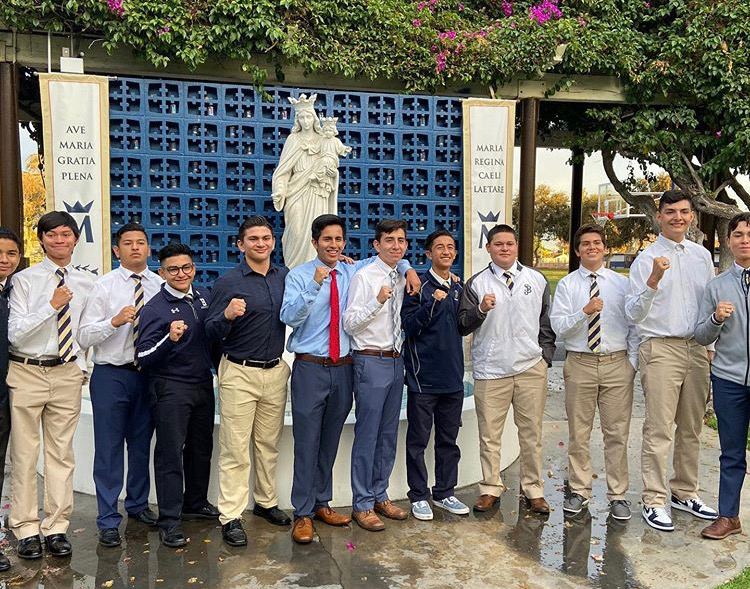
Pictured (Left to Right): Hector Andrade, Diego Santizo, Alfred Munoz, Adrian Garcia-Esparza, Joseph Ochoa, Xavier Zuniga, Vicente Casanova, Andrew Olmos, Joshua Hernandez, Adrian Arredondo, Christian Avila and Jesus Barreto.

Junior rings have been a tradition in many high schools over the years and Bosco is no stranger towards the tradition. The ring is a token of appreciation and congratulations to juniors in the man they are today and the man they are shaping into. It also signifies their progression through high school, and the start of the end of their high school days.

Students were to meet in the Chapel with their family shortly after school ended, and they were seated together while their families sat towards the back of the chapel.

The mass focused on admiring, wishing the junior’s a good future. The main difference between this mass and others, was that it had a more professional tone to it, almost like mini graduation.

Following the mass, Mr. Flaherty delivered a speech detailing the significance of the ring and what exactly the purpose of the ceremony is and what it means to him.

Mr. Flaherty’s advised students to not look at the ring simply as a piece of jewelry, rather the significance and the hard work experienced by all juniors.

“When I put my ring on with my class number glaring on the side I don’t see a piece of metal I see a token of appreciation and a reminder of me and my friend’s hard work and dedication to becoming a better version of ourselves each day,” said junior Josh Hernadez.

For many students, the ring acts as a symbol of remembrance, the ring reminds students of the young man they once were at Bosco and the memories they’ve made throughout the years.

“The ring for me represents my class and the memories I have made during my years at Bosco,” said junior Jake Cuellar.

Many other juniors shared the same expression towards the ring, and the class of 2021 appreciates the memories they’ve made and will make with their fellow Bosco brothers.

“In future years I want to look at the ring and remember the great times I once had at Bosco and all the people that were once apart of my life,” said junior Diego Santizigo.

Multiple juniors also explained how the ring signifies the strong brotherhood that is found between students at Bosco and how it will stay with them for the rest of their lives.

“When I was with my friends in the quad and we were all laughing and talking and taking photos with each other flexing our new rings it reminded me of what it really means to me which is the solid bond between me and my Bosco brothers,” said junior Adrian Esparza.

Following Mr. Flaherty’s speech, he began to call the names of the class of 2021 to retrieve their junior ring from the table upfront.

After the two-hour ceremony, juniors met up in the quad where they took photos and were able to show off their new junior rings to the rest of their family. All in all, it was a great experience for the juniors who had a strong sense of being a Brave that day.

« Older Entries Recent Entries »